



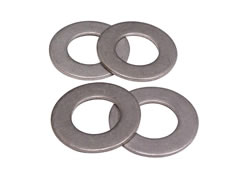
Are you familiar with the different cross-sectional shapes in which washers are made? All washers have a cross-sectional shape. It represents the shape of a washer if you cut it straight through the middle and view it from the side. Different types of washers, however, have different cross-sectional shapes. Below is a list of some of the most common cross-sectional shapes for washers.
Rectangular
You can find washers with a rectangular cross-section. It’s the most common cross-sectional shape in which washers are made. Most round and flat washers, for instance, feature a rectangular cross-section. They are typically used to distribute the load of a threaded fastener, such as a bolt. When a fastener is driven into an object, the head will press against the washer, thereby protecting the object from load-related damage.
Beveled
Another common cross-sectional shape for washers is beveled. Washers with a beveled cross-section don’t have a completely straight profile. Instead, they have an angled or slanted profile. Beveled washers are often used in applications involving similar angled surfaces. They allow fasteners to sit flush against nonuniform surfaces.
Wave
Some washers have a wave-shaped cross-section. They aren’t completely straight. Instead, washers with a wave-shaped cross-section have an irregular profile that mimics the appearance of a wave. Wave spring washers, for instance, feature this unique cross-sectional shape. Their wave-shaped cross-section acts as a spring to resist vibrations. As you drive a fastener into an object, the wave spring washer will flatten — much like a traditional compression spring under a load.
Conical
Another common cross-sectional shape for washers is conical. It’s a distinguishing characteristic of Belleville washers and conical spring washers. Belleville washers and conical spring washers are essentially cupped. Like with wave spring washers, they are designed to resist vibrations. Cupped washers such as these will flatten during installation, which causes them to resist external forces by pushing outward towards the fastener.
Why the Cross-Sectional Shape Is Important
You can’t ignore the cross-sectional shape when choosing a washer. It’s not just an aesthetic feature. Rather, it will affect the washer’s performance and utility.
Washers with a straight, rectangular cross-sectional shape offer superior load distribution. Washers with a beveled cross-sectional shape are better suited for angled surfaces. Washers with a wave or conical cross-sectional shape are designed to resist vibrations. Hopefully, this will give you a better understanding of the different cross-sectional shapes and how they affect washers.
