


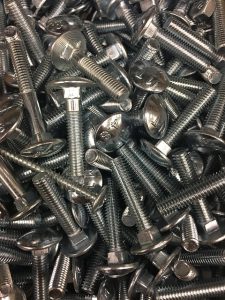
They may be small in size, but fasteners play a big role in aerospace engineering. They are used to mechanically hold two or more parts together. Temporary fasteners include bolts, screws and nuts, whereas permanent fasteners include rivets, staples and weld-on fasteners.
While they are all used to hold multiple parts together, aerospace fasteners are available in different finishes. Some of them have a zinc-plated finish. Other aerospace fasteners have a cadmium-plated finish.
What Are Zinc-Plated Aerospace Fasteners?
Zinc-plated aerospace fasteners are characterized by a thin outer layer of zinc. These fasteners are still made of strong and durable materials, such as stainless steel and various alloys. However, they feature an outer layer of zinc.
Zinc plating is typically achieved via electroplating. The fastener is placed in a bath consisting of a zinc-based electrolyte solution. An electrical current is then applied to the fastener, causing micro-sized zinc particles to cling to the fastener’s surface.
What Are Cadmium-Plated Aerospace Fasteners?
Cadmium-plated aerospace fasteners feature a thin outer layer of cadmium. They are available in many of the same materials as their zinc-plated counterparts, including steel and various alloys. Rather than a zinc outer layer, though, cadmium-plated fasteners feature a cadmium outer layer.
Cadmium plating also uses the same electroplating process as zinc plating. The electrolyte bath leverages cadmium ions, which cling to the fastener’s surface.
Differences Between Zinc and Cadmium-Plated Aerospace Fasteners
Both zinc and cadmium-plated aerospace fasteners offer a high level of protection against corrosion. When zinc is exposed to oxygen, it undergoes oxidation. This process results in the formation of a protective layer, zinc oxide, which further slows and protects against corrosion. Cadmium, though, offers an even higher level of protection against corrosion. Cadmium-plated aerospace fasteners can withstand humidity, rain, snow and salt spray.
Cadmium-plated aerospace fasteners offer excellent lubricity. Cadmium is naturally smooth. When applied to the surface of a fastener, it offers a similar level of lubricity to reduce friction.
Cadmium is also relatively soft and ductile. Cadmium-plated aerospace fasteners can deform slightly when exposed to vibrations or mechanical stress without jeopardizing the underlying steel or material.
There are still reasons to choose zinc-plated aerospace fasteners. For starters, they are harder than cadmium-plated aerospace fasteners. Zinc is a harder material that offers improved wear resistance in fastening-related applications.
Zinc-plated aerospace fasteners are more environmentally friendly. Zinc is a nontoxic metal, whereas cadmium is classified as toxic. And because it’s toxic, it’s restricted by organizations like the Environmental Protection Agency (EPA) and the Occupational Safety and Health Administration (OSHA).
Another advantage of zinc-plated aerospace fasteners is the price. They typically cost less than cadmium-plated aerospace fasteners. Zinc is a more readily available metal, so zinc plating costs less.
source
