


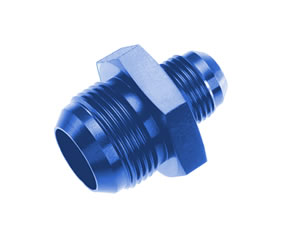
Reducer fittings offer a simple and effective way to connect two pipes of different diameters. As their name suggests, they “reduce” the diameter of the pipes. With a reducer fitting, you can connect one pipe to another pipe with a smaller diameter. Below are six facts about reducer fittings.
#1) Most Are Threaded
Most reducer fittings are threaded. Each end has an externally threaded section. One of these ends, however, has a smaller diameter than the other. You can install a reducer fitting by twisting threaded pipes of the appropriate sizes onto the ends. In addition to threaded, though, some reducer fittings leverage compression. They feature a nut that compresses a ring around the end.
#2) Concentric vs Eccentric
There are two primary types of reducer fittings: concentric and eccentric. Concentric reducer fittings are symmetrical and straight. Eccentric reducer fittings, on the other hand, are offset. One side is essentially flat to prevent air pockets from forming. They are both used to join two threaded pipes of different diameters; concentric and eccentric fittings simply have different internal designs.
#3) Aerospace Reducer Fittings Use a 37-Degree Angle
Reducer fittings in aerospace-related applications typically use a 37-degree angle. Both ends have a 37-degree angle. This design allows for a leak-proof seal, which is essential for pressurized systems. With that said, reducer fittings used in non-aerospace applications may feature a 45-degree or higher angle.
#4) Available in Different Materials
You can find reducer fittings in different materials. Some of them are made of stainless steel or carbon steel. Others are made of aluminum. Stainless steel reducer fittings offer excellent corrosion resistance. Carbon steel reducer fittings are stronger and harder. Aluminum reducer fittings are prized for their lightweight characteristics.
#5) Not the Same as Reducer Bushings
Reducer fittings aren’t the same as reducer bushings. While they are both used to connect two pipes of different diameters, they are designed differently. Reducer fittings are typically designed for female-to-female pipe connections, whereas reducer bushings are designed for male-to-female pipe connections.
#6) Leak-Resistant Sealing
Reducer fittings offer leak-resistant sealing. When used in conjunction with the right size pipes, they allow for a smooth transition without leaks. Reducer fittings are designed in tight tolerances to ensure that no fluid leaks out. If you use other methods to connect two pipes, you may encounter leaks. Therefore, reducer fittings are often preferred for applications where leaks are a concern.
In Conclusion
Reducer fittings play an important role in pipe connections. From threaded and compression styles to concentric and eccentric layouts, each variation serves a clear purpose: to connect two pipes of different diameters. One end has a smaller diameter than the other. With this design, you can use reducer fittings to connect two pipes of different diameters.
source
