

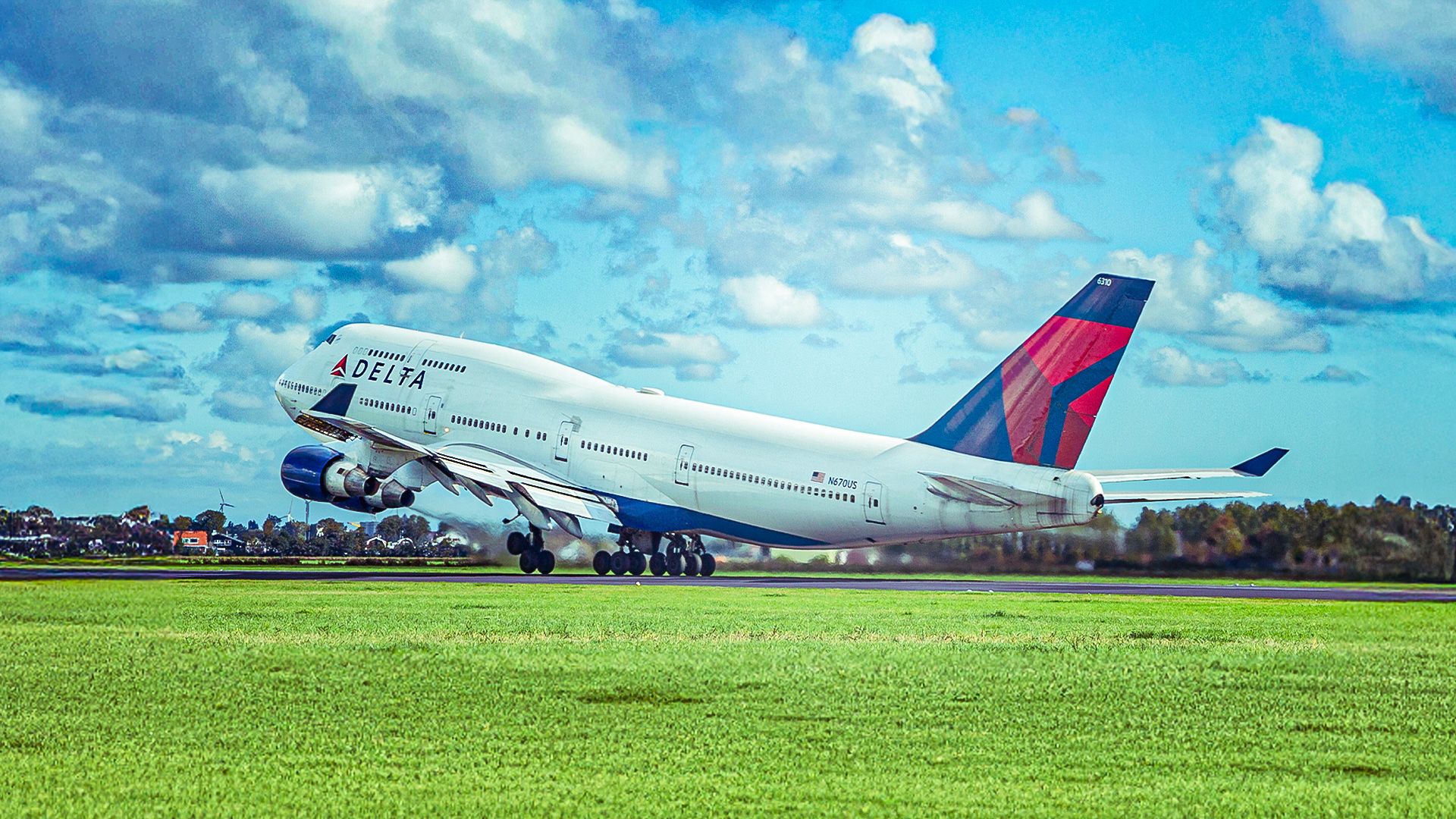
 Delta Air Lines’ decision to bring the Boeing 747 back into its fleet after an 18-year gap is one of those striking chapters in airline history that raises eyebrows: Why re-adopt a four-engine “jumbo” in an era of twinjets? This guide will walk you through Delta’s early 747 era (1970–1977), the intervening hiatus, and the eventual “resurrection” after the 2008 merger with Northwest, and what made Delta give the 747 a second life.
Beneath the surface, the story involves evolving route networks, fleet synergies, merger dynamics, and how legacy fleet decisions sometimes come full circle. Let’s examine the history and reasoning behind these changes. In our article, we will explore in detail Delta’s two distinct eras of 747 service, the variants both Delta and Northwest operated, and the real reasoning for bringing the 747 back before its final farewell in 2017.
Delta’s First 747 Era (1970–1977)

When Delta accepted its first Boeing 747-132 in 1970, it joined the ranks of global carriers, ushering in the widebody age. The airline acquired five 747-100 series aircraft (designated 747-132 by Boeing) in that period, with Ship 101 (registration N9896) delivered to Atlanta on October 2, 1970. The aircraft entered scheduled service on October 25, 1970, between Atlanta, Dallas, and Los Angeles, as described by the Delta Flight Museum.
These early Delta 747s were luxurious and forward-thinking for the time. The airline’s “Penthouse” upper-deck lounge became a signature feature, offering cocktails, sofas, and panoramic windows, and was a showcase of early-1970s glamour in the skies. Each aircraft carried roughly 370 passengers, featured overhead luggage bins (a novelty at the time), and had the first audio in-flight entertainment system.
Despite its grandeur, the 747-100 proved too large for Delta’s network. At the time, Delta’s operations were exclusively domestic, favoring frequency and flexibility over capacity. The airline quickly realized that a 370-seat jumbo was excessive for its route structure. By 1977, all five of Delta’s 747-132s were sold to other airlines and replaced by the smaller, but more efficient trijet Lockheed L-1011 TriStar. That decision made economic sense, but it also ended Delta’s first chapter with the Queen of the Skies.
Thus, the 747 was a bold but ultimately misaligned fit for Delta in the 1970s, so the airline phased out all Jumbos in 1977. For the next three decades, the 747 would be conspicuously absent from Delta’s fleet.
Northwest’s Long Relationship With The 747

While Delta moved away from the jumbo, Northwest Airlines built its global reputation around it with vast international routes. The Minneapolis-based carrier introduced the Boeing 747-100 in 1970, later expanding its fleet with Boeing 747-200s, 747 freighters, and eventually the state-of-the-art Boeing 747-400.
Northwest’s geographic advantage made it a natural 747 operator. The airline’s strong Pacific network, connecting the US Midwest with Tokyo, Seoul, Beijing, and other megacities in Asia-Pacific, demanded the capacity and range the 747 provided.
By 1985, Northwest reaffirmed its commitment to the type with a $2 billion order for new aircraft, including 747-400s as reported in the New York Times, on Oct. 23, 1985. The 747-400 entered Northwest’s service in 1989, offering a two-pilot glass cockpit, improved range, and distinctive winglets. It became the airline’s flagship, flying mainly to Asia and beyond.
When Delta merged with Northwest in 2008, it inherited not only Northwest’s strong route network, some new Airbus planes, but also its fleet of 16 Boeing 747-400s – a symbolic reunion with the aircraft Delta had once abandoned.
The Second Jumbo Era: Delta’s 747-400 Operations (2008–2017)

When Delta and Northwest merged, the combined airline faced a strategic choice: retire the aging 747s or leverage them across its newly expanded intercontinental network. Delta chose the latter, recognizing that the 747-400s still had strong utility in transpacific markets, and were loved by the passengers!
The reasoning was pragmatic. The aircraft were well-maintained, long-range-capable, and ideally suited for high-demand Asia routes from US cities to Tokyo, Seoul, and Shanghai. The merger also gave Delta an instant transpacific presence – something the pre-merger airline had never achieved on its own.
In essence, Delta’s second 747 era was a byproduct of opportunity. The 747-400s provided:
-
Fleet flexibility: They allowed Delta to maintain widebody capacity while waiting for the next-generation
Airbus A350-900
and
Boeing 777-200LR
deliveries. - Network efficiency: High-density routes from Detroit, Minneapolis, and later Seattle to Asia were perfect for the 747’s range and capacity.
-
Cargo benefits: Delta inherited Northwest’s 747-200 freighters, which helped transition its cargo operations before discontinuing dedicated freight flights in 2009, and handing most of the freighters to
Kalitta Air
.
Delta retained 16 747-400s (registered N661US–N676US), originally delivered to Northwest between 1989 and 2002. The airline upgraded them with new interiors, lie-flat BusinessElite seats, and modern in-flight entertainment systems. By the early 2010s, the aircraft became Delta’s intercontinental flagships.
Boeing 747 Variants Operated by Delta and Northwest:
|
Variant |
Operator |
Years in Service |
Quantity |
Primary Use |
Notes |
|---|---|---|---|---|---|
|
Boeing 747-132 (-100) |
Delta Air Lines |
1970–1977 |
5 |
Domestic trunk & Pan Am interchange |
Returned to Boeing; replaced by L-1011s |
|
Boeing 747-251B (-200 Passenger) |
Northwest Airlines |
1975–2007 |
8 (2 at merger) |
Long-haul & charter |
Last passenger flights Sept 2007 |
|
Boeing 747-251F / -251SF (-200 Freighter) |
Northwest / Delta |
1977–2009 |
12 |
Cargo operations |
Final Delta cargo flight Dec 2009 |
|
Boeing 747-451 (-400) |
Northwest → Delta Air Lines |
1989–2017 |
16 |
Passenger flagship |
Last U.S. passenger 747s in 2017 |
Sources: Delta Flight Museum; Northwest Airlines History Center
The 747-400 primarily served Delta’s Detroit hub, connecting the US with Asia. Additional flights operated from Honolulu, Los Angeles, and Tokyo Narita.
According to schedule data from September 2017 from Cirium, an aviation analytics company, Delta operated 191 monthly 747-400 flights, carrying over 71,800 seats and generating 469 million Available Seat Miles (ASMs). The average route length was about 6,540 miles, ideal for the type’s long-range design. You can find Delta’s 747-400 Network chart in the next chapter.
Performance, Economics, And The March Toward Retirement

Despite its prestige, the 747-400 became increasingly uneconomical to operate in the 2010s. Four engines meant higher maintenance and fuel costs compared with new-generation twinjets like the Airbus A350 and Boeing 777.
In 2014, Delta announced it would retire the 747-400 fleet early, replacing them with A350-900s. By September 2015, the first of Delta’s 747s (N661US was the world’s first 747-400 ever built) was withdrawn and now it is preserved at the Delta Flight Museum in Atlanta.
Delta’s 747-400 Network in 2017
|
Origin |
Destination |
Flights |
Seats |
Available Seat Miles (ASMs) |
Average Distance (mi) |
|---|---|---|---|---|---|
|
Detroit (DTW) |
Seoul (ICN) |
30 |
11,280 |
74,865,360 |
6,637 |
|
Detroit (DTW) |
Tokyo (NRT) |
30 |
11,280 |
72,158,160 |
6,397 |
|
Detroit (DTW) |
Shanghai (PVG) |
30 |
11,280 |
80,505,360 |
7,137 |
|
Honolulu (HNL) |
Los Angeles (LAX) |
1 |
376 |
961,056 |
2,556 |
|
Honolulu (HNL) |
Tokyo (NRT) |
4 |
1,504 |
5,742,272 |
3,818 |
|
Seoul (ICN) |
Detroit (DTW) |
30 |
11,280 |
74,865,360 |
6,637 |
|
Los Angeles (LAX) |
Detroit (DTW) |
1 |
376 |
744,104 |
1,979 |
|
Tokyo (NRT) |
Detroit (DTW) |
30 |
11,280 |
72,158,160 |
6,397 |
|
Tokyo (NRT) |
Honolulu (HNL) |
5 |
1,880 |
7,177,840 |
3,818 |
|
Shanghai (PVG) |
Detroit (DTW) |
30 |
11,280 |
80,505,360 |
7,137 |
|
Total |
191 |
71,816 |
469,683,032 |
6,540 |
Source: Cirium
Nevertheless, Delta honored the aircraft’s legacy with a farewell tour in December 2017. The final scheduled passenger flight, DL158 from Seoul Incheon to Detroit, landed on December 19, 2017, marking the end of 747 passenger service by any US airline.
For several weeks afterward, Delta operated farewell charters, including sports team flights, before retiring the last jet to Pinal Airpark in Arizona in early 2018, according to CNN.
Why The Second Stint Was Always Temporary

Delta’s reintroduction of the 747 was never intended to be permanent. It was a strategic bridge between the past and the future: a way to maintain capacity and network continuity after the Northwest merger.
But as Delta’s A350-900 deliveries accelerated, the writing was on the wall. The A350 offered superior fuel efficiency, extended range, and lower carbon emissions, aligning with Delta’s sustainability and modernization goals.
By 2017, the 747-400s were an average of 24 years old. These aircraft were still majestic but technologically and economically outclassed. Delta’s final 747 flights represented not just the end of an aircraft type but the conclusion of a distinct chapter in US aviation history.
Legacy And Reflection

For Delta Air Lines, the Boeing 747 symbolizes both ambition and adaptability. It served as the airline’s bold entry into the widebody era in the 1970s and, decades later, as a bridge to its modern global network.
From the Penthouse lounges of the early 747-100s to the fully flat BusinessElite seats aboard the 747-400s, the Queen of the Skies evolved with Delta’s identity. Her retirement in 2017 marked the end of the 747’s half-century reign over American skies.
Today, Ship 6301 stands proudly at the Delta Flight Museum – a tangible reminder of how Delta twice embraced, and twice bid farewell to, one of aviation’s greatest icons. For passengers and pilots alike, the 747 remains more than an aircraft; it’s a memory of an era when flying truly felt special.
source
