

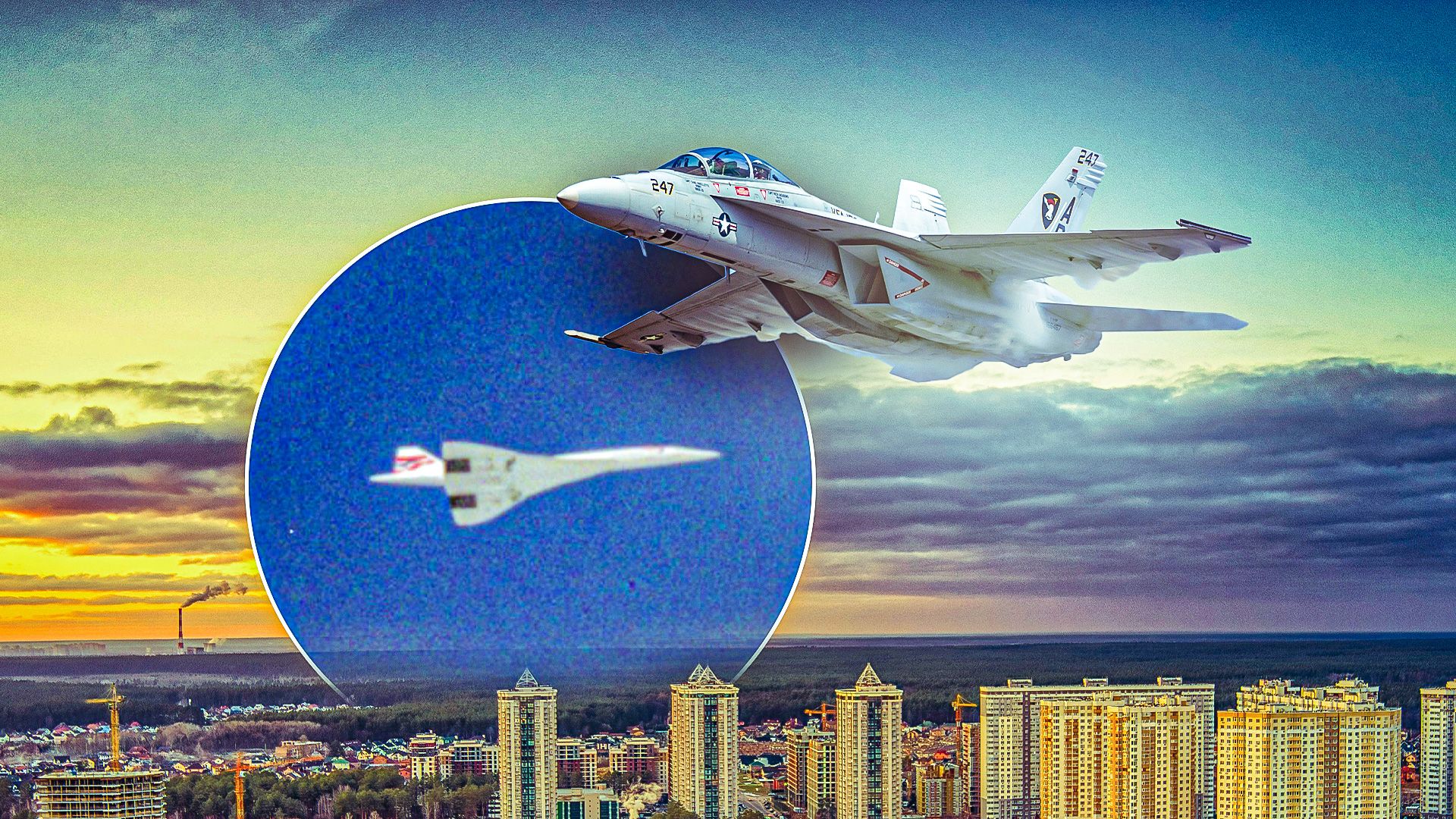
In the year 1990, a strange series of events led to a bizarre encounter between the US Navy F-14 Tomcat fighter jets and the supersonic Concorde jetliner. Although no official records of the aircraft’s commercial flight plan have been publicly published, confirmation was delivered in the form of a photograph by the Tomcat pilots. That picture is the only known photo ever taken of a Concorde flying over Mach 2.
Why was a charter flight, presumably, of a famous and rare commercial jet, intercepted by fighter jets? The reason is that this particular route took the graceful supersonic transport (SST) over a raging conflict in the Persian Gulf. A shooting war between Iraq and Iran was in the throes of major aerial engagements between Soviet and American-made combat aircraft fielded by both sides.
The Cold War had not yet come to its dramatic and sudden end, as the US Navy was on high alert as its carrier strike group prepared to contain any spill over from the Iran-Iraq War. Concorde Jets operated by both British Airways and Air France were just as frequently flown on private charters as they were on commercial transatlantic corridors. However, this particular aircraft came to pass where and when it did, very nearly ending in tragedy.
Pretext To A Supersonic Interception

The Iran-Iraq War began in 1980 after Iran was invaded by the regime of Saddam Hussein. At that point in history, both nations had two of the largest air forces in the world. Iraq also boasted one of the largest armies on the planet. The overthrow of the Shah of Iran in 1979 had led Saddam Hussein to believe there was a significant risk of the theocratic state, which now controlled Iran, taking action against his nation.
As the dictator of Iraq, Saddam Hussein ordered an aerial campaign and ground invasion. Iran was armed with a large force of American-made warplanes and other military equipment that had only recently been delivered to the overthrown government. The new revolutionaries not only posed an ideological threat to Iraq but possessed the means with which to enact a large-scale campaign against their religious adversaries if they chose to take their holy crusade beyond Iran’s borders.
The US had taken steps to prevent hostilities from destroying the massive fields of oil caught in the crossfire. In response, Iraq modified a Dassault 50 business jet to carry two anti-ship Exocet missiles and attack the USS Stark in 1987, as the National Interest wrote. The attack killed 37 sailors and injured 21 more, and made the US Navy wary of any unidentified aircraft, even if they were not obviously a military platform.
Targeting Errors At Twice The Speed Of Sound

US intelligence was aware of the Iraqi Air Force’s full inventory, including the MiG-25 “Foxbats” and MiG-29 “Fulcrums,” long before that day in 1990. The Soviet Union had forward deployed multiple MiG-25 and MiG-31 “Foxhound” supersonic fighters in attempts to intercept the Lockheed Martin SR-71 Blackbird that flew reconnaissance missions over the Middle East for some years already.
The Jets were never capable of intercepting the SR-71, but they are still some of the fastest aircraft to ever fly with missiles carried aboard for the mission of interception and even strategic strike. A United States aircraft carrier is one of the highest value targets in any conflict between America and the Soviet Union.

The strike group is extremely cautious in defending itself against any potential threat. Russia’s fastest and highest-flying fighter, with some of the longest range missiles in its arsenal, is at the very top of the threat list for the strike group. If the Soviet Union was making a play to use Iraq as a means to take down one of the Navy’s flagships, or if Iraq independently launched the attack, the response would be the same.
Any officer in the position of authority when a Foxbat or Foxhounds could be barreling down range at Mach 3 with anti-ship missiles aboard is in a position of extreme pressure. There are a myriad of risks that come scrambling fighters against a false threat as well, but when it comes to protecting the “boat” (as carriers are called), all bets are off.

How Many F-14 Tomcats Are Left?
Find out how many exist now that Maverick’s trusty fighter jet has retired from the Navy.
The Events As We Know Them

The Iraqi attack that used a Dassault business jet changed the rules and engagement for the remainder of the conflict. Aircraft on combat Air Patrol were instructed to follow aggressive tactics and intercept any unidentified aircraft that approached them. In 1990, as the invasion of Kuwait by Saddam Hussein’s Iraq continued to drag out, two F-14A fighters were returning to their carrier from Saudi Arabia when they got the call.
In a story about the incident from the aviation geek club, David “Hey Joe” Parsons, one of the F-14 Tomcat’s Radar Interception Officer (RIO), was quoted:
“The TAO’s voice was several octaves higher than normal and they were going into “warning red, weapons tight”. As we swung our nose in the direction of the vector we got, I got an immediate lock on an extremely fast and high-flying aircraft…”
The F-14 Tomcat was a super fighter capable of launching from the deck of an aircraft carrier and fighting with the highest-performance air superiority jets in the world, including the US Air Force’s counterpart, the F-15 Eagle. On top of that exceptional performance, it was armed with one of the longest-range air missiles in the world, the AIM-54 Phoenix, which had recorded kills and 136 miles in testing.
The Tomcat was the perfect platform to protect the striped crew from any airborne threat. The F-14 could accelerate to over Mach 2, just like the Concorde. The boat gave the flight of Tomcats and intercept course and instructed them to approach in “warning red, weapons tight” condition. That basically translates to “finger on the trigger,” and being ready to fire immediately upon identifying a hostile aircraft.
The fighters closed in on the white streak passing through the upper atmosphere and pointed a camera at it. At that moment, all doubt was erased as the silhouette of the legendary airliner became clear at last. Parsons snapped a picture with his 300 mm camera, capturing the only existing photo of a Concorde flying at its cruising speed of Mach 2.

30 Years On: When Concorde Set A Speed Record For A Round-The-World Flight
Remembering a milestone in the career of the fastest airliner to ever grace the skies.
Concorde’s Unique Freedom

It is not hard to understand why an air controller on a Navy ship that was not familiar with Concorde wouldn’t think to consider the possibility of the supersonic jet passing overhead. In the first place, the aircraft was flying through an area close to commercial air traffic and extremely dangerous for anything in the sky. On the other hand, given its unique performance capabilities, the Concorde was often given passage that other commercial airplanes were not and could not fly, even if they wanted to.
Not only was the Concorde the fastest commercial plane to ever take to the sky, it cruised at as much as 60,000 feet, which is typically airspace reserved only for the highest performance combat aircraft or ballistic missiles. With that freedom also came a restriction that was well known and largely responsible for the plane’s lack of commercial success. That is that it could not fly over land because of the sonic booms it produced.
The Concorde was popular with charters in Australia during the 1980s and 1990s and on around-the-world tours with stops in the Middle East at places like Bahrain, Dubai, and Muscat. The jets’ roughly 4,000-mile range enabled them to perform their famous transatlantic transits. On the 1986 around-the-world tour, the plane had stopped at Cairo, Egypt, and Colombo in Sri Lanka.
The Concorde was never flown on a classified military mission of any kind, but it was frequently chartered for diplomatic flights. It is reasonable to believe that, should the plane have been in the service of the United Kingdom or the French government at the time, its flight plan may well not have been publicly recorded for any of a myriad of security reasons that come with sensitive political affairs.
The Brutality Below Silent Skies

The Iran-Iraq War has often been compared to World War I despite the use of modern warplanes, missiles, and other military systems. Both sides made large-scale use of trench warfare with barbed wire and fortified defensive lines, and incorporated machine gun pillboxes and medieval warfare strategy. Iran employed massive human wave attacks in bayonet charges, while Iraq freely employed chemical weapons and deliberately attacked civilian targets.
The widely accepted religious and philosophical value of martyrdom under Iranian Islam enabled the revolutionary theocracy to easily assemble massive forces of essentially untrained soldiers to execute bloody and horrific attacks. In the air, both Iraqi and Iranian pilots suffered heavy losses as their warplanes were nearly equally matched, and neither Air Force had the highest training by international standards.
Iraq was originally much more closely aligned with the Soviet Union before the outbreak of the conflict. The US began to make overtures to open diplomatic channels in an effort to counter Iran’s growing influence and destabilizing impact on the Gulf region. Although these efforts would not lead to significant progress by the end of the conflict, Iran openly attacked the United States armed forces, which continued to make Iran the preferred partner in diplomatic affairs.
source
