



The National Transportation Safety Board (NTSB) has just released its preliminary report about that bizarre accident we saw roughly a month ago, where a United jet struck a light pole (which in turn struck a truck) on the New Jersey Turnpike, and it highlights just how avoidable this incident was…
Cause of the United Boeing 767 approach accident at Newark
On May 3, 2026, a United Boeing 767-400ER was landing on runway 29 at Newark Airport (EWR), after a flight from Venice (VCE). This runway is right up against the New Jersey Turnpike (I-95), and somehow the plane came in too low, to the point that it struck a light pole, which in turn, struck a truck (initially the belief was that the plane directly struck the truck, but that wasn’t the case, per the report).
While there was damage to the aircraft, and also major damage to the truck, this could’ve been so much worse, because at least no one was seriously inured. If the plane had come in just feet lower, this could’ve been a catastrophe.
What we knew is that it was a gusty day, and that runway 29 is short, so it’s understandable that pilots would want to touch down as early as possible to avoid a runway overrun. However, that of course doesn’t in any way explain why the plane hit something on the interstate.
So, what actually happened? Well, all signs point toward the pilots just not following best practices. For what it’s worth, the captain was flying this sector, and he had a lot of experience, with over 16,000 hours.
Runways have Precision Approach Path Indicator (PAPI) lights, which are the four lights to the side of the runway, that are either red or white, and they’re supposed to help pilots maintain the right glideslope. The ideal descent profile is two white lights and two red lights — if you have more red, you’re too low, while if you have more white, you’re too high.
In this case, during the approach briefing, the captain indicated he wanted to fly the approach with three reds and one white, given the short length of the runway. So he intentionally wanted to fly in a bit low. However, the actual data shows that starting at around 4,500 feet, the plane was flying with four reds the entire time, rather than three reds and one white. So he didn’t actually fly the approach the way he said he would.
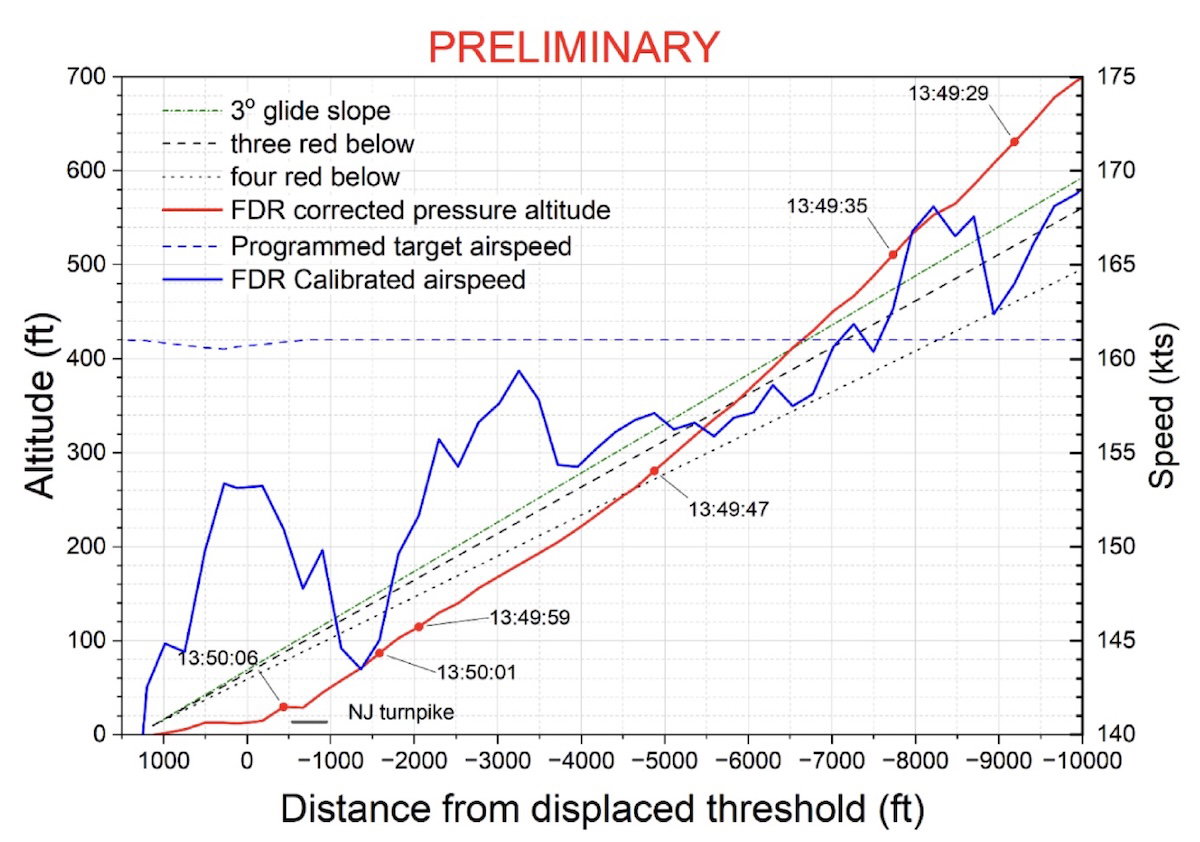
According to the first officer (who was the pilot monitoring), at an altitude of around 500 feet and within half a mile of landing, he recalled saying that he stated “hey you are slow,” followed moments later by saying “you are still slow and a little low.” In response to that, the captain claims he looked outside and “thought we were low,” however, since they were about to touch down, he didn’t have time to process the information in time to get a go around callout verbalized.
The captain explained that he turned off the autopilot at just under 900 feet. He said he “got fast” while he turned the airplane into the headwind, and pulled back the power levers to compensate, all while the airplane shortly returned to a stable airspeed, even though the wind gusts were producing “moderate turbulence.”
Was this get-there-itis, deference to the captain, or what?
The preliminary report only shares the details of the incident, but doesn’t actually come to a conclusion as to the cause (not that there’s much mystery here, as there were no mechanical issues with the plane).
Of course hindsight is 20/20, but aviation operates under a system of best practices, and erring on the side of caution. The idea is that either the captain or first officer can call a go around if they feel it’s not stable, in order to prioritize safety above all else.
So suffice it to say that this didn’t happen here. For one, the plane was coming in too low most of the way, and due to the gusts, the captain also seemed to be “wresting” the plane down a bit at the last minute, though he still decided at 500 feet that the approach was stable (was it really, if they were so low?).
But it’s concerning that the first officer told him twice that he was too slow, and once that he was too low, yet no go around was called. This sure seems like a situation that may come down to two factors:
- The much less experienced first officer perhaps not wanting to speak up to the captain, as it sounds like he should’ve called a go around; I think Nathan Fielder would have a thing to say about that, and one has to imagine if roles were reversed and the first officer were flying, the captain might’ve called a go around as the pilot monitoring
- They just completed a transatlantic flight and were probably tired and just wanted to get home, so it’s possible that get-there-itis played into it as well; this is essentially a plan continuation bias, a psychological condition where a person irrationally pushes to complete a journey despite red flags or unsafe conditions
Or I dunno, maybe it was all just DEI…
Bottom line
The NTSB has released its initial report into the landing accident that happened at Newark Airport roughly a month ago, involving a United Boeing 767, where it struck a light pole on the New Jersey Turnpike, which in turn struck a truck.
According to the report, the plane was coming in too low starting at an altitude of 4,500 feet, but not much was done to correct that. Then shortly before landing, the first officer pointed out twice how the plane was flying too slow, and once how it was flying too low, but they continued with the approach.
Of course in hindsight it’s obvious that a go around should’ve happened, but for whatever reason, that didn’t happen…
What do you make of the report on this United 767 landing incident?
