

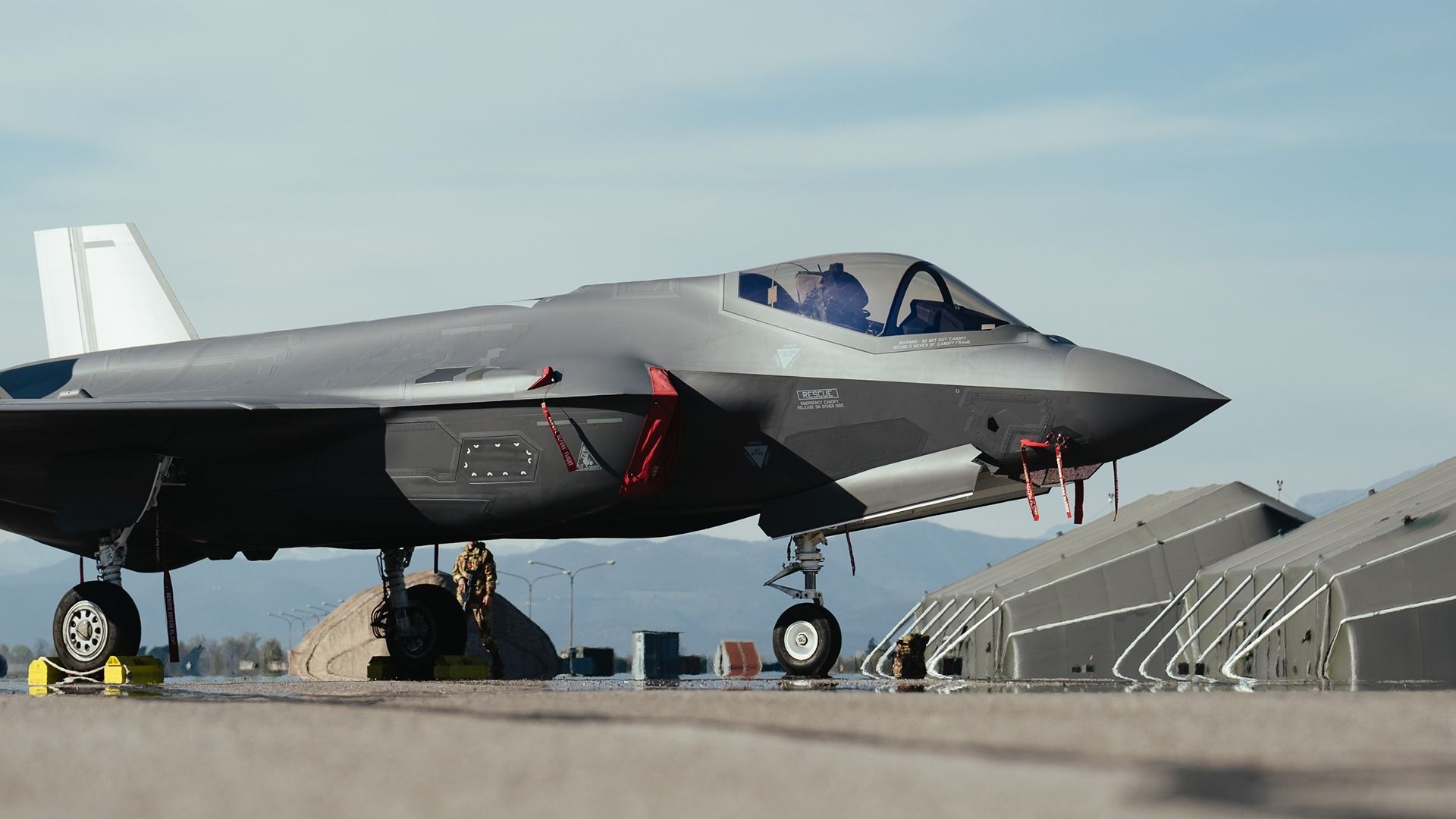
Since its inception in 2001, the F-35 Lightning II program has expanded to become the largest combat aircraft project in history. The Joint Strike Fighter (JSF), another name for the F-35 has production lines in Fort Worth as well as Cameri, Italy, and a final-assembly site in Nagoya, Japan. It is a vast enterprise that includes data centers on two continents, continuously updating the type’s software.
Twenty countries now fly or have ordered the fifth-generation fighter. Still, the core of the program is made up of the United States, Japan, the United Kingdom, Australia, and Italy. Together, they will field almost 3,000 airframes in three variants. The United States operates more than two-thirds of the worldwide fleet, but allies are steadily expanding their fleet of stealth fighters to build a stronger shared defense network.
Top Five Fleets: By The Numbers

The scale of Washington’s F-35 is unprecedented, even in the history of America’s mega-projects. The enormous task was to replace the Air Force, Navy, and Marine Corps’ three very different Cold War workhorses: the F-16C/D, F/A-18C/D, and AV-8B. That spawned a family of aircraft that share a standard airframe but optimized features for each service. Since, the United States Air Force (USAF) has procured 1,763 conventional-takeoff F-35As, while the Navy ordered 340 carrier-capable F-35Cs, and the Marines bought 353 short-takeoff-vertical-landing (STOVL) F-35Bs.
|
Ranking |
F-35 Fleet Numbers (Total Planned) |
|---|---|
|
1. USA |
1,763 F-35As, 340 F-35Cs, 353 F-35Bs |
|
2. Japan |
105 F-35As, 42 F-35Bs |
|
3. United Kingdom |
138 F-35Bs |
|
4. Australia |
100 F-35As |
|
5. Italy |
60 F-35As, 30 F-35Bs |
The impact of the Lockheed Martin Skunk Works program has become increasingly apparent. Marine B-models have been forward-deployed in Japan, prepared to deploy from American amphibious assault ships. The Navy’s C-model squadrons aboard have already completed operational cruises. Air Force units at Hill Air Force Base (AFB) , Eielson AFB, and RAF Lakenheath perform constant rotation to Europe and the Indo-Pacific. Now, the Pentagon is planning propulsion upgrades, joint command-and-control consolidation, and refreshed open-systems technology. These will eventually lead to the Block 4 configuration and adaptive cycle engine technology.
The industrial impact has been equally sweeping, with every jet’s center fuselage rolling off a Northrop Grumman assembly line and more than three hundred US suppliers providing components to Lockheed Martin. They range from Martin-Baker ejection seats to Collins electro-optical sensors, and sustainment contracts for software, spares, and training that will last until at least 2070. The commitment to the Lightning II is as much an attempt to revolutionize procurement, logistics, and kill-chain integration as it is a purchase of aircraft.
Japan’s Defensive Fighter Fleet

Japan’s adoption of the F-35 was motivated as much by technological aspirations as by geopolitical urgency. A growing threat from China which has manifest in new stealth fighters and violations of Japanese air-defense identification zones (ADIZ) with worrying regularity. Thus, Tokyo chose the JSF. To expedite crew training, the Ministry of Defense had the first four aircraft constructed in the United States. However, the remaining aircraft are being manufactured at a new Final Assembly and Check-Out (FACO) facility operated by Mitsubishi Heavy Industries in Nagoya.
Thanks to this arrangement, the Japanese aerospace industry has gained its entry into the construction of stealth aircraft. That is also a major step in reducing the dependence on importing so much of the supply chain for its new fighter fleet. The 2018 National Defense Program Guidelines reclassified the aircraft carrier Izumo and her sister ship Kaga with the ability to deploy short-takeoff F-35Bs.
|
Spec |
F-35A |
F-35B |
F-35C |
|---|---|---|---|
|
Powerplant |
One Pratt & Whitney F135-PW-100 turbofan engine |
F135-PW-600 |
F135-PW-100 |
|
Thrust |
43,000 pounds |
38,000 pounds (40,500 pounds Vertical) |
43,000 pounds |
|
Length |
51.5 feet (15.7 meters) |
51.2 feet (15.1 meters) |
51.5 feet (15.7 meters) |
|
Wingspan |
35 feet (10.7 meters) |
35 feet (10.7 meters) |
43 feet (13.1 meters) |
|
Payload |
18,000 pounds (8,160 kilograms) |
15,000 pounds (6,800 kilograms) |
18,000 pounds (8,160 kilograms) |
Tokyo consequently increased the fleet by adding 42 F-35Bs to the books and then increased the A-model request to 105 airframes. Multiple Lightning squadrons are currently stationed at Misawa and Hyakuri by Japan’s Air Self-Defense Force (JASDF). Stealth fighters stand ready to launch intercept operations over the East China Sea against Russian and Chinese aggressors.
The F-35 already serves as an airborne intelligence node as well as being a shooter thanks to its onboard computer and sensor suite paired with Active Electronically Scanned Array (AESA) radar. That data feeds into the JASDF’s multi-layered command network, giving Tokyo an advantage in the game of cat-and-mouse surveillance that takes place around the Senkaku Islands. While this is going on, the airframe serves as a bridge to Japan’s domestic F-X sixth-generation fighter, which is still in the early development stages.
Politically, the initiative represents a step toward more technological integration between the United States and Japan. Japanese engineers are involved in the Global Fleet Autonomy Center, which oversees the management of classified software patches, and the two governments are jointly funding missile upgrades and exploring the possibility of shared maintenance depots in the Pacific.
The United Kingdom’s Armada

The UK has committed to a fleet size of 138 F-35Bs and is in talks for F-35As to replace outgoing Eurofighter Typhoons. These jets serve three roles for the Royal Air Force (RAF) and Royal Navy: revitalize carrier power, strengthen US-UK aerospace ties, and enhance the combined forces’ multi-domain operations. The Royal Navy’s two new Queen Elizabeth-class carriers made the F-35B the best platform for the naval air arm.
The UK rearmed 617 Squadron, known as “The Dambusters,” at RAF Marham, and 809 Naval Air Squadron, both of which served aboard HMS Queen Elizabeth during the Indo-Pacific Carrier Strike Group deployments. The transition is a demonstration of the country’s capacity to project power without depending on American supercarriers. UK jets have conducted Baltic Air Policing missions, and RAF and Fleet Air Arm B-model pilots frequently integrate with US Marine squadrons, strengthening deterrence along the alliance’s eastern flank. Despite worries about the cost of Block 4 upgrades and the scarcity of spare parts, Whitehall’s strategic calculation still holds that the Lightning is essential to maintaining Britain’s position as a leading contributor to airpower.
BAE Systems plays a crucial role in the global sustainment network at the same time. It manufactures 15% of the airframe of every F-35, including the aft fuselage, and operates a maintenance facility at RAF Marham that serves both European and British fleets. The Lightning also functions as a technology tester for the upcoming Tempest future-combat-air-system (FCAS) sixth-generation fighter. Tempest’s design is already incorporating pilot feedback on man-machine teaming, helmet-mounted displays, and sensor fusion derived from the F-35.
Australia’s Modernized Air Force

The Royal Australian Air Force (RAAF) procured the F-35 with a distinct set of priorities owing to its vast geography and alliances with the US under the ANZUS treaty. To prevent a capability gap after the old F/A-18 Hornet and F-111C strike bomber aged out, lawmakers in Canberra decided to procure the JSF. After a lengthy process of industrial negotiation and strategic development, the F-35A was ordered to the tune of 100 aircraft. The No. 3 and No. 75 Squadrons at RAAF Williamtown and Tindal have been conducting advanced exercises with American and Japanese partners since 2021.
Australia values the long-range intelligence, surveillance, and reconnaissance (ISR) capability of the F-35 over the Indo-Pacific maritime expanse. The Lightning II’s stealth and sensor fusion, paired with a secure data link, integrates with the RAAF’s Wedgetail AWACS platforms for battlespace management. The jets will also be matched with the upcoming Ghost Bat loyal-wingman drones. The program has also supported an ecosystem of over 50 Australian suppliers operating domestically, bringing in billions of dollars.
In terms of strategy, the aircraft allow for what Australia refers to as self-reliant defense within an alliance framework. That is the ability to keep an eye on and, if needed, strike possible enemies thousands of miles away from the Australian mainland while maintaining close coordination with allies. The F-35A is the vital enabler of a focused force to deter aggressors like China. The JSF displays a force to be reckoned with.
Italian Air Power From Land And Sea

Italy presents one of the most intricate stories of F-35 operators, especially as one of the core members of the ongoing Eurofighter Typhoon production chain. Rome became a partner early in the program and made it possible for Leonardo and Lockheed Martin to run Europe’s final assembly line at Cameri Air Base. The factory positions Italy as a major logistics hub by assembling Italian airframes, producing wings for the entire international fleet, and performing maintenance for other European users.
Eventually, both air and naval forces agreed on the same type. Sea trials in 2019 of a joint Air Force-Navy detachment aboard Cavour showed that the short-deck carrier could accommodate B-models. Operational squadrons from Amendola and Ghedi have conducted Baltic Air Policing and Red Flag exercises in the US since then.
The advanced electronic warfare suite of the aircraft complements Italy’s investment in the sixth-generation GCAP (Global Combat Air Programme) initiative alongside the United Kingdom and Japan. The design of the future fighter is aided by the F-35’s experience with low-observable coatings, data fusion, and software. The Lightning is essential to maintaining Italy’s aerospace workforce and fulfilling its NATO duties.
source
