


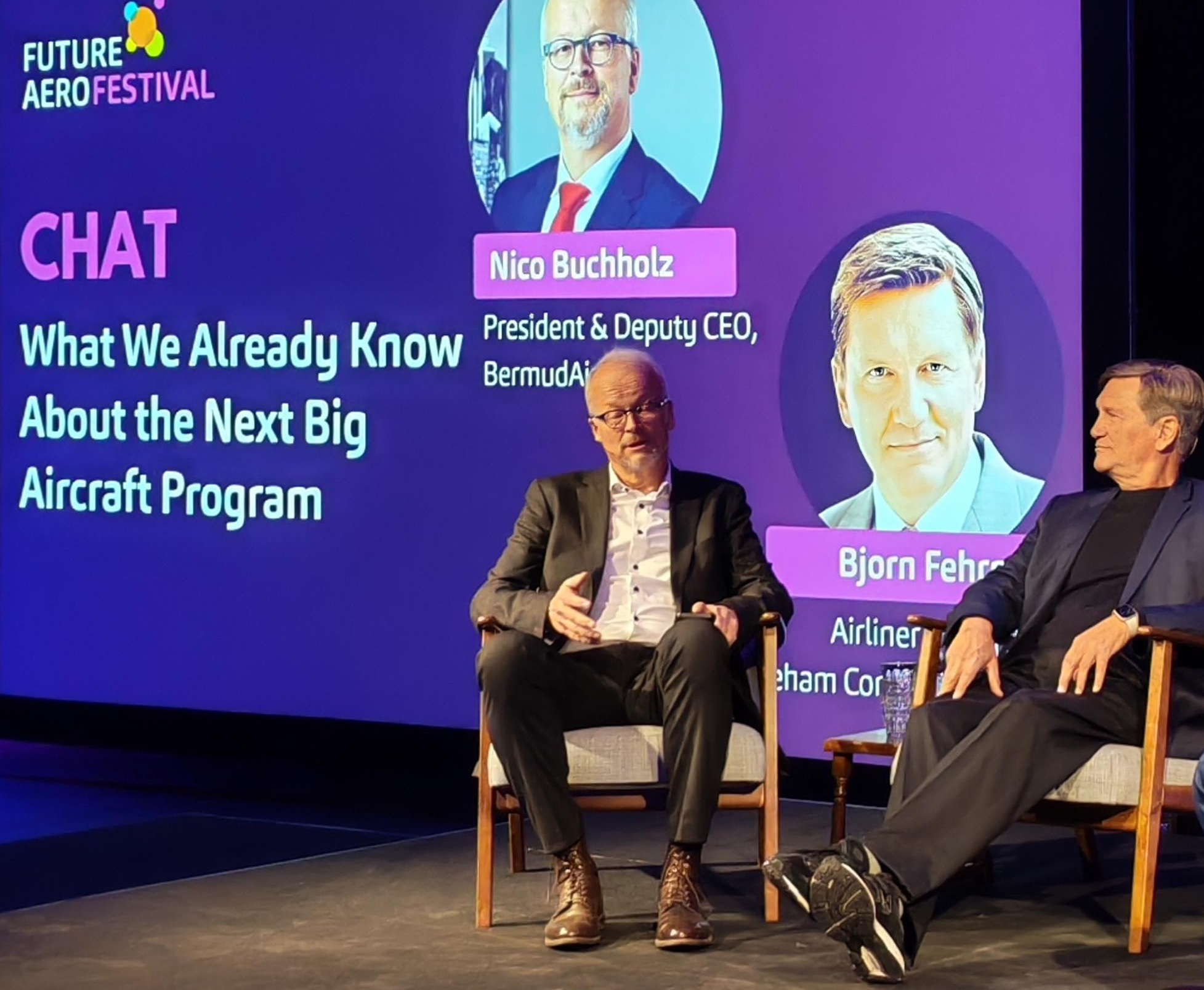
Bjorn Fehrm (right) discusses the industry’s challenges with Nico Buchholz (left). Credit: Charlotte Bailey, Leeham News.
By Charlotte Bailey
Dec. 2, 2025, © Leeham News: As aerospace companies, investors, and industry analysts gather in Amsterdam for the second iteration of the annual Future Aero Festival, the attributes and advantages offered by clean-sheet aircraft concepts are in the spotlight. Bjorn Fehrm, analyst and consultant at Leeham Co, believes that an initial early propulsion evolution to come to market will be the so-called “micro-hybrid” innovation.
The ’next big aircraft program’: a simultaneously inevitable yet somehow elusive concept OEMs and airlines alike are already considering with a view to future operations. Certainly, the scale of the challenge facing aircraft developers is significant.
From alternative propulsion strategies to entirely clean-sheet designs, industry insiders agree that tomorrow’s airliners are likely to be substantially different from currently operational concepts. But how are these ideas starting to shape up, and what is currently understood about commercial aviation’s future direction?
An aircraft is a “production tool for an airline: it exists to satisfy a certain need,” clarified Nico Buchholz, president and deputy CEO of BermudAir. Although Buchholz has personally participated in the launches, demo flights, and entry into service of more than ten aircraft types, “on the other side, we see the slowness” of development, he added.
Fehrm of Leeham Co believes that a combination of motor, generator, and battery “makes a lot of sense on turbofans and turbofan engines,” he said, citing complexities with gas turbine acceleration and deceleration. “You actually have to design the engine a little less efficiently because of that. So, if you have the electrical motor in there to help, you can actually make a more efficient engine.”
Cars and airplanes are very different
Although there are notable technology parallels between automotive battery advancements and aeronautical applications, “a car case is very different,” said Fehrm. In particular, with no ‘stop-start’ elements of “stop lights in the sky,” the constant energy requirements mean that “hybrid [powertrains] in the sky have a much tougher task.”
Potential electrification is far from the only consideration. With aircraft development cycles typically running at around nine years, could contemporary advancements in technologies, such as the application of Artificial Intelligence (AI) speed up aircraft design and development?
“It doesn’t seem very promising,” suggested Fehrm. “One of the reasons is that for AI to do something consistent and reliable, it needs to train on real data.” However, OEMs are understandably cautious about releasing that proprietary data for applications such as these.
Incremental advancements in engine efficiency are also unlikely to provide further substantial leaps in performance, with powerplant technology having already addressed what Fehrm termed the “low-hanging fruit.”
An example of this is the replacement of the V2500 engine (powering the Airbus A320ceo family) with the A320neo’s Pratt & Whitney Geared Turbofan (GTF). This technological initiative doubled the powerplant’s bypass ratio, increasing the engine’s efficiency. However, Fehrm cautioned that a similar future doubling of bypass ratio can no longer be achieved with a so-called ‘normal engine,’ necessitating architecture such as the Open Fan concept.
“The reason why [developers] are pushing for the Open Fan is that you actually [increase] the bypass ratio six-fold, instead of increasing at half the time what you can do with the turbofan,” he explained.
This, admitted Buchholz, “would need someone to commit to it,” questioning whether OEMS would be reticent to adopt something “where they’re not 100% sure of the maturity”. However, he believes “it will happen, [albeit] in combination with a new [clean-sheet] aircraft.” This combination of engine and airframe is, understandably, of key concern for OEMs.
Replacing the A320neo and 737 MAX
The change from the A321 and the Boeing 737 MAX to the next generation of narrowbodies is going to materialize in the form of “change that has never been done before,” Fehrm said. What are the most significant challenges of such a program? “Is it the development cost, which is around $50 billion, perhaps? No, it’s not,” he cautioned.
Instead, the sheer volumes of aircraft involved present perhaps the most significant obstacle to adopting clean-sheet innovation. At the end of the 2030s, an estimated 20,000 in-service units of the A321 and 737 MAX combined will represent a fleet far surpassing the 1,500 units that Fehrm estimates are usually impacted by a fleet substitution. With expectations necessitating some 1,000 copies a year (or 300 units a month), “that’s a 30-fold increase,” he stressed.
Tim Clark’s desire
What of the hypothetical Airbus A380neo that Emirates CEO Tim Clark has publicly pushed for? Buchholz believes it ultimately comes down to how a flight schedule is split up, comprised of either “one A380, or two A350s or two [Boeing] 787s. I have the same seat mile cost in both aircraft today. I get a better quality of schedule, I get a better yield, but my profitability is significantly up when I have the two flights versus one flight,” he mused. “If Airbus would have taken the A350 or 787 engines, they would have saved a couple of percent of fuel. Is that trade-off enough to bring it back? It needs some aerodynamic [attention], and therefore you come to a couple of billion in development costs.”
Ultimately, what could be the quickest way to bring a new aircraft to market? Buchholz stresses that apart from technical innovation, the supply chain, industrialisation, and product support are all imperative from an operator’s perspective. Fehrm added his opinion that the industry has, on the whole, “lost about 10 years.” Despite announcing back in 2014 that its prototype two-seat electric E-Fan aircraft would go into production, this was cancelled just three years later.
However, with this “hype curve… on the way up,” the future for alternative-propulsion aircraft (such as Beta Technologies’ platform) is looking more positive, he concluded. The nine-seat commuter sector is also likely to be an early beneficiary of advancements in battery technology, which will incrementally increase in range as the technology matures.
Related
source
