

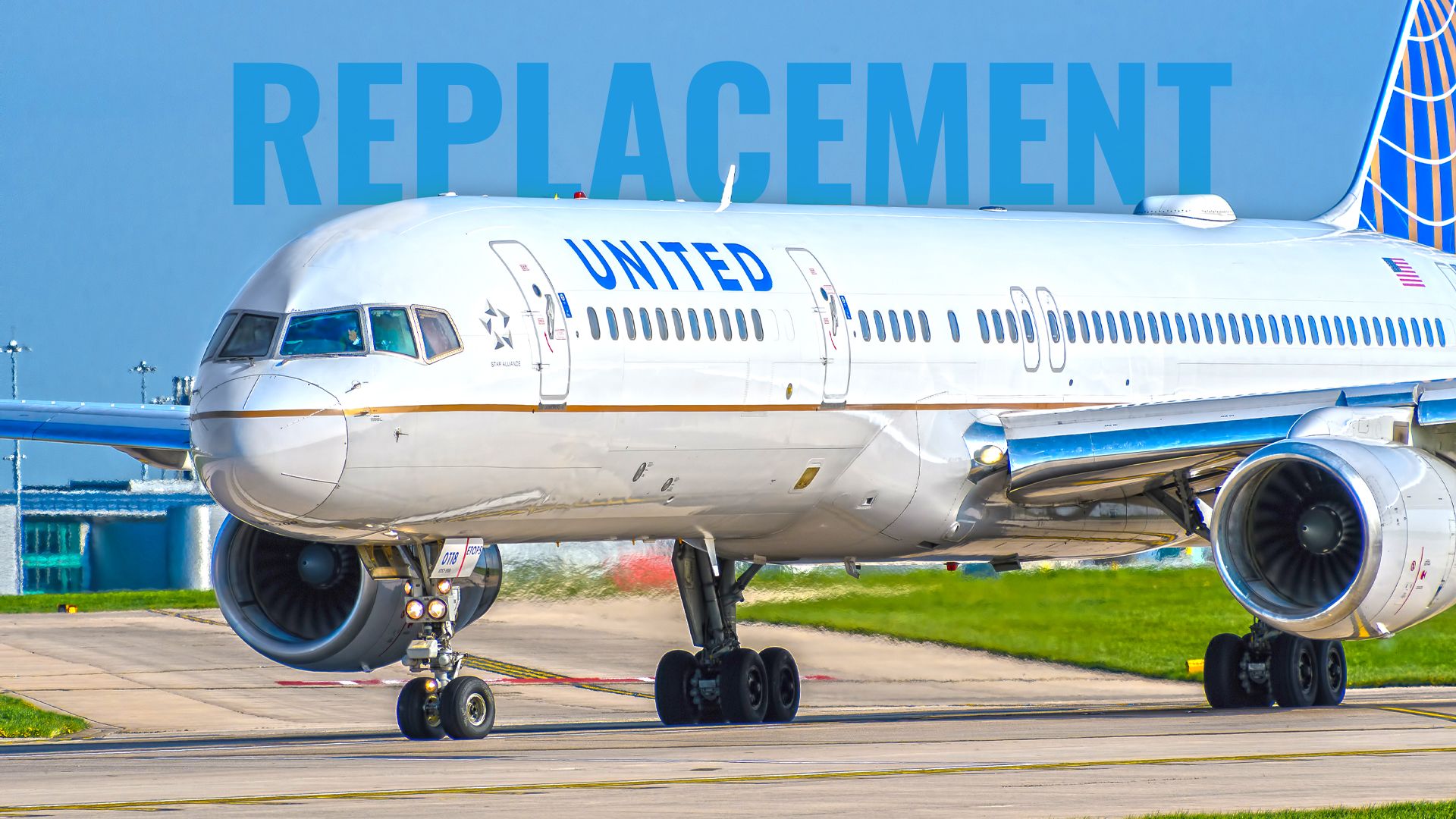
For more than three decades, the Boeing 757 has been  United Airlines‘ transatlantic workhorse, a narrowbody that could do what few others could: cross the ocean efficiently. From Newark to Edinburgh, Boston to Dublin, and Washington to Lisbon, the 757-200 carved out a unique niche, bridging the gap between domestic narrowbodies and widebody jets. But as fuel prices climbed, maintenance costs rose, and passengers demanded more comfort, United faced a pressing question that Boeing still hasn’t really provided an answer to: what could replace an aircraft that had no true successor from its original manufacturer?
Enter the Airbus A321XLR, the European-built long-range narrowbody that United now plans to use as the cornerstone of its next-generation transatlantic fleet. Ordered in late 2019, the A321XLR promises similar range to the 757 but with modern efficiency, cutting-edge comfort, and greater flexibility for “long and thin” routes, flights too long for typical narrowbodies but too small for widebodies. As the first deliveries approach later this decade, United’s decision marks both a symbolic and practical turning point in its transatlantic strategy.
The End Of An Era: Saying Goodbye To The 757

Few aircraft in aviation history have held the mystique of the Boeing 757. With its distinctive profile, tall landing gear, and powerful takeoff performance, the “flying pencil” became a favorite among pilots and spotters alike. It could climb like a rocket and reach European cities from the United States‘ East Coast that no other narrowbody of its era could touch. For decades, the 757 filled a unique niche, capable of crossing the Atlantic efficiently while remaining nimble enough for domestic operations. But time has caught up with United’s fleet. Many of the carrier’s 757s date back to the late 1990s, and their age now shows in higher maintenance costs, rising fuel burn, and cabin interiors that feel increasingly out of step with modern expectations for sustainability and comfort.
Beyond economics, passenger preferences have shifted dramatically. Today’s travelers expect seamless connectivity, spacious cabins, and a consistent product across the fleet. The 757 lacks premium economy seating, the latest inflight entertainment systems, and the quieter, mood-lit environment that’s now standard on next-generation jets. United’s strategy under CEO Scott Kirby revolves around delivering a unified premium experience, a goal that’s made much more complicated with aircraft designed in the 1980s.
The Airbus A321XLR offers an elegant and timely solution. It delivers nearly the same range and performance as the 757 but with 30% lower fuel burn per seat and a far more flexible cabin layout. For United, the move isn’t just about retiring an icon; it’s about resetting the economics of transatlantic flying, reducing emissions, and positioning the airline for the next two decades of efficient, passenger-friendly long-haul travel.
Why The A321XLR Fits United’s Needs Perfectly

The A321XLR is, in many ways, the aircraft the industry has been waiting for. It extends the proven Airbus A321neo platform with an extra fuel tank integrated into the fuselage, giving it a range of up to 4,700 nautical miles (8,704 km), enough to comfortably fly from New York to Berlin or from Boston to Rome. Its smaller size and lighter frame make it ideal for routes that can’t fill a widebody but demand better efficiency than the 757 can now deliver.
For United, this sweet spot aligns perfectly with its network goals. The airline’s planners see the XLR as a way to serve smaller European cities, places like Porto, Shannon, or Faro, that would otherwise be unreachable with traditional narrowbodies. It also allows flexibility during off-peak seasons: when demand dips, United can utilize an XLR in place of a larger aircraft without cutting a route entirely.
|
Parameter |
Value / Range (Airbus) |
|---|---|
|
Range |
4,700 nautical miles (8,700 km) |
|
Maximum Flight Time |
Up to 11 hours |
|
Maximum Seating (High Density) |
Up to 244 passengers |
|
Typical Two-Class Seating |
180–220 passengers |
|
Maximum Takeoff Weight (MTOW) |
101,000 kg (222,667 lbs) |
|
Fuel Tank / Additional Fuel Capacity |
Rear Center Tank (RCT) — 12,900 liters |
|
Emissions / Efficiency Improvement |
30% lower fuel burn / CO₂ per seat |
|
Noise Footprint Reduction |
50% less noise footprint |
|
Cruise / Max Speed |
Mach 0.82 |
The aircraft’s commonality with other A320-series jets also offers cost savings in training, maintenance, and operations, particularly valuable as United diversifies its fleet further to include more modern-era jets in the coming years. In short, the XLR gives United reach, efficiency, and consistency, three pillars of its long-haul strategy.
Inside United’s A321XLR: A New Standard In Comfort

United isn’t treating the A321XLR as a stopgap, it’s designing it as a showcase for its next-generation premium experience. The aircraft will debut a three-class cabin featuring United Polaris business class, Premium Plus, and an updated economy section, all redesigned for long-haul narrowbody comfort.
At the front, United will install lie-flat Polaris suites in a 1-1 layout, each with direct aisle access, sliding privacy doors, and upgraded inflight entertainment. Behind that, Premium Plus offers wider seats and extra recline for mid-tier travelers. Even in economy, passengers will benefit from larger overhead bins, ambient lighting, and quieter cabins, hallmarks of the A321neo family.
Altogether, the configuration will seat around 150 passengers, fewer than the 757’s typical 170–180, reflecting United’s intent to prioritize comfort and yield over sheer capacity. The A321XLR’s cabin will set a new standard for transatlantic narrowbody service, one that blends efficiency with an experience closer to a widebody.
Strategic Routes: Where The A321XLR Will Fly

While United hasn’t officially announced its first A321XLR routes, the airline has hinted at its ambitions. Senior vice president Patrick Quayle has said the aircraft will “take over virtually all of our 757 routes.” That includes many of the thinner transatlantic markets from Newark, Washington D.C., and Chicago, along with potential new European destinations beyond the main hubs.
Cities like Reykjavik, Tenerife, and Porto are strong contenders, destinations with growing demand but limited widebody economics. United may also deploy the XLR on select Latin American routes from Houston or on high-premium domestic services like Newark–Los Angeles during early phases of fleet introduction.
The strategy is actually quite simple on the surface. Use the A321XLR to sustain and expand connectivity where traditional aircraft are either too big or too small. It’s a continuation of what the 757 started, only smarter, quieter, and more profitable.
Timing, Delays, And The Path To Entry

When United placed its order for 50 A321XLRs in 2019, the plan was to begin flying them by 2024. However, certification delays have shifted the timeline. Airbus only received European approval in 2024, with FAA certification expected soon after, pushing United’s first delivery to early 2026.
In the meantime, United will continue operating its 757s, some of which have received cabin refurbishments to bridge the gap. While the delays are frustrating, United executives remain bullish, calling the XLR a “game-changer” once deliveries ramp up.
United Airlines’ current fleet as per Planespotters.net data.
|
Aircraft Type |
Current |
Avg. Age |
||
|---|---|---|---|---|
|
In Service |
Parked |
Total |
||
|
Airbus A319 |
75 |
4 |
79 |
23.9 Years |
|
Airbus A320 |
68 |
3 |
71 |
25.7 Years |
|
Airbus A321 |
49 |
49 |
0.9 Years |
|
|
Boeing 737 |
536 |
29 |
565 |
12.1 Years |
|
Boeing 757 |
54 |
7 |
61 |
26.8 Years |
|
Boeing 767 |
49 |
4 |
53 |
28.0 Years |
|
Boeing 777 |
87 |
9 |
96 |
22.2 Years |
|
Boeing 787 Dreamliner |
79 |
1 |
80 |
7.2 Years |
The longer timeline may actually benefit United operationally: it gives the carrier time to finalize cabin design, train crews, and integrate the aircraft gradually without disrupting its long-haul schedules. Once in service, United expects to deploy the type aggressively across both Atlantic and South American networks.
The 757’s Legacy And What Comes Next

The Boeing 757 may be nearing retirement, but its legacy will live on through the routes, networks, and operational flexibility it created over decades of service. For United, the aircraft was more than just a transatlantic tool; it was a bridge between continents, a symbol of ingenuity, and a workhorse that connected communities in ways few other jets could. Its replacement by the Airbus A321XLR marks the end of a chapter and the start of a new one, shaped by efficiency, comfort, sustainability, and the evolving demands of modern travelers.
As aviation moves toward smaller, long-range jets, United’s XLR strategy reflects a broader industry trend, “right-sizing” the sky. Instead of flying half-empty widebodies, airlines can now serve niche markets profitably, opening doors to destinations previously considered too small or too remote. This approach could fundamentally redefine global connectivity, giving passengers more options, more frequent service, and more direct routes, all while maintaining economic and environmental efficiency.
In that sense, the A321XLR isn’t just replacing the 757; it’s carrying forward its spirit, connecting distant cities in ways that keep air travel personal, practical, and profitable, while embracing the technological and operational innovations of the next generation.
source
