


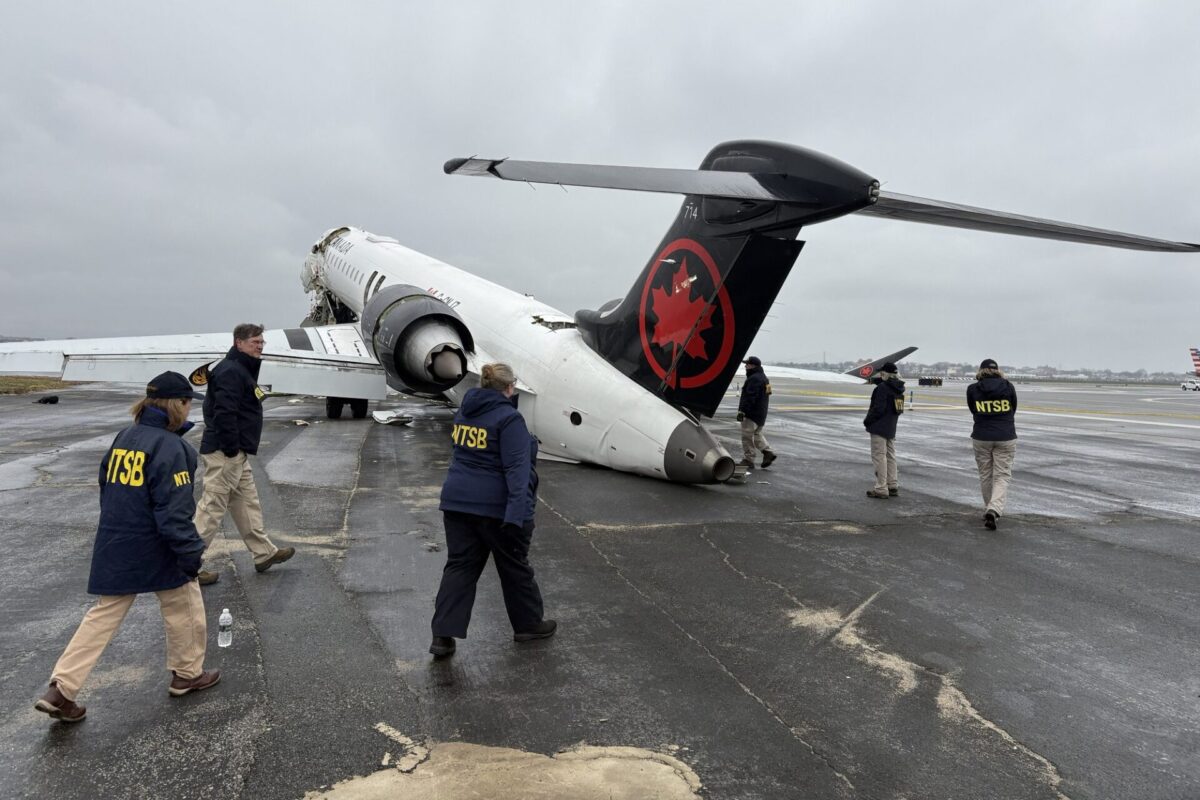
The National Transportation Safety Board (NTSB) has published a preliminary report into the fatal collision of a landing Air Canada Express and a fire truck at New York’s LaGuardia Airport (LGA).
The two pilots lost their lives during the incident on March 22, 2026. Despite the destruction of all those onboard, the fire truck survived.
While the preliminary report describes the early findings of the NTSB investigators, it is only publication of the final report that will fully conclude the investigation.
According to the NTSB, during the evening of the crash, a total of six Aircraft Rescue and Firefighting (ARFF) vehicles were responding to an emergency on another aircraft near terminal 3.
A few minutes after the emergency was declared, the Air Canada Express CRJ900, operated by Jazz Aviation, was cleared to land on runway 4 while around five miles from the airport.
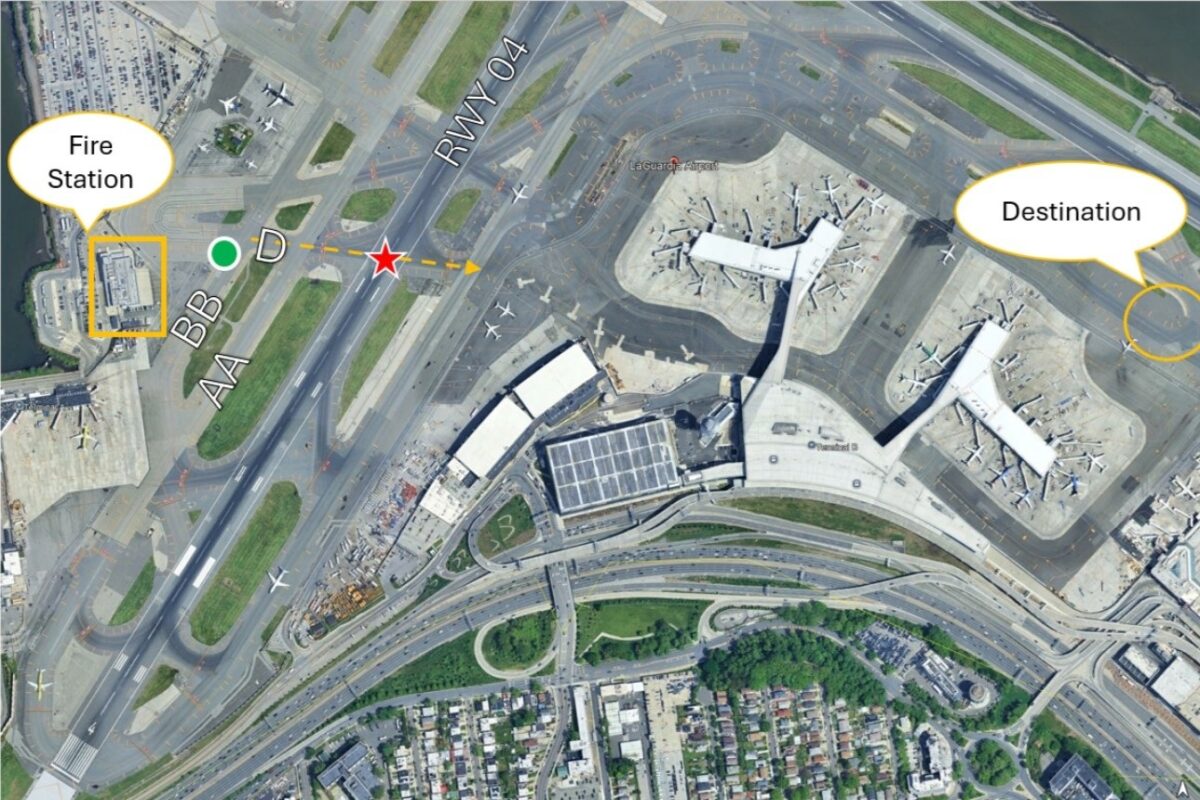
After leaving the station, the convoy of emergency vehicles waited to cross runway 4 at taxiway D.
At 23:36, the airport tower instructed the convoy to cross. Around the same time, the Air Canada Express flight was at an altitude of about 130 ft above ground and about ¼ mile away on final approach.
The fire truck involved in the collision, named Truck 1 by the NTSB, was leading the convoy as someone onboard read back the clearance and began moving ahead.
As the lead fire truck was crossing a second taxiway, the controller, who had been giving taxiing instructions to another aircraft, told the lead truck to stop.
As there was no response, the controller gave the instructions again. At this point, the Air Canada Express aircraft brake application began and the thrust reversers were deployed.
At 23:37:21, the red runway entrance lights (RELs) extinguished. At 23:37:22, roughly two seconds before the collision, the plane’s nose landing gear touched down.
The lead fire service vehicle began entering runway 4, and as it turned left, it was impacted by the aircraft traveling at 104mph.
NTSB investigator’s insights
During interviews conducted with some of the firefighters, a driver of another vehicle in the convoy claimed to have reported hearing a controller clearing the front vehicle and company to cross runway 4. Shortly thereafter, she saw the airplane and announced “stop stop” on the radio.
The turret operator in the impacted truck recalled hearing the words “stop stop stop” on the tower frequency radio, but he did not understand who that transmission was intended for.
He then heard “Truck 1 stop stop stop” and realized it was for them, subsequently noticing that they had already entered onto the runway.
My son is at LGA right now. Here’s the view. It’s sad what happened. I can’t believe it happened. So happy to hear the flight attendant who was ejected from the plane survived. pic.twitter.com/2KY0wwxweb
— @Heather_Poole (@Heather_Poole) March 23, 2026
The aircraft’s Cockpit Voice Recorder (CVR) captured the communications between the lead truck and the controller, including the request and clearance to cross runway 4.
The NTSB noted that there were two controllers on duty in the tower at the time of the accident, “consistent with the mid-shift basic watch schedule”. One controller had 18 years of experience, the other 19 years.
Airport detection equipment
The airport was equipped with an Airport Surface Detection Equipment, Model X (ASDE-X), used by the controllers to track surface movement of aircraft and ground vehicles.
It brings data from a range of monitoring devices together into a display in the control tower, allowing controllers to see the real-time positions of aircraft and vehicles on the airport surface.
“ASDE-X provides visual and aural alerts when it detects potential runway incursions or conflicts, giving controllers the ability to intervene before an accident occurs,” the NTSB report said.
According to the preliminary report, the system did not generate an aural or visual alert on the displays to warn of any potential crash.
The NTSB said that the convoy of vehicles, none of which had transponders, were intermittently detected as radar targets, while holding on taxiway D.
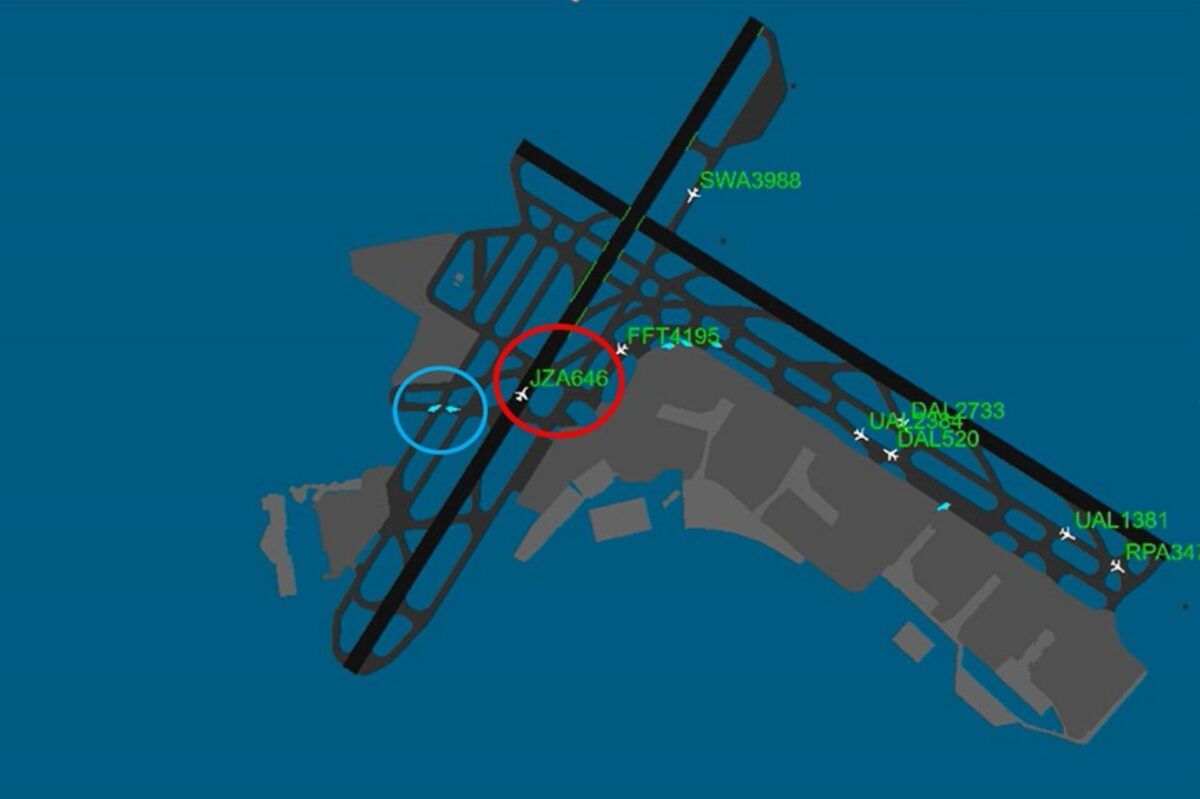
“Due to their close (and varying) proximity to each other, and the intermittent merging and unmerging of radar targets, the ASDE-X system was unable to establish high-confidence tracks. At the time of the accident, ASDE-X displayed only two radar targets on taxiway D (near taxiway BB), rather than all seven of the response vehicles as distinct targets at their respective locations,” the NTSB clarified.
The report added: “Without transponder-equipped vehicles, the ASDE-X system could not uniquely identify each of the seven responding vehicles or reliably determine their positions, or tracks. As a result, the system was unable to correlate the track of the airplane with the track of Truck 1 (or any of the other vehicles in the group) and did not predict a potential conflict with the landing airplane.”
Red runway entrance lights
Additionally, the NTSB highlighted that the RELs at the airport light up when a plane is approaching a runway for landing, in order to prevent dangerous crossings.
After a plane touches down, the RELs turn off at each taxiway sequentially as the aircraft progresses down the runway. The system is designed to turn the lights off about two to three seconds before the plane reaches each intersection.
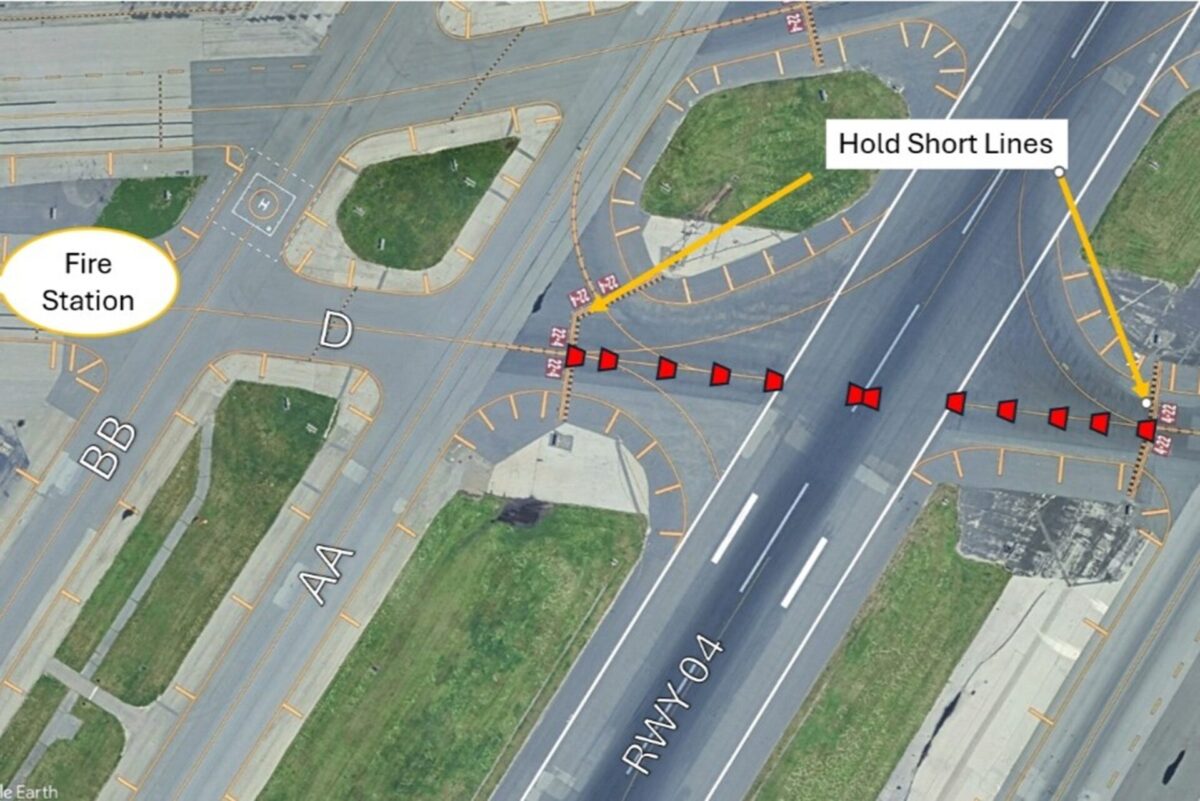
“The RELs on taxiway D remained illuminated until about the time Truck 1 reached the (near) edge of the runway, when they extinguished, about 3 seconds prior to the collision,” the NTSB report said.
source
