

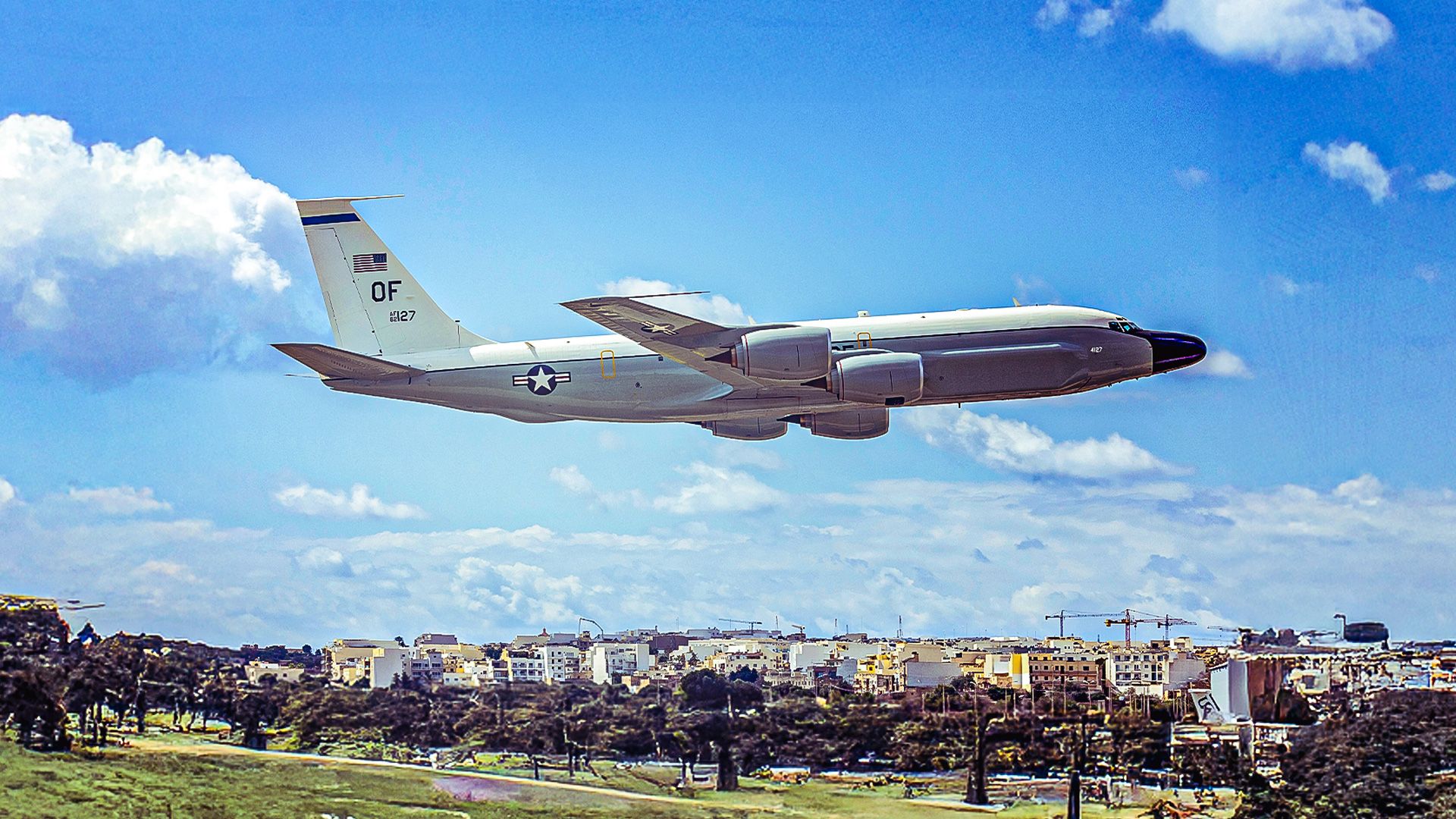
The Boeing TC-135W is a flying legend that quietly carries the DNA of Cold War innovation into the present day, often hiding in plain sight among the US Air Force’s storied fleet. With its distinct four-engine profile and unmistakable Rivet Joint silhouette, this rare training and test derivative of the C-135/RC-135 reconnaissance family continues to train and test missions long after its contemporaries have retired. At the 2025 Malta International Airshow, I had the rare opportunity to step inside one of only two surviving TC-135Ws, serial 62-4127, gleaming under the Mediterranean sun at Luqa Airport , a living link to six decades of US aerial intelligence history. While most spectators crowded around the fast jets, helicopters and aerobatic teams, I was drawn to this quiet, unassuming Boeing parked near the static display line.
To the untrained eye, its white-and-gray livery and four-engine silhouette might suggest an aging transport plane, but its hog-nose radome and dummy cheek fairings reveal its true identity: a rare training variant of the C-135/RC-135 family , dedicated to preparing reconnaissance crews for the high-stakes world of aerial espionage. Stepping inside its stripped fuselage felt like entering a time capsule, blending past and present in a machine that trains tomorrow’s spies. This article explores the TC-135W’s origins, the storied paths of its two airframes, their technical evolution, and why these understated jets remain indispensable to the USAF and its allies.
From Stratolifter To Spy Trainer: The TC-135W’s Origins

The TC-135W filled a quieter but essential role: training the next generation of reconnaissance and electronic warfare crews without risking classified assets. The TC‑135 is part of the enormous C‑135 Stratolifter lineage, a family that has served the US Air Force for more than six decades. Born from the same basic design as the Boeing 707, the C‑135 became the foundation for dozens of specialized variants , like the RC-135V/W Rivet Joint for signals intelligence (SIGINT), the WC-135 Constant Phoenix for nuclear sampling, and the KC-135 Stratotanker for refueling.
The idea of a dedicated reconnaissance trainer solidified in the mid-1980s, following a major loss within the RC-135 fleet. On February 25, 1985, the air crash of RC-135T Rivet Dandy (55-3121) near Valdez, Alaska, claimed the lives of six crew members and left the Air Force without a safe, purpose-built platform for Rivet Joint and Cobra Ball training.
The Air Force responded swiftly: by July that same year, the 6th Strategic Aerospace Wing at Eielson AFB, Alaska, received a TC-135S, marking the debut of a dedicated trainer for the Cobra Ball crews, specialized in ballistic missile tracking.
Flying Classrooms

The TC-135W program, introduced in the early 1990s, carried this concept forward. Two former C-135B airframes, 62-4127 and 62-4129, and one ex-VC-135B (62-4133) were converted into “flying classrooms” and assigned to the 38th Reconnaissance Squadron at Offutt AFB, Nebraska. These aircraft became indispensable to the training pipeline, allowing crews to rehearse complex electronic reconnaissance missions without tying up operational RC-135V/W Rivet Joint assets.
Raytheon E-Systems in Greenville, Texas , transformed these aircraft into TC-135Ws. Operational sensors were removed, replaced with modular training suites that simulate SIGINT, electronic intelligence (ELINT), and communications intelligence (COMINT) missions. Dummy cheek fairings and hog-nose radomes were added to mimic the RC-135W’s aerodynamics, ensuring realistic flight dynamics for trainees.
From take-off procedures to simulated intelligence-gathering missions, every sortie in a TC-135W reproduces the rhythm and coordination of operational missions. For over half a century, these jets have served as the platforms on which Rivet Joint and Cobra Ball crews first learned their craft.These aircraft were once the living simulators that prepared generations of reconnaissance crews for electronic warfare, signals analysis, and airborne systems management. While RC‑135 crews gathered intelligence across the globe, the TC‑135s stayed closer to home, honing the skills of operators before they ever flew a real mission.
Operational History: Across Six Decades Of Service

There were once four TC-135Ws in total, but only two remain active in 2025, both assigned to the 55th Wing at Offutt Air Force Base, Nebraska. The surviving aircraft, 62-4127 and 62-4129, collectively logged ~50,300 flight hours, a solid reminder of their enduring value across six decades. Each airframe has a distinct service record, yet both share a common thread of versatility, evolving from transports to VIP jets, reconnaissance support platforms, and finally trainers.
-
62-4127: Delivered April 20, 1962 (c/n 18467), it began as a C-135B with the 1611th Air Transport Wing at McGuire AFB, New Jersey, for cargo and troop transport. In 1967, it was converted to a VC-135B under the “Rivet King” program, assigned to the 89th Military Airlift Wing at
Andrews Air Force Base
, Maryland, for VIP transport, supporting Pentagon and diplomatic missions across the Pacific and Europe. By 1977, it reverted to C-135B status, then briefly served as an EC-135B for reconnaissance logistics. Converted to TC-135W from 1985 by Raytheon E-Systems, it joined the 38th Reconnaissance Squadron (RS) at Offutt AFB in 2005. Re-engined with
CFM56
/F108 turbofans by 2010, it has flown ~25,500 hours, with deployments including NATO exercises at RAF Waddington, UK, and static displays at the Malta Airshow 2023 and 2025. - 62-4129: Delivered May 1962 (c/n 18469), it followed a similar path, starting as a C-135B and later serving as a VC-135B before the EC-135B designation. Converted to TC-135W in 2006, it joined the 38th RS and received F108 engines alongside 62-4127. It has logged ~24,800 hours, with key operations in Pacific exercises and European training sorties. Its reliability made it a staple for long-duration SIGINT simulations.
These aircraft fly 200–300 hours annually, using modular consoles to replicate RC-135V/W missions without classified gear. Their training sorties span theaters from the Indo-Pacific to Europe, preparing crews for real-world intelligence operations.
For example, joint exercises with the RAF’s 51 Squadron at Waddington train Airseeker crews (the UK’s RC-135W equivalent), ensuring NATO interoperability for SIGINT missions in contested regions like Eastern Europe. The TC-135Ws’ ability to simulate 10–12-hour sorties mirrors the endurance required for operational missions, making them critical to crew readiness.
My Experience Inside 62-4127 At Malta International Airshow 2025

Stepping inside the TC-135W 62-4127 at the 2025 Malta International Airshow was a surreal experience that brought its storied history to life. Held on September 27–28 at Luqa Airport, the airshow featured 62-4127 as a static display, parked alongside flashier jets like Tornado and Eurofighters. I entered the plane through the left cargo door, and while I was climbing the ladder I expected to find a cockpit full of analog indicators and gauges, rows of consoles and racks of training gear, as if the aircraft were a flying classroom.
Instead, the interior told a different story. In the cockpit, most of the analog dials of the early Stratolifter era have been supplemented by modern avionics displays, navigation systems, and updated communication panels: 62-4127 was, in fact, the first to receive Baseline-Charlie glass cockpit modification in 2019. To my surprise, the flight deck lacked workstations, test consoles, and racks of mission equipment.
The interior was starkly empty, a hollow aluminum tube with dangling cable runs, with red net seats running all over both sides of the fuselage. A crew member explained this was deliberate: the modular stations had been removed for the airshow to reduce weight for the transatlantic flight and allow public access without exposing sensitive sim tech.
The emptiness amplified the aircraft’s mystique, like exploring a retired spy’s office stripped of secrets. The crew pointed out the nose radome’s mounting points for dummy telemetry antennas and the cheek fairings’ hollow shells, designed to mimic RC-135V/W aerodynamics. This airframe’s ability to bridge past and present left me in awe, a tangible link to the Cold War’s espionage legacy. For me, this unassuming Boeing stole the show, especially during the departures, the day after the show, when it departed with a very short takeoff run.
Technical Evolution: From TF33 To F108 Engines

The TC-135W’s technical evolution mirrors the broader C-135 family’s knack for reinvention, keeping 62-4127 relevant through upgrades like re-engining and modern avionics. Its transformation from a 1960s transport to a 21st-century trainer is a masterclass in military aviation longevity.
The most significant upgrade came around 2010, when 62-4127 swapped its Pratt & Whitney TF33 turbofans for CFM56/F108 engines. These high-bypass turbofans deliver 22,000 lbf of thrust each, 30% better fuel efficiency, and a quieter profile, extending range to over 4,000 nautical miles and cutting maintenance by 20%. In 2019, the Baseline Charlie upgrade introduced a glass cockpit with multi-function displays, replacing analog gauges to mirror the RC-135V/W’s setup. This allowed trainees to practice on interfaces identical to operational aircraft, enhancing realism for SIGINT/COMINT scenarios.
|
Specification / Feature |
Pratt & Whitney TF33-P-5 |
CFM International F108-CF-100 (CFM56-2A) |
Details / Notes |
|---|---|---|---|
|
Type |
Low-bypass turbofan |
High-bypass turbofan |
The F108 introduced a much more efficient high-bypass design, significantly improving fuel economy and reducing cabin and external noise. |
|
Thrust (each) |
Approximately 18,000 pounds-force (80.1 kiloNewtons) |
Approximately 22,000 pounds-force (97.9 kiloNewtons) |
The F108 provides about 20 percent more thrust, improving take-off performance and climb rate. |
|
Bypass Ratio |
Around 1.0 to 1 |
Around 6.0 to 1 |
A major leap in efficiency. The F108’s high bypass ratio drastically reduces fuel burn and acoustic footprint. |
|
Specific Fuel Consumption |
Approximately 0.85 pounds per pound-force per hour |
Approximately 0.65 pounds per pound-force per hour |
The F108’s SFC is ~23–25% lower, extending range and endurance, particularly in cruise conditions. |
|
Noise Level (Take-off) |
Around 130 decibels |
Around 117 decibels |
The F108 meets modern ICAO Stage 3 noise standards, allowing greater flexibility at civilian airports. |
|
Year Introduced |
Early 1960s |
Early 1980s |
The F108 began replacing the TF33 in the KC-135 and RC/TC-135 fleets during the 1980s. |
|
Compressor Configuration |
Two low-pressure plus fourteen high-pressure stages |
One fan, three low-pressure, and nine high-pressure stages |
The simplified fan-based design improves airflow and efficiency while easing maintenance. |
|
Turbine Configuration |
One high-pressure plus three low-pressure stages |
One high-pressure plus four low-pressure stages |
Advanced materials and a more efficient turbine layout improve reliability and thrust stability. |
|
Length |
146 inches (3.71 meters) |
98 inches (2.49 meters) |
The F108 is shorter but uses a wider fan to produce more thrust at lower noise levels. |
|
Diameter |
53 inches (1.35 meters) |
61 inches (1.55 meters) |
The wider diameter fan design is key to the F108’s high-bypass efficiency. |
|
Dry Weight |
Around 4,300 pounds (1,950 kilograms) |
Around 5,600 pounds (2,540 kilograms) |
The F108 is heavier, but its improved efficiency offsets the added mass. |
|
Maintenance Interval |
Shorter overhaul cycles |
Longer on-wing lifespan |
The F108 can remain on-wing more than twice as long before overhaul, reducing costs. |
|
Primary Operational Use |
Early KC-135A and EC-135 aircraft |
KC-135R, RC-135, TC-135, and E-6B Mercury |
The F108 now powers nearly every active USAF C-135 variant. |
These upgrades aligned 62-4127 with modern Rivet Joint standards, ensuring crews could train for real-world threats, such as intercepting encrypted communications. This technical resilience keeps it flying when peers like the KC-135E have long retired.
Why Is The TC-135W Still Flying?

Why does a 63-year-old airframe like the TC-135W remain in service when ground-based simulators exist? Its unique ability to replicate real flight conditions for both USAF and RAF crews makes it indispensable. The UK, the only other operator of RC-135-derived aircraft via its three RC-135W Airseekers, relies on TC-135Ws for joint training, as noted in a 2023 Offutt AFB report detailing visits to the RAF’s 51 Squadron at Waddington.
The TC-135W’s modular design allows rapid reconfiguration, with consoles removed for maintenance or displays like Malta 2025, keeping costs low; operational Rivet Joints cost $5M–$10M annually to maintain. Its F108 engines and durable airframe enable 10–12-hour sorties mimicking real missions. For the RAF , joint exercises at RAF Waddington train Airseeker crews alongside USAF operators, ensuring NATO interoperability for SIGINT missions in contested regions like Eastern Europe.
The TC-135W’s niche is its ability to train crews in real-world conditions: turbulence, long sorties, and live navigation, something simulators can’t fully replicate. As long as RC-135s fly, the TC-135W will likely endure, complemented by the simulators.
The Future Of The TC-135W

Looking ahead, the TC-135W’s role in the USAF’s reconnaissance ecosystem remains secure, even as newer technologies emerge. Its future hinges on balancing legacy airframe costs with the unique value it brings to crew readiness. For 62-4127, the path forward involves continued upgrades and global deployments.
The USAF plans to keep the TC-135Ws active through at least 2030, with potential avionics refreshes to match RC-135 Block 45 upgrades. These could include AI-driven SIGINT sims, enhancing training for cyber threats. At Malta, a 55th Wing officer hinted at discussions to integrate virtual reality consoles, reducing physical hardware weight, a concept tested on 62-4127 in 2024. With only three trainers left, their rarity makes each flight a precious asset.
The TC-135W’s legacy is its adaptability, from Cold War VIP jet to modern trainer. As the USAF eyes next-gen platforms, 62-4127’s story proves that old airframes, when cleverly repurposed, can outlast flashier rivals, keeping the skies a classroom for intelligence excellence.
source
