


Anduril will provide the U.S. Army with a minimum of 3,000 Surface-Launched Barracuda-500M, starting in 2027 with the first 1,000 along with the associated containerized launch systems.
Anduril announced on May 13, 2026, that it signed a framework agreement with the U.S. Department of War to deliver a minimum of 3,000 Surface-Launched Barracuda-500M (SLB-500M) autonomous air vehicles to the U.S. Army. Meeting the DoW’s current need for affordable, simple, mass-producible, and modular weapons, the SLB-500M is a “cruise missile solution to the long-range precision fires and stand-off strike problem,” for the Army’s Program Acquisition Executive FIRES (PAE FIRES), says the company.
While the contract value is not known, Anduril said the framework agreement with the Undersecretary of War for Research and Engineering (OSWR&E) involves a minimum of 1,000 all-up round units per year, with the first tranche expected to be delivered by mid-2027. Anduril will also deliver 60 of the SLB-500M’s associated containerized launch systems in 2027.
PAE FIRES is acquiring the missiles for the Army’s Ground-Launched Low-Cost Containerized Munition program. The SLB-500M can also be optionally integrated with Anduril’s in-house flight autonomy software, Lattice, for enhanced “survivability and effectiveness against large target sets in contested environments,” further adds the company.
Anduril has signed a production agreement with @DeptofWar to rapidly deliver Surface-Launched Barracuda-500M at scale.
Affordable missiles designed for long-range precision strikes.
We will deliver a minimum of 1,000 rounds per year for three years, with the first rounds… https://t.co/j9nlNOE1XR pic.twitter.com/G2Lj6GiemS
— Anduril Industries (@anduriltech) May 13, 2026
Anduril had first unveiled the Barracuda family of weapons in September 2024, with the Barracuda-500M being tested a few times since then. The Barracuda-500M is also one of the contenders for the Air Force’s Enterprise Test Vehicle (ETV) program, for which Anduril announced on Mar. 4, 2025, its selection by the Air Force’s Armament Directorate and Defense Innovation Unit (DIU) to move to the effort’s next phase.
Anduril says the production-friendliness to meet the DoW’s mass-producibility is achieved by manufacturing the Barracuda, and all its other weapons, with commercially, readily available, non-exquisite spares, components, electronics, while the design and materials ensure the weapons are not over-engineered. This enables what the company calls “hyper-scale” production at its nearly $1 billion Arsenal-1 factory in Columbus, Ohio, that can “meet additional surges in demand.”
SLB-500M
According to Anduril, the “highly capable and affordable” SLB-500M “enables high-volume, coordinated, long range strikes,” with the 100 pound munition payload and 500+ nautical miles range “effective against a wide range of land and maritime targets.”
Dziś oficjalnie. Tak, to tylko porozumienie jakich PGZ podpisała już dziesiątki, ale może tym razem przyniesie konkretne rezultaty.
▶️https://t.co/sPTsvOOKGa@PGZ_pl i 🇺🇸 firma @anduriltech podpisały porozumienie o współpracy w zakresie wspólnego opracowywania i produkcji… pic.twitter.com/Yin1A0qqKY— Tomasz Dmitruk (@goltarr) October 27, 2025
The weapon does not require “additional infrastructure to support large-scale fielding,” since it can be fired from a “standard 20-foot ISO container,” that can be loaded with up to 16 all-up round units. An operator can choose Lattice or other existing software, select targets and pick and fire the “right combination” of SLB-500M munitions.
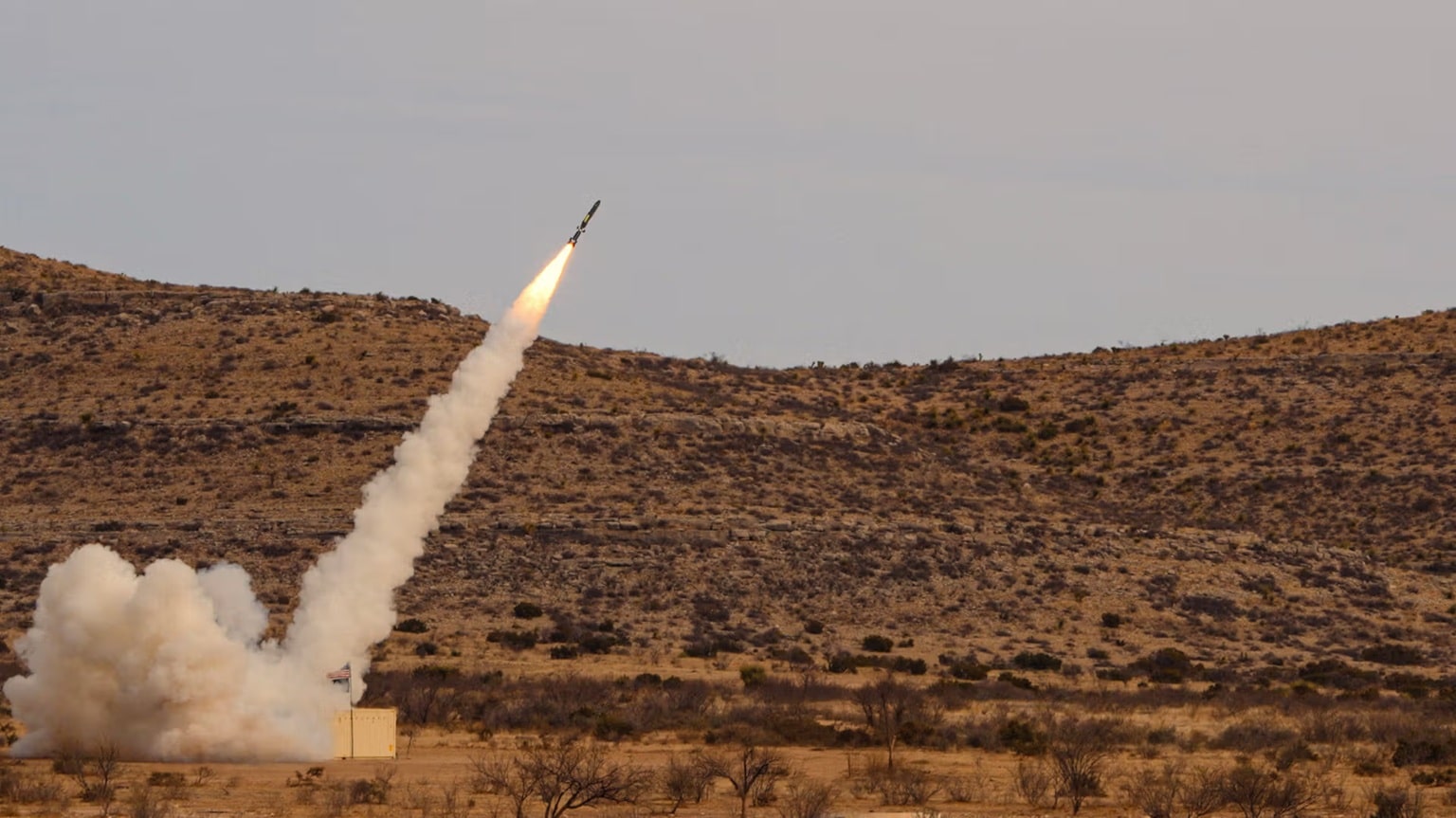
A video released by Anduril also showed the SLB-500M being launched both vertically and diagonally from the ground. The containerized launch shows a Solid Rocket Motor (SRM) booster falling off, with the main air-breathing jet engine taking over and the top-mounted wings later deploying in the cruise phase.
Barracuda family of scalable cruise missiles and AAVs
The other two missiles in the Barracuda family are the Barracuda-100 and Barracuda-250, with their respective ‘M’ variants denoting kinetic effects. A similar approach is also seen with the Copperhead series of Autonomous Underwater Vehicles, with the vehicles without the ‘M’ designation being sensing and/or ISR platforms.
Anduril describes Barracuda-250 as a low-cost AAV that can be flexibly employed from diverse air, ground, or maritime platforms, including the internal weapons bays of fifth-generation fighter aircraft.
🇺🇸 Anduril (@anduriltech) announced a production agreement for Surface-Launched Barracuda-500M with U.S. Department of War (@DeptofWar).
“Under the agreement, Anduril will scale production to deliver a minimum of 1,000 all-up rounds per year, with the first tranche of… pic.twitter.com/V4fNSYiK7c
— Counter Unmanned Systems (@CUAS_NEWS) May 13, 2026
Anduril’s product information page lists the Barracuda-500M’s range under 500 nautical miles (926 km), with a speed between 190 and 500 knots (350-926 km/h). The speed would also depend upon the type and weight of its warhead, and other payload.
Likewise, the smaller Barracuda-100 and the Barracuda-100M have a 120 NM (222 km) range. Platforms that can be expected to operate the Barracuda are the F-35 and frontline bombers in their internal weapons bays, or lugged externally by F-15s, F-16s and F/A-18 Super Hornets.
The weapons can be adopted for palletized launches from C-130 and C-17 cargo aircraft, if the Air Force decides to have a larger variety of mass-producible and technically simple cruise missiles to throw mass in a fight, apart from the FAMM/ERAM class of weapons.
In a September 2024 test of the Barracuda-500M overseen by the DIU, the missile was launched vertically from a ground-based cell “to emulate palletized employment from air-lift aircraft.” The missile performed “autonomous navigation and flight for over 30 minutes, successful capture of a GPS coordinate target identified in Lattice, and autonomous terminal guidance to the target.”
Barracuda-500, a low cost cruise missile, is the big brother of the Barracuda family.
An air & ground launched cruise missile developed by 🇺🇸#US manufacturer Anduril Costing <$200,000 with a range of up to 925km, a speed of Mach 0.75, and a 45kg warhead⬇️ https://t.co/NVnh25S1CE pic.twitter.com/clg6aiNdx1
— 🇺🇸 🇺🇸 🇺🇸Midobecker 🇺🇸 🇺🇸 🇺🇸 (@midobecker_1) October 13, 2025
Scalability
Anduril has long distinguished itself from legacy defense companies by injecting scalability and logistical simplicity in the Barracuda family, the Copperhead maritime weapons and the YFQ-44A Fury Collaborative Combat Aircraft (CCA). It achieves this by selecting readily available, proven components, electronics, assemblies, simple designs and reconfigurable factory and assembly lines with the requisite machinery to dynamically respond to production needs.
The Barracuda also represents the trend of blurring difference between long-range One-Way Attack (OWA) drones and cruise missiles for standoff strikes, meant to be thrown at enemy targets while being simultaneously mass-produced. Anduril has also described the Barracudas as a family of air-breathing cruise missiles, which are modular open-systems architecture (MOSA)-enabled and software defined for rapid upgrades.
@anduriltech Unveils Barracuda-M Family of Cruise Missiles
The Barracuda family of AAVs consists of Barracuda-100, Barracuda-250, and Barracuda-500. Each increment offers increasing size, range and payload capacity, but all Barracudas are compatible with a host of payloads and… pic.twitter.com/NW1RvpUI6W
— Global Defense Insight (@Defense_Talks) September 12, 2024
In the latest press release, Anduril said that “existing solutions are too expensive, too exquisite, and too hard to produce at scale.” The Barracuda weapons are also supported by simple tooling and manufacturing machinery.
When it first unveiled the weapons in September 2024, Anduril said that “the Barracuda family of AAVs only requires ten or less tools to assemble. Barracuda can be produced by the broad commercial automotive and consumer electronics workforce, rather than […] the much smaller, over-stretched, highly-specialized, defense-specific manufacturing labor pool.”
In its latest release, Anduril said that the entire Barracuda family, including the SLB-500, have 70% of their components openly available, while “the remaining 30% are de-risked by competing open-architecture designs among multiple vendors.” This makes the SLB-500M resistant to supply chain disruptions.
