

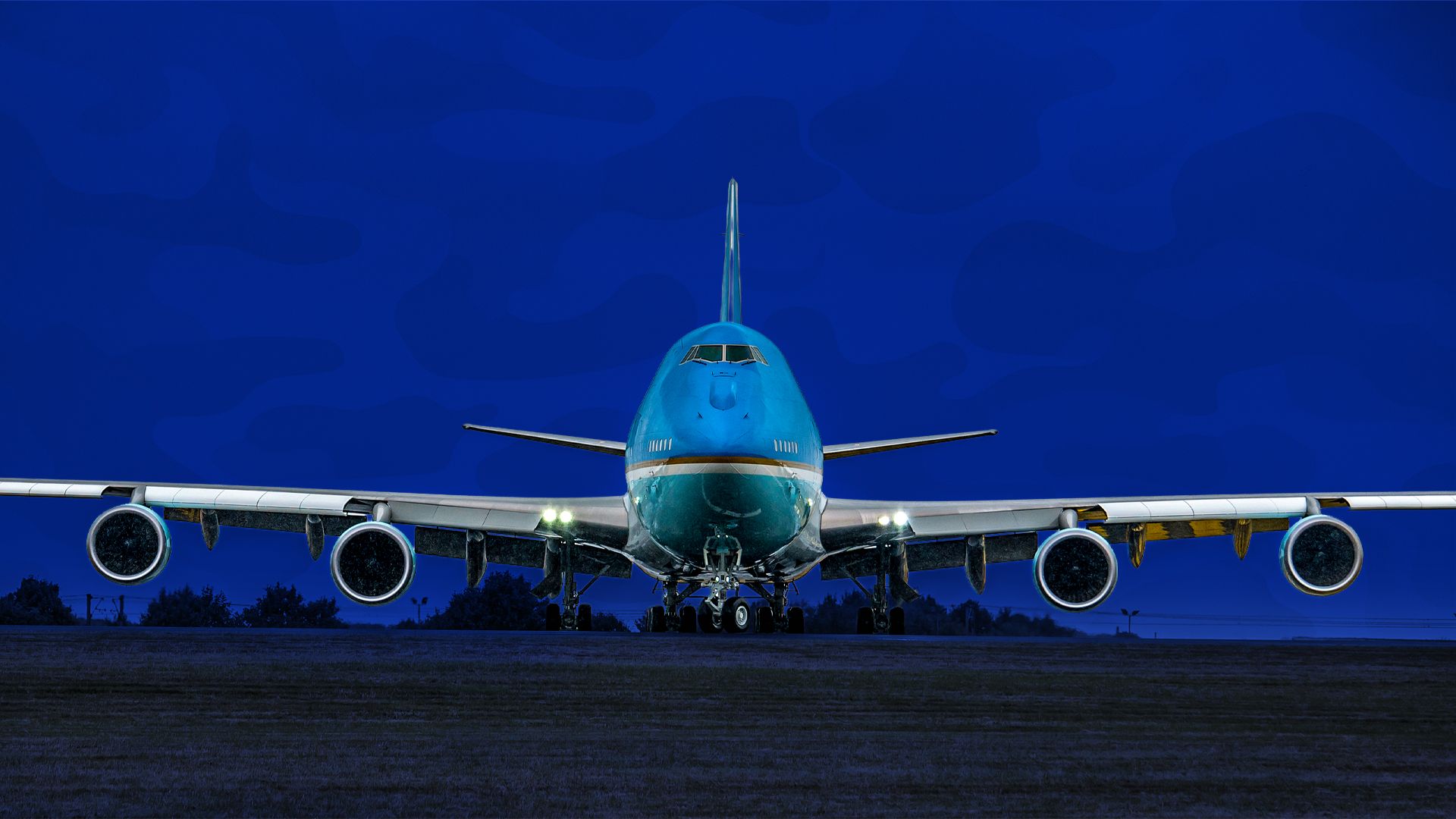
The United States military typically flies a mix of specially designed aircraft and models derived from civilian aircraft. You have, for instance, the Boeing P-8 Poseidon, a naval reconnaissance aircraft derived from the Boeing 737-800 airliner, and then the Boeing C-17, a freighter aircraft that was a clean-sheet design. Naturally, the VIP transport aircraft used by the United States Air Force are based on Boeing airliners, such as the C-40 (based on the 737-700), the C-32 (based on the 757-200), and, of course, the famous VC-25 (based on the 747).
These are all prior-generation aircraft that are no longer in production (although the 737 is still produced as the 737 MAX). The 747, however, is a unique case. Despite the aircraft no longer being in production, the USAF will be acquiring second-hand 747-8s to be converted for its purposes. The 747 went out of production due to its inefficiency and impractical size, yet the USAF went out of its way to purchase second-hand examples while new 747s are no longer available. Why is the United States Air Force doing this?
The Boeing 747 In The USAF Arsenal

While the size of the 747 lent itself to some radical concepts and experiments for military aircraft (such as the YAL-1 airborne laser or an airborne aircraft carrier), the United States Air Force currently only operates six Boeing 747s, making it one of its smallest fleets. All six aircraft are based on the Boeing 747-200B, split into two types of aircraft: two Boeing VC-25A VIP transports and four Boeing E-4B Nightwatch airborne strategic command centers.
The Boeing VC-25A is Air Force One. Air Force One is the callsign used for any USAF aircraft carrying the United States president, but the VC-25As are the aircraft most commonly used as Air Force One, and as such are essentially synonymous with the callsign. They feature extensive defensive capabilities, including aerial refueling, wire shielding, and missile protection. While the two VC-25As are old, they are perhaps the safest and most protected aircraft in the entire world.
The Boeing E-4B is also sometimes referred to as the “Doomsday” aircraft, or as Air Force One when it matters. Whenever the president travels, one of these follows along as it serves as a mobile command center and Oval Office for the US president. It features even more advanced communication and defensive capabilities, along with a far less luxurious interior. They’re used by the same person, but the VC-25A is intended for the US president, whereas the E-4 is intended for the Commander in Chief.
More Boeing 747s To Replace The VC-25A

The Boeing 747-200B is an ancient aircraft by industry standards, and not only are the two VC-25As over 35 years old, but parts for the increasingly unreliable planes are difficult to source today. In 2015, after years of evaluation, the United States Air Force selected the Boeing 747-8 as the replacement for the VC-25A, dubbed the VC-25B. There are two Boeing 747-8s currently undergoing retrofits as one-for-one replacements, with a tentative first delivery scheduled for 2027.
Unlike the VC-25As, the VC-25Bs are conversions of pre-built 747-8 “white tails” which were originally ordered by Russian carrier Transaero. The 747 line was still active when the VC-25Bs were ordered, but the procurement of white tails was intended as a cost-saving measure compared to ordering new aircraft. However, this decision may have backfired on the USAF, as Boeing has had well-documented issues with removing the aircraft’s existing wiring and installing new wiring, resulting in extensive delays.
In addition to the wiring, Boeing has suffered from labor shortages and quality control issues. The delays on the VC-25B program have led the Trump Administration to acquire another Boeing 747-8, formerly owned by Qatar, to serve as interim transport. While the Qatari 747 has been controversial politically due to the costs and manner in which it was acquired, there is merit in using a third aircraft to supplement the aging VC-25A fleet until the VC-25Bs are ready.

Why Is Boeing’s Delayed 747-8 Air Force One Program $2 Billion Over Budget?
It will be more costly than expected due to a time-consuming modification process, supply disruptions, and other challenges.
The Replacement For The Boeing E-4

The SNC E-4C Survivable Operations Center is the replacement for the Boeing E-4B fleet. The E-4s entered service in the 1970s as the E-4A, and were later converted to E-4B standards, along with one aircraft delivered as an E-4B. The contract was awarded to Sierra Nevada Corporation in 2024, and shortly afterwards, the company announced that it had purchased five Boeing 747-8s for the program, one more than the number of E-4Bs in service.
As production of the 747 had already ended, SNC purchased five retired 747-8s from Korean Air. These planes are currently in the early stages of being retrofitted for the mission, and flight testing began earlier in 2025. These planes are not expected to enter service until at least 2032. While most of the program’s details are classified, it is known that these planes will feature aerial refueling (present on the VC-25A, but omitted on the VC-25B, hardening against electromagnetic pulses (EMPs) and nuclear effects, along with nuclear command capabilities.
The SNC E-4C will be one of the most secure and advanced aircraft to have ever been released. It’ll feature new communications capabilities as well as the same defensive technologies that are seen on the current fleet. With four engines, the E-4C will have redundancy in case of a technical issue, and its aerial refueling permits it to stay airborne until food runs out. In addition, the nuclear capability will enable the E-4C to take over the role of the Boeing E-6B, which can also launch nuclear missiles.
Why The USAF Wants The Boeing 747

In the late 20th century, the Boeing 747 was the pride of aviation, and as the largest and most capable airliner ever, it made sense to select it for the VC-25A project. With its size, this also made it suitable for the requirements of the E-4 program. Today, however, the Boeing 747-8 was a failure in part due to its high operating costs, and its increased size over prior 747s made it even more impractical, as its wingspan placed it in the ICAO Code F (prior 747s were Code E). The 747 was also out of production when the E-4C contract was awarded, and yet the 747-8 was specifically sought.
The reason why the USAF continues to favor the 747 in today’s world is simply that it’s a quadjet. The Air Force is hesitant to move to a twin-jet, instead preferring the redundancy of having four engines. The only other recently produced quads are the European Airbus A340 and A380. The Airbus A380 was initially rumored to be competing in the late 2000s, but Airbus later confirmed that it would not participate, as it found the prospect of assembling two A380s in the US uneconomical.
|
Aircraft |
Production Site |
|---|---|
|
Boeing 747 |
Everett, Washington, United States |
|
Airbus A380 |
Toulouse, France |
The 747-8 was the only plane that met the USAF’s requirements for the VC-25B, and the E-4C program had similar, if not more stringent, requirements. In addition, the VC-25A and E-4B make use of the 747’s floor space with scores of equipment and office space, as well as substantial passenger seating on the VC-25A. They function like flying White Houses, and moving down in size with an aircraft like the Boeing 787 would likely require cutting some capabilities.

The Aircraft Replacing The Boeing 747
As Boeing’s flagship, the Boeing 777X is the closest thing to replacing the Jumbo, although it is not a direct replacement.
Why Alternative Aircraft Would Not Work Today

The USAF has preferred selecting in-production airliners (ie, not an aircraft or variant that is still in development) that are assembled in the United States for its VIP transports. The Boeing 787 is too small to serve as Air Force One, but the Boeing 777-300ER was in production during the 2010s, and purchasing end-of-line examples would have come with fairly low pricing and a reliable delivery date.
The 777-300ER is a capable airliner that has even greater range than the 747-200B, and it has a similar amount of floor space. There are also nearly 1,800 777s in service worldwide, meaning that parts are easy and cheap to source, and the aircraft is still in ICAO Code E, making it more versatile than the 747-8. Ultimately, however, the 777-300ER is a twinjet, essentially eliminating it from contention.
|
Aircraft |
Years Of Production |
Engines |
|---|---|---|
|
Boeing 747-200B |
1970-1991 |
4x General Electric CF6-80 (VC-25B) 4x Pratt & Whitney JT9D-7 4x Rolls-Royce RB211-524 |
|
Boeing 747-8 |
2008-2023 |
4x General Electric GEnx-2B |
|
Boeing 777-300ER |
2002-2024 |
2x General Electric GE90-115B |
If an engine on the VC-25A or VC-25B fails, the aircraft can fly virtually unbothered without an immediate need to divert, and the aircraft is only losing 25% of its thrust. But no matter how reliable the General Electric GE90 is, if one engine fails, the aircraft has to divert to another airport. In addition, the aircraft loses 50% of its thrust, greatly impacting aircraft performance. These are compromises that the United States Air Force is not willing to put up with.
Rundown Of The Air Force’s 747 Fleet

The United States Air Force currently only operates six Boeing 747s, but the 747s that it does fly are vital to the safe transportation of the United States president and the continuation of the US government if Doomsday happens. The USAF requires four engines for these roles, and the Boeing 747-8 is the only plane that meets this criterion.
When the VC-25B and E-4C become as old as their predecessors are today, the USAF may need to finally move to a twinjet, as this engine configuration is the future. But until then, the US president will continue to fly on these iconic, four-engined double-deckers.
source
