

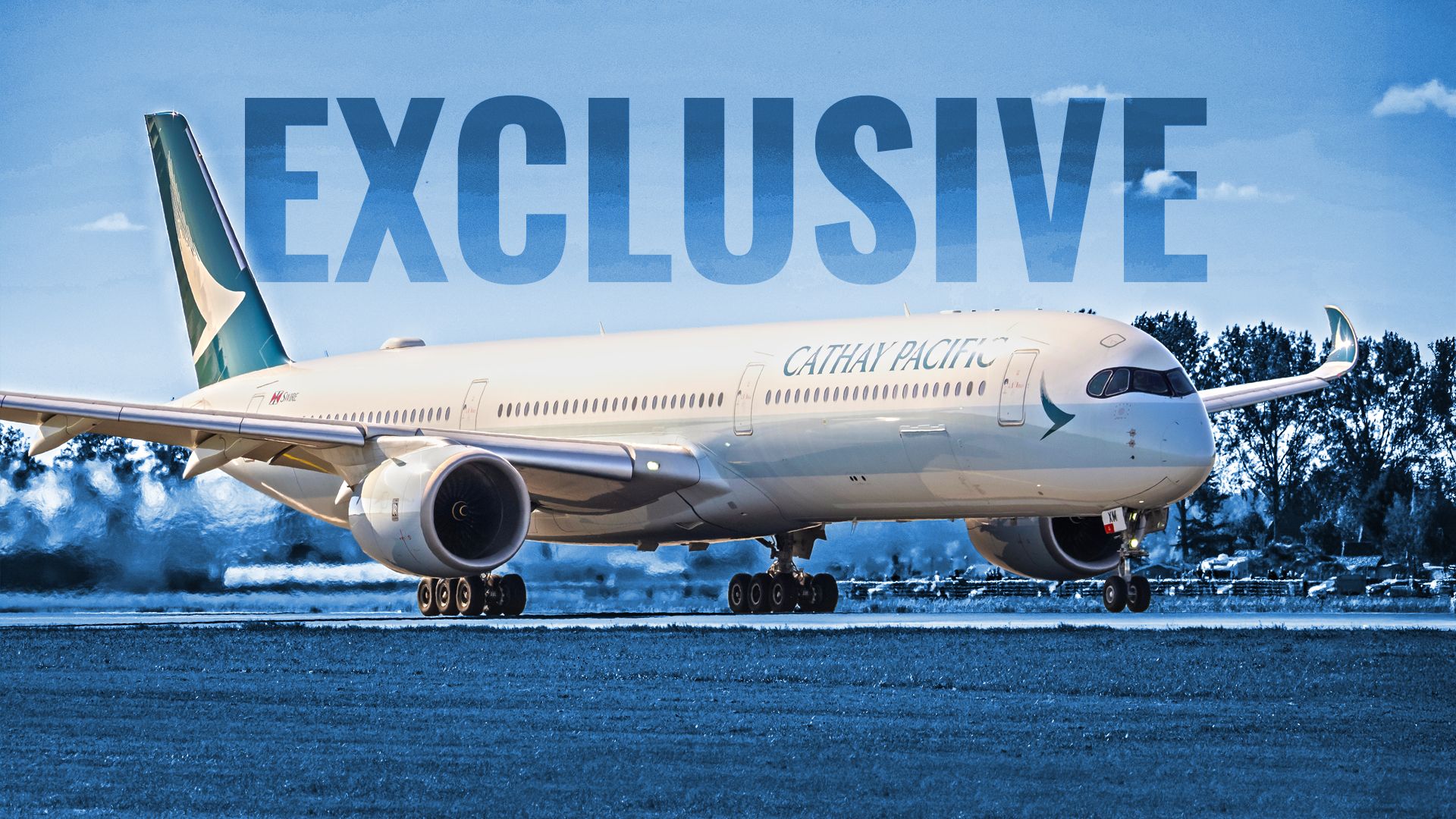
The Airbus A350 is one of the most advanced aircraft ever built: a long-range, widebody designed for efficiency, comfort, and endurance. And, beyond its carbon-fiber fuselage and futuristic cockpit lies an equally impressive secret: it can only fly thanks to one specific type of engine. Every A350, without exception, flies with a single type of engine: the Rolls-Royce Trent XWB. That exclusivity is the result of more than a decade of collaboration between Airbus and Rolls-Royce to redefine what a modern jet engine could deliver. When the A350 first took shape, the two companies conceived the engines and the airframe as a matched set, each one tailored to the other’s strength.
For travelers, this means quieter flights and lower emissions. For engineers, it represents one of the most finely tuned partnerships between an aircraft manufacturer and an engine maker in modern aviation. So why did Airbus commit one of its most important programs to a single engine supplier, and why has that decision never been revisited? The answer lies in the XWB’s balance of power, efficiency, and reliability, but also in a deeper story: how exclusivity, when done right, can become a design philosophy rather than a business constraint.
A350 XWB & Trent: Born Together, Built As One

When Airbus formally launched the A350 XWB program in 2006, it was stepping up to a challenge already set by Boeing 787 Dreamliner. The American rival had changed the conversation around long-haul travel with its all-composite design and ambitious promises of fuel savings. Airbus needed a response, not just a derivative of the A330, but a clean-sheet design that would set new benchmarks in efficiency and comfort on its own terms, in order to compete with both the brand-new Boeing 787 and a popular workhorse, the Boeing 777. That’s where Rolls-Royce stepped in.
From the outset, Airbus and Rolls-Royce engineers worked side by side, sharing data, aerodynamic models, and design philosophies. The goal was to build an engine with the Airbus A350. Over nearly a decade of testing, Rolls-Royce refined what would become the Trent XWB through thousands of hours of wind tunnel testing and computational modeling, providing the established Trent family architecture with new materials, ultra-efficient compressors, and a larger fan optimized for quieter, smoother thrust.
The outcome was worth the effort: a powerplant capable of reducing fuel burn by around 15% compared to the previous generation, primarily through a higher bypass ratio (~9.6:1), ultra-efficient compressors, and lighter composite fan blades.
The A350’s aerodynamic design and the XWB’s nacelle integration were tuned in harmony, allowing for optimal airflow, reduced drag, and lower noise footprints. This philosophy produced not only compatibility, but interdependence: the A350 performs at its best only when powered by its dedicated Trent XWB.
Trent XWB: The Quiet Giants Under The Wing

At its core, the Trent XWB is a large, three-shaft turbofan, an architecture that sets it apart from the twin-spool layouts used by many competitors. Each of its three rotating assemblies serves a distinct role in optimizing performance across every phase of flight:
- Low-pressure spool (fan and LP turbine): Drives the massive 118-inch fan, generating most of the engine’s thrust with remarkable efficiency.
- Intermediate-pressure spool: Balances airflow between the front fan and high-pressure core, improving responsiveness and reducing the risk of compressor surge.
- High-pressure spool: Powers the combustion core at extremely high temperatures, ensuring maximum thermal efficiency and sustained thrust at cruise altitude.
The engine pairs this architecture with a very large 118 inches (300 centimeters) fan and modern aerodynamic profiling to maximize bypass flow; in practice, that means more of the engine’s thrust comes from accelerated airflow around the core, improving propulsive efficiency for heavy, long‑range aircraft.
Beneath the fan, the XWB’s thermodynamic performance relies on a high overall pressure ratio, careful stage matching, and efficient cooling techniques. Rolls‑Royce uses single‑crystal superalloys, directionally solidified components, and advanced thermal barrier coatings, together with complex internal cooling passages, to protect turbine blades from gas‑path temperatures that would otherwise shorten life or force conservatism in operation. These technologies translate directly into improved durability and higher temperatures, with an advantage in fuel burning.
|
Feature |
Specification |
|---|---|
|
Thrust Range |
84,000–97,000 lbf |
|
Fan Diameter |
118 inches (300 centimeters) |
|
Bypass Ratio |
~9.6:1 |
|
Overall Pressure Ratio |
~50:1 |
|
Noise Reduction vs Trent 700 |
~40% |
|
Primary Applications |
A350-900, A350-1000 |
Acoustics and passenger experience are also important design targets. The large fan and refined nacelle aerodynamics reduce fan‑tone noise and broadband emissions, while structural and balance design minimize vibration transmitted to the airframe. For flight crews and passengers, that engineering work shows up as steadier cruise, quieter climbs and approaches, and fewer inflight anomalies caused by transient thermal stresses.
For airline operations, the payoff is straightforward: improved block‑fuel efficiency on long sectors, lower community noise footprint at departure and arrival, and maintenance cycles that are easier to schedule around complex long‑haul networks.
Exclusivity By Design: Why Only Rolls-Royce

When Airbus initially invited engine proposals for its new widebody A350, several manufacturers, including General Electric, expressed interest. But GE ultimately declined, citing insufficient overlap with its existing GE90 and GEnx programs. That left Rolls-Royce as the only partner willing to tailor an engine precisely for Airbus’ requirements.
The result is an unusually intimate engineering relationship. With only one engine partner, Airbus and Rolls‑Royce could tune nacelles, inlets, and bleed systems without the usual compromises that come with dual sourcing. That focus helped the A350 hit tight targets for fuel burn, noise, and maintenance predictability, but it also meant airlines gave up choice and the commercial leverage that comes with competing engine offers. This kind of exclusive pairing isn’t new, but the A350 deal stands out for its depth of integration and long-term alignment.
Past programs have used sole suppliers, yet here Airbus and Rolls-Royce engineered systems and installation details together, so improvements can be introduced without the compromises that come from supporting multiple engine types. The payoff is an engine optimized for decades of incremental gains, at the cost of some vendor competition, a trade-off Airbus and many operators judged worth making.
Trent XWB Evolution: XWB‑84 To XWB‑97, And The 2025 EP Upgrades

When Airbus’s first A350-900 took to the skies in 2015, it did so with the Rolls-Royce Trent XWB-84, the world’s most efficient large aero engine at the time. Delivering 84,000 pounds of thrust, it was purpose-built for range, fuel economy, and reliability. Its high bypass ratio (~9.6:1), combined with a remarkably high overall pressure ratio (~50:1), allowed airlines like  Qatar Airways and
  Singapore Airlines to operate ultra-long sectors with reduced fuel burn and cabin noise.
But the story didn’t stop there. As Airbus began developing the stretched A350-1000, new performance targets emerged. The larger, heavier model required more power, particularly during high-altitude and hot-weather takeoffs. Rolls-Royce’s answer was the Trent XWB-97, a re-engineered evolution with a larger core, new intermediate-pressure compressor stages, and improved cooling systems to manage higher thermal loads.
The engine’s advanced fan design, using thinner, aerodynamically refined titanium blades and lighter composite casings, helped maintain efficiency despite the significant power increase. Crucially, the XWB-97 retained about 80% commonality with the XWB-84, reducing maintenance and training complexity for airlines operating both aircraft types.
And in 2025, the partnership continued to evolve. Airbus and Rolls-Royce received EASA certification for the enhanced-performance Trent XWB-84EP, offering improved fuel efficiency and durability through refined turbine materials, higher core temperatures, and advanced digital health monitoring. A similar upgrade, the XWB-97EP, is already undergoing ground testing, promising even better reliability for the A350-1000 and future A350F freighter.
Which Airlines Use The A350:Operators And Operational Benefits

Few aircraft have achieved such rapid and widespread adoption among leading long-haul carriers as the Airbus A350. Since its first commercial flight in 2015, the aircraft quickly became the preferred choice for airlines looking to balance comfort, efficiency, and global reach. Its exclusive partnership with Rolls-Royce through the Trent XWB engine has ensured reliability and performance across diverse operating environments, from the deserts of Doha to the Arctic routes of Helsinki.
Today, the A350 family serves as the backbone of several major international fleets. Qatar Airways, the type’s launch customer, operates one of the largest A350 fleets worldwide, using both the -900 and -1000 variants on high-profile routes such as Doha–New York and Doha–Auckland. The airline’s CEO, Akbar Al Baker, has often described the aircraft as a “game changer” for its ability to connect distant markets nonstop while maintaining exceptional fuel economy and passenger comfort.
Meanwhile, Singapore Airlines operates the A350-900 in multiple configurations, including ultra-long-range (ULR) variants capable of operating nonstop flights like Singapore–Newark and Singapore–San Francisco, some of the longest commercial routes ever flown. These missions highlight the A350’s efficiency, made possible by its lightweight structure and the Trent XWB’s high bypass ratio, which delivers both endurance and quiet operation.
Top 10 Airbus A350 Operators:
|
Airline |
Fleet Size (Active) |
Variants Operated |
Notes |
|---|---|---|---|
|
Singapore Airlines |
62 (65 total) |
A350-900 / A350-900ULR |
World’s longest nonstop (~18+ hrs); only ULR operator; all orders received |
|
Qatar Airways |
57 (58 total) |
A350-900 / A350-1000 |
Global launch customer; luxurious quiet cabin; canceled 19 -1000 orders in 2022 |
|
Cathay Pacific |
47 |
A350-900 / A350-1000 |
Final passenger delivery Dec 2023; 6 A350F freighters on order |
|
Air France |
34 (35 total) |
A350-900 |
Replacing A330/777; part of 50-order with KLM (mix -900/-1000) |
|
Delta Air Lines |
32 (35 total) |
A350-900 |
Shift to Airbus widebodies; 8 more -900 + -1000s on order |
|
Air China |
29 (30 total) |
A350-900 |
Flag carrier; new 80-inch lie-flat business seats; operates COMAC C919 |
|
Lufthansa |
26 (30 total) |
A350-900 |
Replacing A340-600; first Allegris first class in Oct; 15 -1000s on order |
|
Turkish Airlines |
24 |
A350-900 |
Absorbed 6 from Aeroflot; up to 92 on order; new 19-hr routes in 2024 |
|
Ethiopian Airlines |
23 |
A350-900 / A350-1000 |
Africa’s leading operator; all-Airbus widebodies; 1 more -1000 on order |
|
Iberia |
22 |
A350-900 |
Spain’s flag carrier; all-Airbus fleet; A321XLR launch customer |
Sources: ch-aviation, Airbus, Simple Flying
For many of these airlines, the A350 has replaced aging models such as the Airbus A340, Boeing 777-200ER, and Boeing 747-400, dramatically reducing fuel costs and emissions. The combination of Trent XWB reliability and Airbus’s lightweight composite design has made the type a cornerstone of sustainable long-haul strategies.
Even low-cost carriers like French bee, and World2Fly have adopted the A350, demonstrating its operational flexibility. While legacy airlines use it to anchor premium global networks, leisure and hybrid carriers appreciate its ability to deliver widebody comfort with narrowbody economics. The aircraft’s consistent reliability, supported by Rolls-Royce’s TotalCare maintenance program, has also contributed to its popularity. Airlines benefit from predictive monitoring of every Trent XWB engine in service, allowing real-time diagnostics and reducing unscheduled maintenance downtime.
In essence, the A350’s success is about real-world performance across continents and climates. No matter if it’s cruising over the Pacific or crossing the Arctic Circle, the combination of Airbus precision and Rolls-Royce power has proven a winning formula for operators worldwide.
Looking Ahead: UltraFan And The Future Of The A350‑XWB Partnership

Airbus’s decision to keep the A350 tied to a single engine manufacturer continues to shape its long-term evolution. As Rolls-Royce develops the UltraFan, a geared turbofan designed to deliver 10% greater efficiency than the XWB, the potential for an A350 reengining program looms on the horizon. While no announcement has been made, both companies are openly studying integration possibilities.
The UltraFan borrows lessons from the XWB’s success: modularity, durability, and the use of composite fan blades with titanium edges. Its scalable design could power both narrowbody and widebody aircraft, hinting at a future where Airbus and Rolls-Royce might extend their exclusive collaboration even further. Ultimately, the A350’s exclusive relationship with the Trent XWB reflects more than a partnership; it’s a shared pursuit of perfection.
source
