

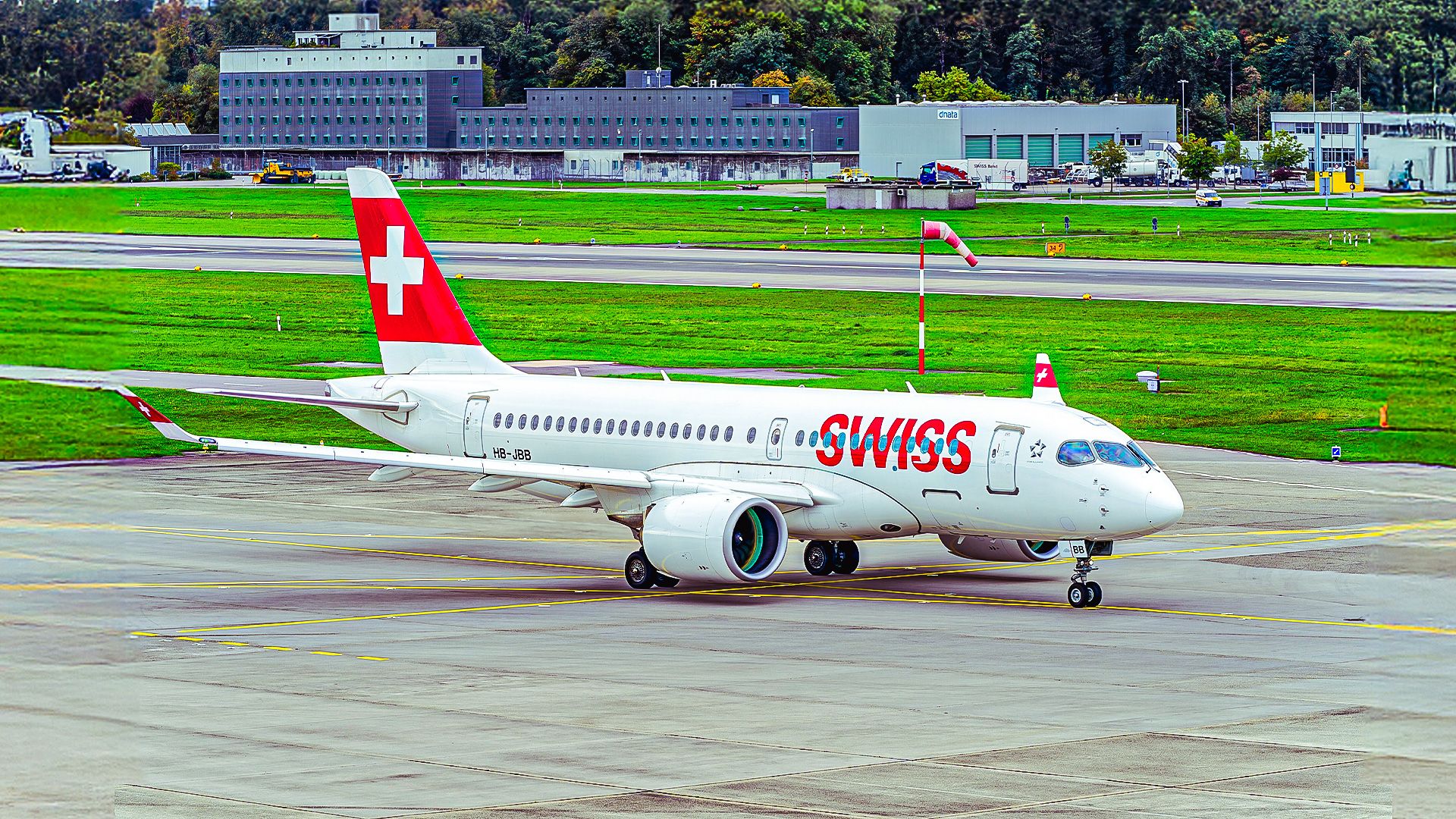
The A220 is Airbus’ newest and most advanced airliner. It wasn’t developed by the company (instead, by Bombardier as the CSeries), but it is the newest clean-sheet aircraft sold by Airbus today, and it’s one of the most innovative aircraft in production today. Carbon composites make up roughly 46% of the plane’s weight, and the plane’s aerodynamic design is among the most advanced in the world, while also using the innovative Pratt & Whitney PW1500G geared turbofan engine.
The A220 has always seen moderate but steady sales, but under the management of Airbus, the A220 has become more successful than ever. 2022 and 2023 were among its best sales years ever, but then 2024 saw more cancellations than orders. In 2025, the A220 appears to be selling once again, with future order prospects appearing bright. While the A220 isn’t nearly as successful as the A320neo family, it’s still received over 900 total orders. Here’s why the Airbus A220 is as popular as it is.
Overview Of The Airbus A220 (Née CSeries)

The A220 was originally developed by Bombardier as the CSeries, consisting of two models: the CS100 and the larger CS300. Bombardier had studied the concept of a larger, five-abreast airliner to slot above its CRJ regional jets since the early 2000s, and after some uncertainty regarding the viability of the program, Bombardier formally launched the CSeries in 2008, and the initial entry-into-service was targeted for 2013. The CS100 was to slot above the CRJ-1000, while the CS300 would compete directly with the Airbus A319-100 and Boeing 737-700.
The CS100 ended up entering service in 2016 with SWISS, while the CS300 entered service later the same year with airBaltic. While the plane was promising, years of delays were an expensive burden for the Canadian manufacturer to bear, and Bombardier also lacked the scale to easily produce and sell the costly airliner. The program also faced another setback after a dumping petition filed by Boeing resulted in the US Department of Commerce placing a 300% tariff on the CSeries in response to a sale made to Delta Air Lines for 75 units.
In 2017, facing general financial struggles and with a 300% tariff shutting the aircraft out of the lucrative US market, Bombardier reached an agreement with Airbus to sell a 50.01% stake in the aircraft program. Airbus paid CAD$1, assumed no debt or liability, and later bought out Bombardier’s remaining stake in the program while also rebranding the CSeries as the A220. Later rulings by the Department of Commerce removed the 300% tariff on the A220, and Airbus opened an additional Final Assembly Line (FAL) in its plant in Mobile, Alabama, which also holds an A320 FAL. Bombardier ended up selling the CRJ and Dash 8 programs as well.
What Makes The A220 Such A Good Aircraft?

One of the major reasons behind the A220’s competitiveness is that it’s a clean-sheet airliner. Because of this, Bombardier was able to design a wing and fuselage that is more aerodynamic than the decades-old designs used by rivals. The fuselage and wings are primarily made out of carbon-composite materials, lowering the aircraft’s weight and boosting fuel efficiency. The aircraft also has large canted winglets to further improve fuel burn, although wingtip devices are an expectation in modern airlines.
The most crucial aspect of an aircraft’s fuel efficiency is the engines. Here, the Airbus A220 uses the Pratt & Whitney PW1500G, a variant of the PW1000G family. The PW1000G is a geared turbofan engine, meaning that it uses a gearbox to allow the fan and low-pressure compressor to each move at their own optimal speed, rather than at the same speed. The PW1500G also has a bypass ratio of 12.5:1, one of the highest ever, which allows it to be more efficient and quieter.
|
PW1000G Variant |
Aircraft |
|---|---|
|
PW1100G |
Airbus A319neo, Airbus A320neo, Airbus A321neo |
|
PW1500G |
Airbus A220-100, Airbus A220-300 |
|
PW1900G |
Embraer E190-E2, Embraer E195-E2 |
All of this was true when the plane was called the CSeries, but one of the major concerns over the jet was product support and a questionable second-hand market, seeing as how it was a new size category of airliner sold by a smaller manufacturer. With Airbus now in control, the carrier is able to more effectively sell the jet as part of its lineup, and it has a much larger support network than Bombardier. Since the Airbus takeover, sales of the A220 have more than doubled.

Continuing To Build On A Clean Sheet Design: Improvements Coming To A220 Family
Airbus is investing in the A220 to make it even more competitive. Here’s what’s new and what’s coming in the future for the smallest Airbus.
The A220’s Economics Versus Its Competition

Of the two variants, the A220-300 is by far the more popular version. It accounts for nearly 88% of A220 sales, and it’s also beating its direct competitors. The A220-300 is similar in size to the Boeing 737 MAX 7, and it also essentially competes against the Airbus A319neo. The A319neo has received 57 orders, and while Boeing does not always disclose the breakdown of sales between 737 MAX variants, it’s highly probable that the 737 MAX 7 has received significantly fewer sales than the 823 orders of the A220-300.
Both the A319neo and 737 MAX 7 are shrinks of larger aircraft. As a fundamental principle, shrinking an aircraft boosts qualities like range and takeoff performance, but worsens per-seat economics as it retains much of the weight of the original aircraft. The A220-300 is a stretch of the A220-100 with a higher Maximum Takeoff Weight (MTOW) to achieve a similar range, which means that its per-seat operating cost is significantly lower than its competitors.
The A220-100 is mainly competing against the Embraer E2 family, which has drastically outsold it (with nearly 500 sales). However, the A220-300 ultimately has superior operating economics and is similarly capable, leaving the A220-100 with little real purpose as airlines favor the larger variant. Delta Air Lines, for instance, originally ordered 75 CS100s/A220-100s with 50 options, but ended up converting 30 of its orders to the A220-300, exercised all of its options as the A220-300, and ordered another 20 A220-300s.
The Flaw Of The Airbus A220

The 100 to 150-seat market is ultimately a difficult space to compete in. No matter the size of the aircraft, some costs remain largely constant, such as personnel costs. A smaller aircraft has fewer seats to spread these costs, bumping up per-seat costs compared to a larger airliner. Regional jets primarily work due to lower labor costs as they’re operated by regional crews that are paid less, but the A220 is a mainline aircraft with staff that are paid mainline salaries.
In the past, a smaller aircraft would be used to more accurately match demand, but the advent of price segmentation (in particular, basic economy fares) has reduced the need for smaller planes.  United Airlines CEO Scott Kirby has publicly spoken about how the use of different fare types has allowed for the use of larger aircraft to smaller destinations. United placed an order for Boeing 737-700s shortly before the Delta order for 75 CS100s/A220-100s, and later converted all of them to 737 MAX aircraft. United has taken delivery of all of its 737 MAX 8s and only has orders for 737 MAX 9s, 737 MAX 10s, and Airbus A321neos.
|
Airline |
Narrowbodies On Order |
|---|---|
|
American Airlines |
Boeing 737 MAX 8, Boeing 737 MAX 10, Airbus A321neo |
|
Delta Air Lines |
Airbus A220-300, Boeing 737 MAX 10, Airbus A321neo |
|
United Airlines |
Boeing 737 MAX 9, Boeing 737 MAX 10, Airbus A321neo |
Delta is unique in the US for flying smaller mainline jets, but both of its aircraft types in this size segment (Airbus A220 and Boeing 717s) were acquired at a cheap price. They were opportunistic buys rather than a necessary acquisition. While the A220-300 is also flown by Breeze Airways, JetBlue, and Air Canada, Delta is the only North American operator of the A220-100. Worldwide, the A220-100 has also seen slow sales, while the A319neo and 737 MAX 7 have also been slow sellers as airlines prefer larger variants.

How Does The Airbus A220 Compare To The Embraer E2 For Regional Airlines?
Do Airbus or Embraer’s narrow-bodied airlines dominate the short-haul and regional market?
Reliability Issues With The A220

Operators love the Airbus A220’s fuel efficiency, while passengers praise its rare level of passenger comfort. However, nearly a fifth of the world’s A220 fleet is currently grounded due to engine reliability issues. The PW1000G has been one of the most troubled engine programs in recent years, but while the Airbus A320neo also offers the CFM LEAP-1A as an engine option, the Airbus A220 only comes with the PW1500G. This means that the A220 is severely impacted by issues with this engine.
SWISS has decided to place its entire fleet of nine A220-100s into storage, in order to move engines to the A220-300 fleet. EgyptAir retired its entire A220 fleet in 2024 primarily due to the high costs that resulted due to engine issues, and Air Austral, which has two of its three A220s grounded, is set to remove its A220 fleet in early 2026. Additionally, aircraft in the Embraer E2 and Pratt & Whitney-powered A320neo families are also being grounded due to engine problems.
The PW1000G has been experiencing premature wear and cracking in several components. The lower on-wing time has greatly increased downtime and maintenance costs. The length of some repairs, as well as global supply chain issues, is what is resulting in the groundings, as airlines are having difficulty obtaining parts. This is leading SWISS, for example, to siphon engines from the A220-100 fleet to keep the more economical A220-300s flying.
Future Of The Airbus A220

Airbus’ current focus is on making the A220 program profitable before any major investment. The aircraft is expensive to build, in part because parts and production contracts were negotiated with Bombardier, a smaller, less financially stable manufacturer. Airbus is currently working on increasing the A220’s production rate to 14 per month, which would greatly boost the program’s finances. Of course, the A220 also has to keep selling to make the production boost sustainable.
Rumors have long existed of an Airbus A220 stretch, even before Airbus acquired the program, typically being labeled as either the A220-500 or the A221, and the CS500 before the Airbus takeover. This aircraft would squarely face off against the Boeing 737 MAX 8 and Airbus’ own A320neo. If the plane retains most of the capabilities of the current variants, then it would likely become the most popular A220 variant, as a stretch of the aircraft would lower its per-seat costs.
The A220 stretch would likely siphon sales away from the A320neo, but this would likely be a positive for Airbus. Demand is currently limitless for the higher-margin A321neo, and production is sold out for years. An ideal scenario for Airbus would be to produce only A321neos and the A220, while the A320neo is available for select customers who desire it, as this makes more money for the company. Of course, the A220 has to first become profitable before the company embarks on such an endeavor.
source
