

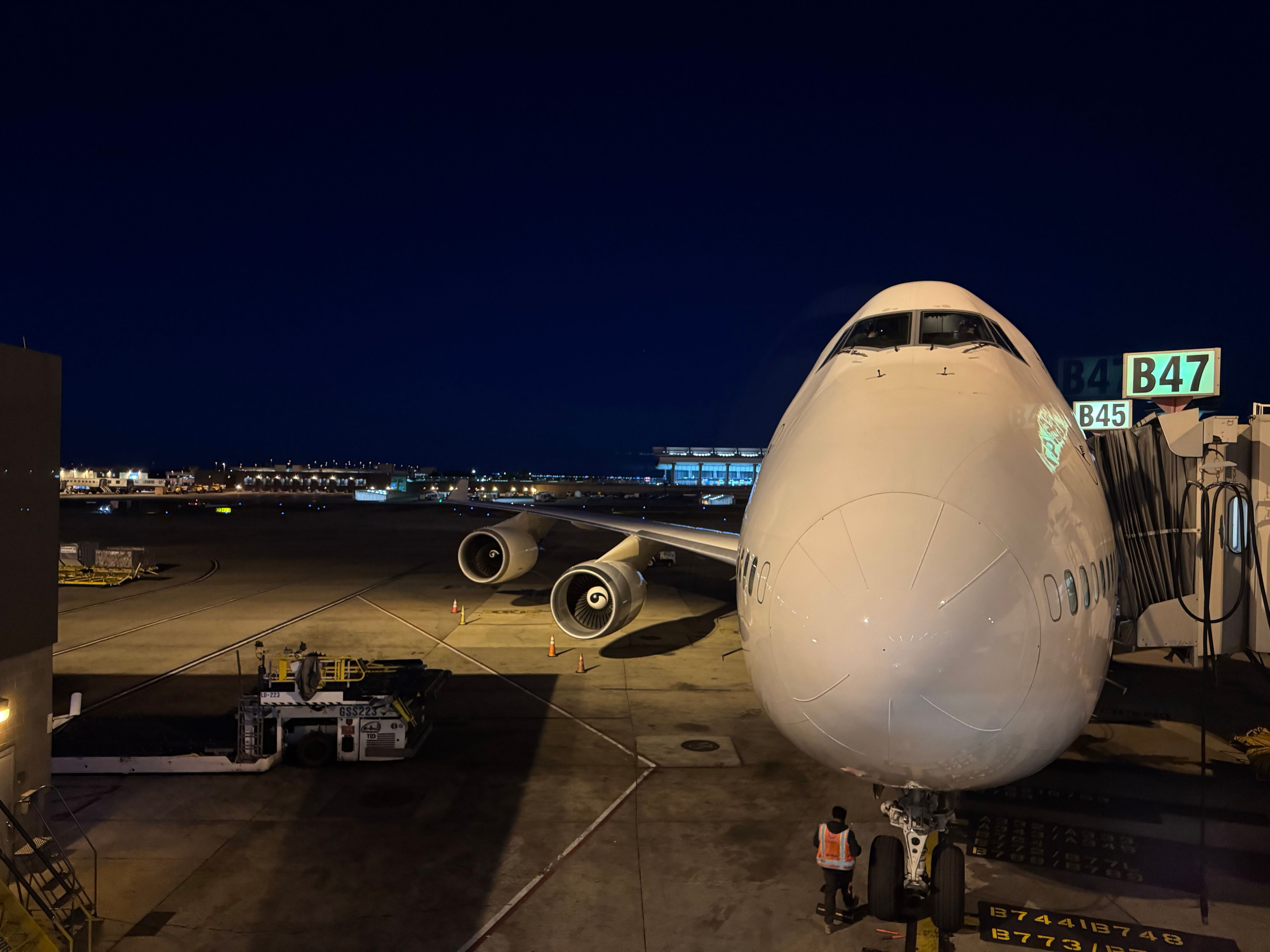
Four-engine commercial jets like the legendary jumbo Boeing 747 and superjumbo Airbus A380 have largely been phased out in favor of more efficient twin-engine widebodies. Yet, there are some cases that suggest future demand for four-engine passenger aircraft could re-emerge, even if only in niche markets.
The world’s busiest airports are experiencing growing congestion and the limited slots for takeoff and landing are getting tighter. If airlines can’t increase flight frequency, the only way to accommodate more passengers is to fly larger aircraft. Quadjet jumbos, with their massive capacity, can efficiently serve the densest routes between major international hubs, or so-called “trunk routes,” where passenger loads regularly ferry 500 or more flyers at a time.
Quad-Engine Demand On The Rise?

The market for oversized or heavy-lift cargo is not only exceptionally strong, but growing thanks to rising online commerce and the globalized economy. Steady demand for the 747-8F and even the Antonov AN-124 has shown no sign of slowing down. Four engines are highly advantageous to lift very heavy or bulky cargo, especially in hot-and-high conditions or on shorter runways.
As world cargo volumes keep growing, and particularly if outsize payloads like components for renewable energy, aerospace, and humanitarian relief, airlines and cargo operators see the business case for new multi-engine freighter designs. One of the world’s largest air cargo carriers, Atlas Air, has a fleet composed exclusively of 747 jets, including a range of variants.

New twinjets, like the 777 and A350, are certified to fly routes far from diversion airports, but very long polar or oceanic routes still present challenges. Four-engine aircraft are not subject to the same extended-range twin-engine (ETOPS) restrictions, so they can offer more direct routings across remote regions.
The extra engines simply provide a higher level of redundancy, which remains attractive to safety-conscious operators and passengers. Rising demand for nonstop flights over ultra-remote regions is another case that could draw in renewed interest in four-engine designs.
The Fall Of The Quadjet

For almost half a century, the 747 was an iconic symbol of intercontinental air travel. A combination of technology, economics, and regulation led to the demise of the 747 along with the Airbus A380, and Airbus A340 quadjets. The decline began as new high-thrust, high-bypass twinjets proved capable of hauling 300- to 400-flyers aircraft between any two cities under ETOPS.
Coming more than three decades after the first 747 in 1969 was Boeing’s final iteration, the 747-8, which launched in the late 2000s with a stretched fuselage and new GEnx engines. By 2020, Boeing announced that the last 747-8F would leave the Everett factory as the “dash eight” line spun down, with the final aircraft handed over in 2023.

The Airbus A380 launched in 2000 on the premise that traffic between the world’s largest hubs would outgrow available slots, forcing airlines to fly higher seat-count jets. By 2012, the Boeing 777-300ER was earning airlines major savings per seat, and later the Airbus A350-1000 began offering the same twinjet economics.
Emirates, the type’s anchor, had to cut and reshuffle its backlog as outside economic forces took their toll on the airline industry, and no other carrier stepped up with follow-on orders. In February 2019, Airbus announced that A380 production would cease, and the final aircraft was delivered to none other than Emirates in 2021.
The Airbus A340 has a similar story but from an earlier time. It unraveled when fuel prices climbed sharply in the early 2000s, magnifying the penalty of carrying four medium-sized engines instead of two large ones. Airbus tried to rescue the line with the longer-range A340-500 and the higher-capacity A340-600, but orders dried up. In November 2011, Airbus formally closed the order book, and the last of the A340s left final assembly in 2012.
The Limits Of The Twinjet

A four-engine airliner, such as the 747, offers greater freedom than a large twin like the 777. A quad has true propulsion redundancy, allowing the aircraft to retain 75% of its thrust and bleed-air, electrical-power, and hydraulic-pressure generation even when one engine is lost. This depth of redundancy gives quads higher dispatch reliability on routes where an alternate might be time zones away.
Distributing the required thrust among four smaller engines allows the airframe to grow larger without asking any one powerplant to reach extremes of diameter or turbine temperature. This results in greater take-off performance at hot-and-high airports, enough installed power to lift outsized freight, and the structural benefit of wing-bending relief created by outboard engines.
The 747 family can perform a three-engine ferry, allowing airlines to reposition a 747 with one engine removed for maintenance or carry a spare engine under the wing in “fifth-pod” delivery configuration. Should there be some key breakthroughs with technology like sustainable fuels or airframe composite technologies, the efficiency gap between twins and quads could narrow.

Although the industry trend is firmly toward high-bypass twinjets, shifting circumstances around infrastructure, ultra-long-haul operations, specialist cargo demands, or new technological breakthroughs could create a renewed, if limited, niche for four-engine commercial aircraft in the coming decades. Any resurgence would likely be focused on particular high-density, remote, or heavy-lift markets, rather than becoming the mainstay of global aviation once again.
The Unique Niche Of The 747

The 747 remains the top choice for special-airlift aircraft, as it can handle large cargo loads or perform unique government and industrial missions that almost nothing else can. The 747’s main deck can load freight through a lifting nose door, allowing operators to carry massive items without disassembly. The 747’s four engines gives it the power to use shorter runways and fly with high performance.
The four engines also provide electrical and pneumatic power for special mission configurations, which require megawatts of steady electrical power and large bleed-air flow for equipment. The final four 747s ever made were 747-8F cargo haulers for Atlas Air. John Dietrich, President and Chief Executive Officer of Atlas Air Worldwide, commented in 2023 upon the delivery of the last 747s to roll off the assembly line:
“Our company’s history and success are directly linked to the 747 platform, and we are honored to continue our long history of flying this iconic aircraft for our customers around the world. Atlas Air was founded over 30 years ago with a single 747-200 converted freighter. Since then, we have spanned the globe operating the 747 into well over 800 airports in over 170 countries with nearly every series of the aircraft, including Boeing’s 747 Large Cargo Freighter for the transport of 787 Dreamliner parts.”

The 747-8, by the numbers, as Boeing describes on the official website:
| Specification | 747-8I |
| Passengers | 410 |
| Range nm (km) | 13,650 km / 7,370 nmi |
| Length | 76.3 m (250 ft 2 in) |
| Wingspan | 68.4 m (224 ft 5 in) |
| Height | 19.4 m (63 ft 6 in) |
| Cruise Speed | Mach 0.86, 659 mph (1,061 kmh) |
| Total Cargo Volume | 6,225 ft3 (175 m3) |
| Aisles | 2 |
| Maximum Takeoff Weight | 447,700 kg / 987,000 lb |
As long as there is a need to move cargo too big for a standard cargo door or governments require flying command centers with the power and redundancy of a small city, the 747 has a place. Its combination of range, speed, payload, four-engine resilience, and conformity to existing infrastructure will keep it in a limited but persistent demand for special roles.
The A380neo & Emirates
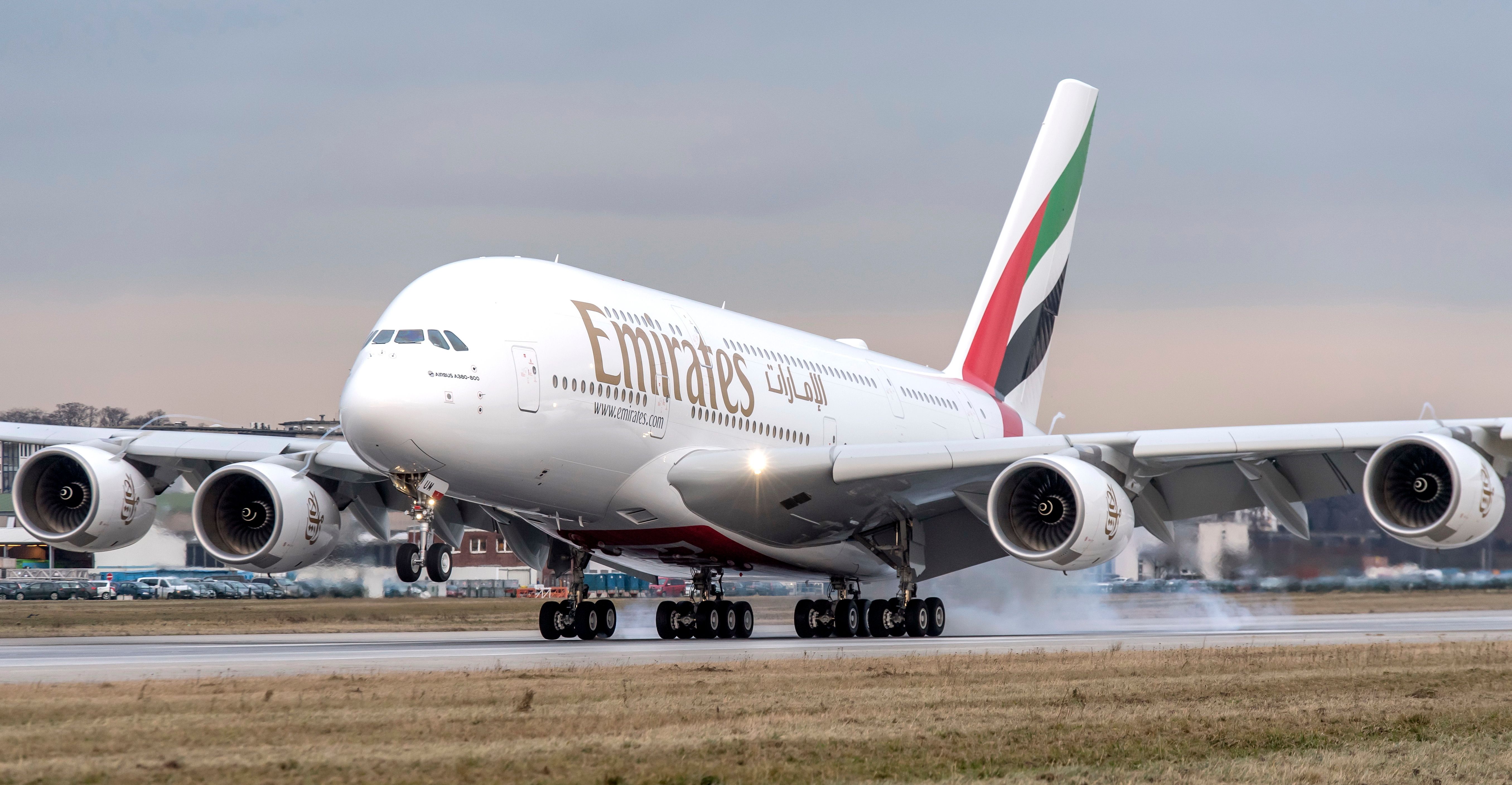
Airbus’ A380 was designed to cater to airports where demand was already exceeding available take-off and landing slots, like  London Heathrow (LHR),
  New York JFK (JFK),
  New York JFK (NRT), and more. The A380’s double-deck fuselage allowed airlines to carry almost 600 passengers in the same slot footprint as a smaller wide-body while leaving room for freight.
Emirates’ business model, which operates at the crossroads of Europe, Africa, Asia, and Oceania, enables  Emirates to fill 80 to 90% of its 500-plus seats with premium-class travelers. Emirates has lobbied Airbus for an “A380neo,” which would re-engine the aircraft with Rolls-Royce Advance or GE9X powerplants, trim structural weight, add aerodynamic tweaks, and possibly even stretch the fuselage.

Below is a snapshot of some of the key specifications of Airbus’ gargantuan A380:
|
Spec |
Airbus A380 |
|---|---|
|
Max Speed |
510 kts (944 km/h) |
|
Normal Cruise |
500 kts (926 km/h) |
|
Height |
79 ft 1 in (24.1 m) |
|
Wingspan |
261 ft 8 in (79.8 m) |
|
Length |
238 ft 7 in (72.7 m) |
|
Cabin Width |
23 ft 5 in (7.1 m) |
|
Cabin Length |
163 ft 8 in (49.9 m) |
|
Passengers |
544 |
Emirates has reportedly claimed it would be happy to procure between 60 and 80 A380neo variants should Airbus proceed with its development. The airline president, Timothy Clark, said in a report from ch-aviation:
“We have made it crystal clear to (Airbus) in the event of the (A380) neo being launched we would buy it.”

In an interview with Business Insider, Clark reaffirmed his airline’s confidence in the A380 and desire to purchase more for its fleet that already leads the world with over 100 in inventory, saying:
“The risk-averse nature of my peer group, CEOs, and boards is probably a major inhibitor to that. But if we were to put $20 billion on the table for Airbus, they’d probably build it for us.”
For Emirates, an A380neo would preserve the gauge advantage, satisfy carbon-emissions limits through lower specific fuel burn, and extend the life of the A380 production line. Airbus still believes that demand beyond Emirates is too thin to justify the investment, following the end of production in 2021.
Quadjets Go Supersonic

Boom’s Overture makes use of fifty years’ worth of technology advancements since the legendary Concorde first soared to the skies. Its four engines are medium-bypass turbofans, which significantly reduce fuel use and exhaust noise while achieving supersonic thrust without the need for afterburners.
A very different strain of four-engine commercial plane, but very likely to be the next to debut as opposed to a new large, heavy lift model. With a redesigned delta wing and a unique gull-wing profile that is tailored for supercruise, it will be a quieter, cleaner replacement. Boom’s aim is to create a high-speed airliner that is quieter, more economical, and more fuel-efficient than any previous Supersonic Transport (SST).
|
Spec |
Boom Overture |
|---|---|
|
Speed |
Mach 1.7 |
|
Altitude |
60,000 ft (18,288 m) |
|
Range |
4,250 NM (7,871 km) |
|
Passenger |
60-80 |
The bulk of the airframe will be made of carbon-fiber composites, which have a greater strength-to-weight ratio and are far more heat-resistant than 1960s metal. Thanks to modern composites, the airframe will endure the intense flight regime and require little maintenance. The material also provides incredibly efficient aerodynamic and airframe shapes for the ambitious new jet.

- Launch Customer(s)
-
Pan American World Airways
- First Delivery
-
January 22, 1970
- Last Delivery
-
January 31, 2023
- Number Delivered
-
1,573
source
