

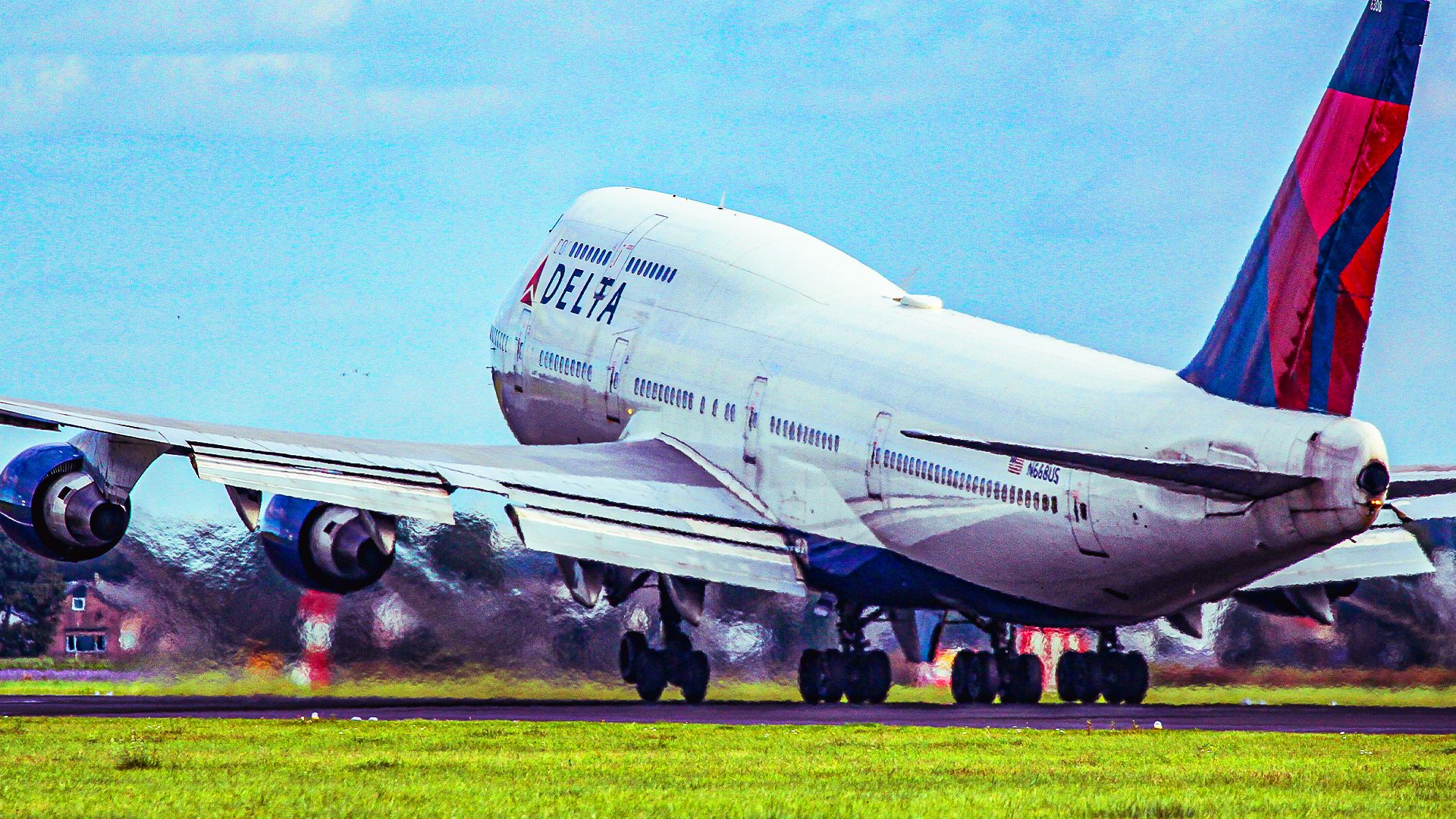
 Delta Air Lines was the final US passenger airline to operate the Boeing 747, bringing its operations with the type to an end in 2017. However, the
  SkyTeam carrier’s relationship with the iconic aircraft dates back much further than that, with Delta Air Lines having previously flown the 747 in the 1970s.
In this article, we will take a look at where Delta Air Lines’ varied fleet of Boeing 747s came from and the routes they operated. We will also consider the legacy of the 747 on the wider commercial aviation industry.
Delta Air Lines’ Original Boeing 747s

Delta Air Lines took delivery of its first Boeing 747 in 1970, with the aircraft, registered as N9896, being delivered by the carrier’s Vice President of Flight Operations, TP Ball. According to the Delta Flight Museum, Delta Air Lines’ Senior Vice President of Marketing at the time, TM Miller, celebrated the news by saying that:
“The 747 is totally unlike any other aircraft, piston or jet. A triumph of American technology, the 747 will bring to our passengers a standard of comfort and convenience no longer limited by the size of an aircraft cabin.”
To much fanfare, Delta Air Lines deployed its new flagship aircraft, featuring an upstairs first class lounge, on several high-profile domestic routes. However, the carrier’s love affair with the Boeing 747 did not last long, as the airline soon decided that the aircraft was simply too big for many of its routes and began trading them back to Boeing in 1974. The last of its original 747s left the fleet in 1977.
Round Two: The Merger With Northwest Airlines

Thanks to Delta Air Lines’ merger with Northwest Airlines in 2008, the Boeing 747 rejoined the fleet, bringing with it a total of 16 747-400s and two 747-200s. However, the 747-200s were only ever used for military charter and freight services, and it was the 747-400 that took the reins of Delta Air Lines’ 747 passenger operation, offering a high capacity of up to 376 passengers in a three-class configuration – 16 in first class, 48 in business class, and 286 in economy class.
Northwest played a significant role in the history of the 747, and was one of its earliest operators. In 1970, Northwest became the second US carrier, after Pan Am, to introduce the 747 into its fleet, with the widebody aircraft revolutionizing the airline’s operations with its size, range, and passenger capacity. Northwest deployed its 747s primarily on transpacific flights, reinforcing its strong presence in Asia, and the aircraft allowed the carrier to expand services to cities including Tokyo, Seoul, and Manila.
Over the years, Northwest Airlines operated several Boeing 747 variants, including the 747-100, 747-200, and, later, the 747-400, which offered improved efficiency and performance. The carrier placed its first order for the Boeing 747-400 in 1985, and it was these newer aircraft that were brought over to Delta Air Lines as part of the merger. Interestingly, Delta went on to operate the first Boeing 747-400 ever built, which was retired in 2015 and is now on display at the Delta Flight Museum.
Where Did Delta Fly With The Boeing 747?

Delta’s first service with the 747 was in 1970, when the carrier operated a daily round-trip routing between Atlanta and Los Angeles via Dallas/Fort Worth. The airline then went on to deploy its 747s primarily on trunk domestic routes, connecting major cities and hubs such as Atlanta, Chicago, Dallas/Fort Worth, Detroit, Los Angeles, Miami, New York, and San Francisco. Delta also deployed the aircraft on a number of its most high-profile transatlantic routes to the likes of London and Frankfurt.
In the years that followed, Delta Air Lines’ Boeing 747 operations were primarily focused on the carrier’s Asia network, making use of its mini-hub at  Tokyo Narita Airport (NRT). The most served route was between Tokyo Narita Airport and Honolulu Daniel K. Inouye International Airport (HNL), with regular 747 services also operated between Tokyo and both Detroit Wayne County Metropolitan Airport (DTW) and Manila Ninoy Aquino International Airport (MNL).
|
Departure Airport |
Arrival Airport |
Number Of Flights |
Distance |
|---|---|---|---|
|
Detroit Wayne County Metropolitan Airport (DTW) |
Seoul Incheon International Airport (ICN) |
30 |
6,637 miles |
|
Seoul Incheon International Airport (ICN) |
Detroit Wayne County Metropolitan Airport (DTW) |
30 |
6,637 miles |
|
Detroit Wayne County Metropolitan Airport (DTW) |
Shanghai Pudong International Airport (PVG) |
30 |
7,137 miles |
|
Shanghai Pudong International Airport (PVG) |
Detroit Wayne County Metropolitan Airport (DTW) |
30 |
7,137 miles |
|
Detroit Wayne County Metropolitan Airport (DTW) |
Tokyo Narita Airport (NRT) |
30 |
6,397 miles |
|
Tokyo Narita Airport (NRT) |
Detroit Wayne County Metropolitan Airport (DTW) |
30 |
6,397 miles |
|
Tokyo Narita Airport (NRT) |
Honolulu Daniel K. Inouye International Airport (HNL) |
5 |
3,818 miles |
|
Honolulu Daniel K. Inouye International Airport (HNL) |
Tokyo Narita Airport (NRT) |
4 |
3,818 miles |
|
Los Angeles International Airport (LAX) |
Detroit Wayne County Metropolitan Airport (DTW) |
1 |
1,979 miles |
|
Honolulu Daniel K. Inouye International Airport (HNL) |
Los Angeles International Airport (LAX) |
1 |
2,556 miles |
When Delta Air Lines commenced Boeing 747 operations for the second time after its merger with Northwest Airlines, the carrier deployed the aircraft on a range of high-capacity domestic and international routes. These included Hartsfield-Jackson Atlanta International Airport (ATL) to Honolulu Daniel K. Inouye International Airport (HNL) and New York John F. Kennedy International Airport (JFK) to Tel Aviv Ben Gurion Airport (TLV).
The carrier also used its Boeing 747s to connect Detroit Wayne County Metropolitan Airport (DTW) with key SkyTeam hubs in Europe, such as Paris Charles de Gaulle Airport (CDG) and Amsterdam Schiphol Airport (AMS). The table above details the fleet’s final full month of normal operations (September 2017), using data from Cirium, an aviation analytics company.
Delta Air Lines’ Final Boeing 747 Flight

Delta Air Lines began winding down its Boeing 747 operations for the second time in 2014, with domestic operations coming to an end by September 2017. However, it was not until December 2017 that the airline operated its final international service with the 747. On December 19, 2017, flight DL158 departed from Seoul Incheon International Airport (ICN), bound for Detroit Wayne County Metropolitan Airport (DTW) as Delta Air Lines’ final scheduled revenue service with the Boeing 747.
The carrier then went on to operate a series of flights around the country as part of an employee farewell tour, taking in Detroit, Seattle, Paine Field, and Atlanta. It then made one last hop from Atlanta to Minneapolis-St. Paul on December 20, 2017, marking the end of a complicated history between Delta Air Lines and the 747. This took place just one month after United Airlines had also operated its final 747 flight, leaving Delta Air Lines as the last remaining US operator of the passenger 747.
Today, the Airbus A350 forms the backbone of Delta Air Lines’ long-haul fleet. The latest data from ch-aviation shows that today, the carrier operates a total of 38 A350-900s, with a further six on order, and it will also soon take delivery of 20 A350-1000s. Together with the 39 A330-900s already in its fleet, Delta Air Lines now operates a streamlined widebody fleet, offering much improved operational performance, fuel efficiency, and passenger amenities.
All About The Boeing 747

The Boeing 747, often referred to as the ‘Queen of the Skies,’ is one of the most famous aircraft in aviation history. First introduced in 1970, the 747 revolutionized commercial air travel by significantly increasing passenger capacity and making long-haul flights more affordable and efficient. As the world’s first widebody aircraft, it featured a distinctive upper deck hump, originally designed as a luxurious lounge area and later used for additional seating or crew rest.
The original model, the Boeing 747-100, could carry more than 400 passengers, setting a new standard for air travel, and over the years, Boeing went on to develop several improved versions, including the highly successful 747-400, which was known for its extended range and upgraded engines. The final variant, the 747-8, introduced even greater fuel efficiency, advanced technology, and cargo capability.
Beyond passenger service, the Boeing 747 has served many other roles, including as a cargo aircraft, military transport, airborne command post, and even as a platform for launching spacecraft. For example, it has famously served as Air Force One and supported NASA missions. Although few 747s remain in the skies today, the aircraft will go down in history as one of the most iconic technological developments of the twentieth century.
The World’s Largest Operators Of The Boeing 747

Today, only three commercial operators of the passenger Boeing 747 remain: Lufthansa, Air China, and Korean Air. Between them, the three carriers operate a total of 41 747s, the majority of which are Boeing’s most modern variant, the 747-8.
|
Top All-Time Boeing 747 Operators |
||
|---|---|---|
|
Ranking |
Airline |
Boeing 747s |
|
1 |
Japan Airlines |
109 |
|
2 |
British Airways |
103 |
|
3 |
Singapore Airlines |
95 |
|
4 |
United Airlines |
90 |
|
5 |
Korean Air |
87 |
Historically, Japan Airlines was the largest operator of the Boeing 747, flying a total of 109 aircraft between 1970 and 2011. This put the carrier ahead of British Airways and  Singapore Airlines, as outlined in the table above.
source
