



French President Emmanuel Macron introduced “forward deterrence” in his speech at Île Longue on March 2, 2026, signaling France’s intent to involve European allies more explicitly in its sovereign nuclear deterrent.
The move did not come out of nowhere. Throughout 2025, as Donald Trump returned to the White House and questions resurfaced in Europe about the long-term reliability of US security guarantees, Macron publicly opened the door to a more European dimension of French nuclear deterrence, including the possibility of deploying nuclear-capable Rafale abroad.
In parallel, France and the United Kingdom deepened their nuclear coordination through the Northwood Declaration, signed at the July 2025 summit, which established a UK-France Nuclear Steering Group and framed the two independent deterrents as mutually coordinateable.
In Macron’s own account at Île Longue, the first group of partners to respond positively to France’s offer included the UK, Germany, Poland, the Netherlands, Belgium, Greece, Sweden, and Denmark. Other front-line states, including Finland, Latvia, and Lithuania, have reported following the debate closely as it gathered momentum.
What is “forward deterrence”?
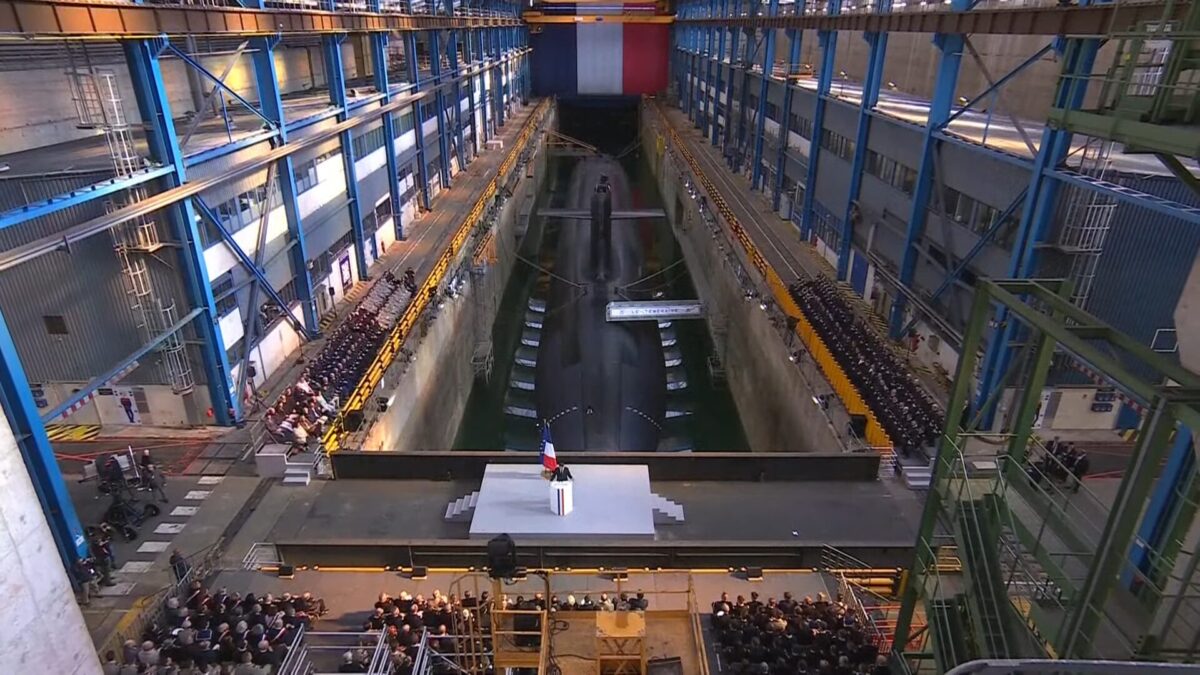
In practical terms, forward deterrence is a two-part equation: allied conventional enablers and French dispersal of the nuclear air component.
On the allied side, conventional support for nuclear operations (CSNO) would provide the strategic enablers and infrastructure needed to make a dispersed posture survivable and credible. That includes early warning, air and missile defense, deep precision strike, and the route-shaping tools needed in heavily defended airspace. One particularly valuable contribution is in suppression and destruction of enemy air defenses (SEAD/DEAD), a capability France is rebuilding after largely abandoning its dedicated MARTEL anti-radar missile in the late 1990s. Paris plans to emphasize SEAD/DEAD in the Rafale F5 standard, paired with MBDA’s STRATUS RS missile. However, this capability is expected to arrive by 2033, with integration by the mid-2030s. Allied fleets of stealth F-35A fighters armed with AGM-88 HARM missiles, already operated by several countries that Macron mentioned, could provide a practical near-term contribution to coalition SEAD efforts.
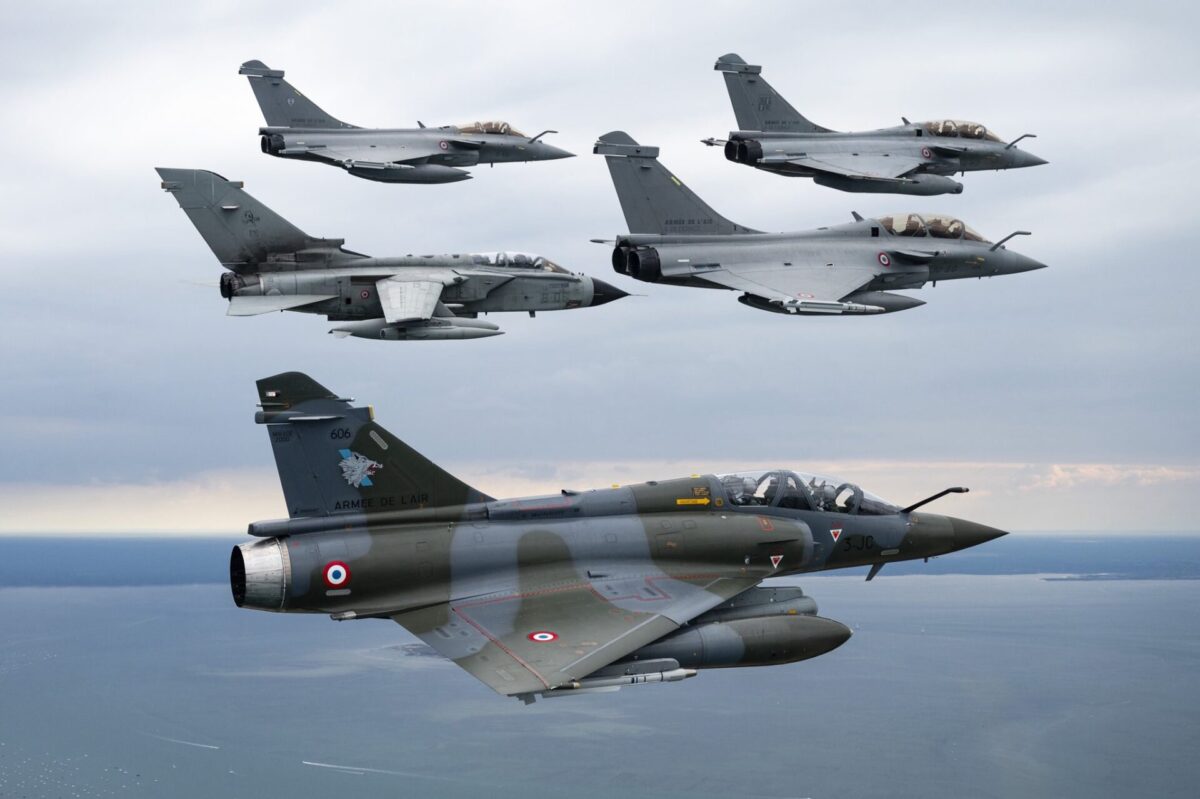
France’s role, meanwhile, is to deliver the strategic air component itself. That mission is concentrated in dedicated units. The French Strategic Air Forces (FAS) operate around 40 nuclear-capable twin-seat Rafale B in two squadrons, EC 1/4 “Gascogne” and EC 2/4 “La Fayette,” both based at BA 113 Saint-Dizier. In March 2025, Macron unveiled plans to reactivate a nuclear mission at BA 116 Luxeuil with two more Rafale squadrons by 2035, a move that would effectively double the number of nuclear-capable Rafale over time. In terms of weapons, about 40 ASMPA-R nuclear air-launched cruise missiles were produced for the FAS, with a further 10 for the French Navy’s carrier-based component (FANu) flown by Rafale M. Each missile carries a TNA warhead, described as having a maximum yield of around 300 kilotons.
Forward nuclear deterrence means temporarily deploying the FAS assets to allied countries across the continent, thereby creating an “archipelago of forces” that complicates an adversary’s strategic calculations during a crisis. That posture only works if the French Air and Space Force can deploy its nuclear-capable Rafale at speed, operate with a reduced footprint, integrate host-nation support, and sustain sortie generation away from its main bases.
This operating logic is known within NATO as Agile Combat Employment (ACE). For years, France has been quietly building that muscle through its national approach, French ACE, designated operationally as MORANE (short for mise en œuvre réactive de l’arme aérienne, or “reactive employment of airpower”).
Understanding Agile Combat Employment (ACE)
ACE is a response to a simple vulnerability: modern strike and ISR capabilities make large, predictable bases easier to target, and air forces need ways to keep operating under pressure by spreading aircraft across multiple locations.
The US Air Force defines it as “a proactive and reactive operational scheme of maneuver executed within threat timelines to increase survivability while generating combat power throughout the integrated deterrence continuum.”
Key factors include maintaining operational tempo away from main bases through disciplined ground routines, efficient management of fuel and munitions, secure communications, and sufficient availability of spares and tooling at appropriate locations.
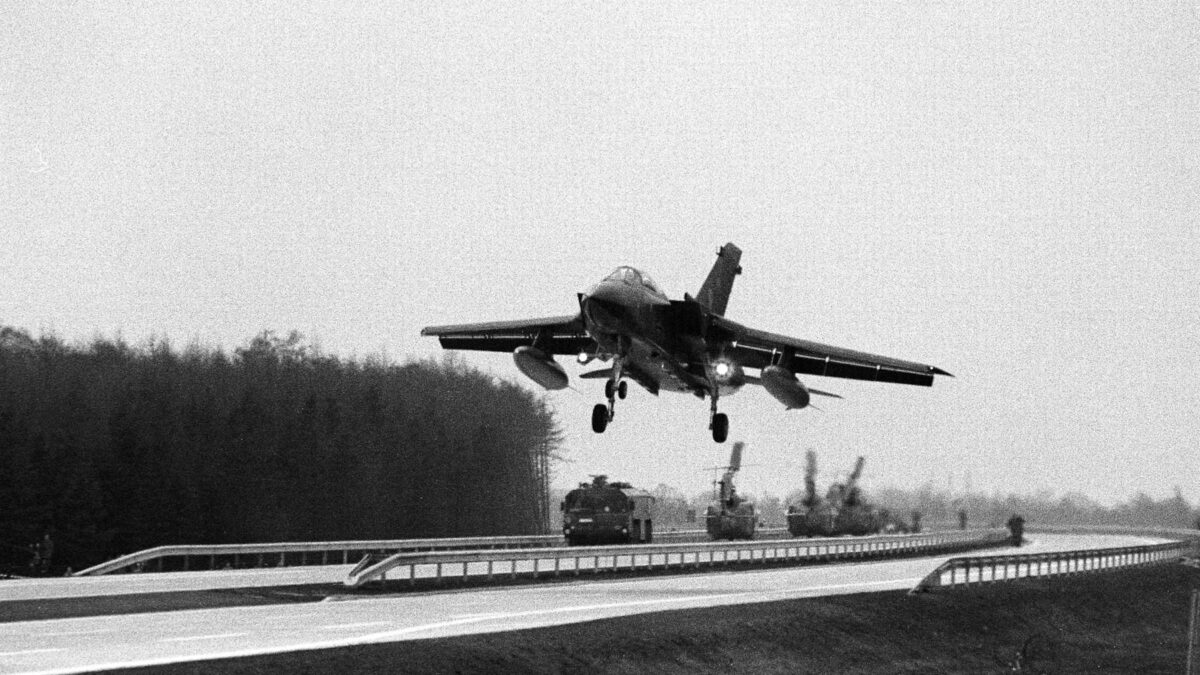
The underlying logic is not new. At heart, ACE revives Cold War dispersed basing: deny the enemy a clean first strike, keep airpower in the fight through dispersion, mobility, and improvisation. In West Germany, NATO and the Bundeswehr prepared sections of autobahn (Notlandeplätze, or NLP) as emergency landing strips so combat aircraft could continue operating if conventional airfields were hit.
But the deepest institutional muscle memory sits further north, with NATO’s newest members. Sweden and Finland built operating concepts around dispersal and road operations decades ago, shaped by geography and proximity to Soviet long-range strike systems.
Sweden’s Bas 60, formalized in the late 1950s and later developed into Bas 90, centered on wartime dispersal and alternative operating strips designed to complicate targeting and preserve sortie generation. While the Cold War-era basing system was scaled back after 1991, Swedish road base training and dispersed operations have remained part of the country’s defense culture and have gained renewed relevance in today’s threat environment.
The concept also survives in Sweden’s fighter design philosophy, with Saab’s Draken and Gripen explicitly built for dispersed, short-field, and road base operations with a small support package.
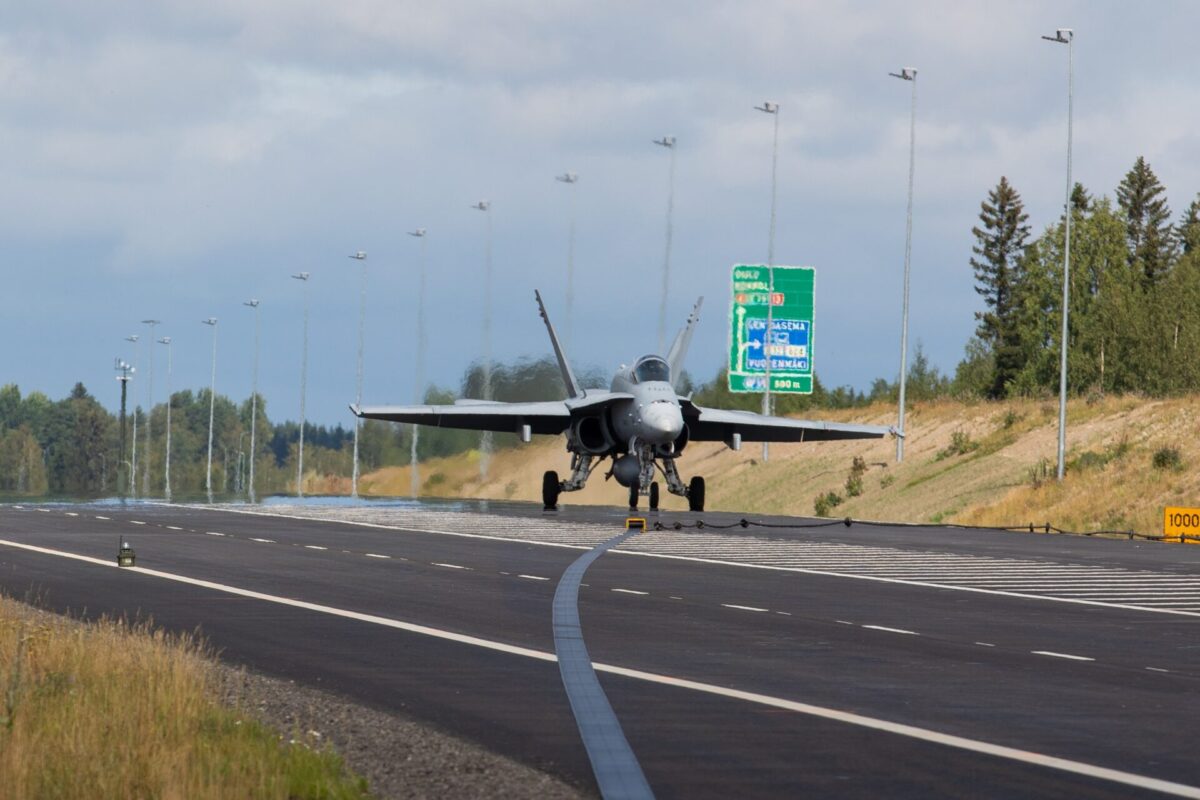
Finland’s highway-strip training began in the 1960s, based on its maantietukikohdat (road base) concept. Its annual Baana exercise now serves as a training ground for visiting air forces to learn dispersed operations in Nordic conditions.
Recent editions have brought in foreign detachments from the United Kingdom, the United States, the Netherlands, and Norway, among others, to practice the full cycle, operating from highway strips, turning aircraft with limited support, and integrating host-nation procedures.
The growing international participation underscores how quickly dispersion has shifted from a niche Nordic specialty to an alliance-wide priority.
Cold War mindset for a post-Cold War force
Beyond traditional tactical challenges, ACE tackles a recent structural issue. The post-Cold War “peace dividend” reduced fleets and basing infrastructure. Across Europe, fewer aircraft, personnel, and runways concentrated combat power at fewer permanent sites, increasing vulnerability to targeting and reducing resilience by design.
The French Air Force was not exempt from this new reality. By the late 1980s, it could deploy a combat fleet of approximately 600 aircraft across roughly 30 runway bases in mainland France; by the end of 2002, this number had decreased to 24. The post-2008 drawdown intensified the reduction: between 2008 and 2014, the service closed 12 airbases and disbanded 15 major units, while its workforce declined from approximately 64,000 personnel in 2009 to about 49,500 in 2014.
By 2025, the result is a more compact force concentrated on a tight network of permanent sites. The French Air and Space Force lists 20 air bases in mainland France (plus five outside mainland France), 40,382 active-duty personnel, and a fighter fleet of 191 aircraft.
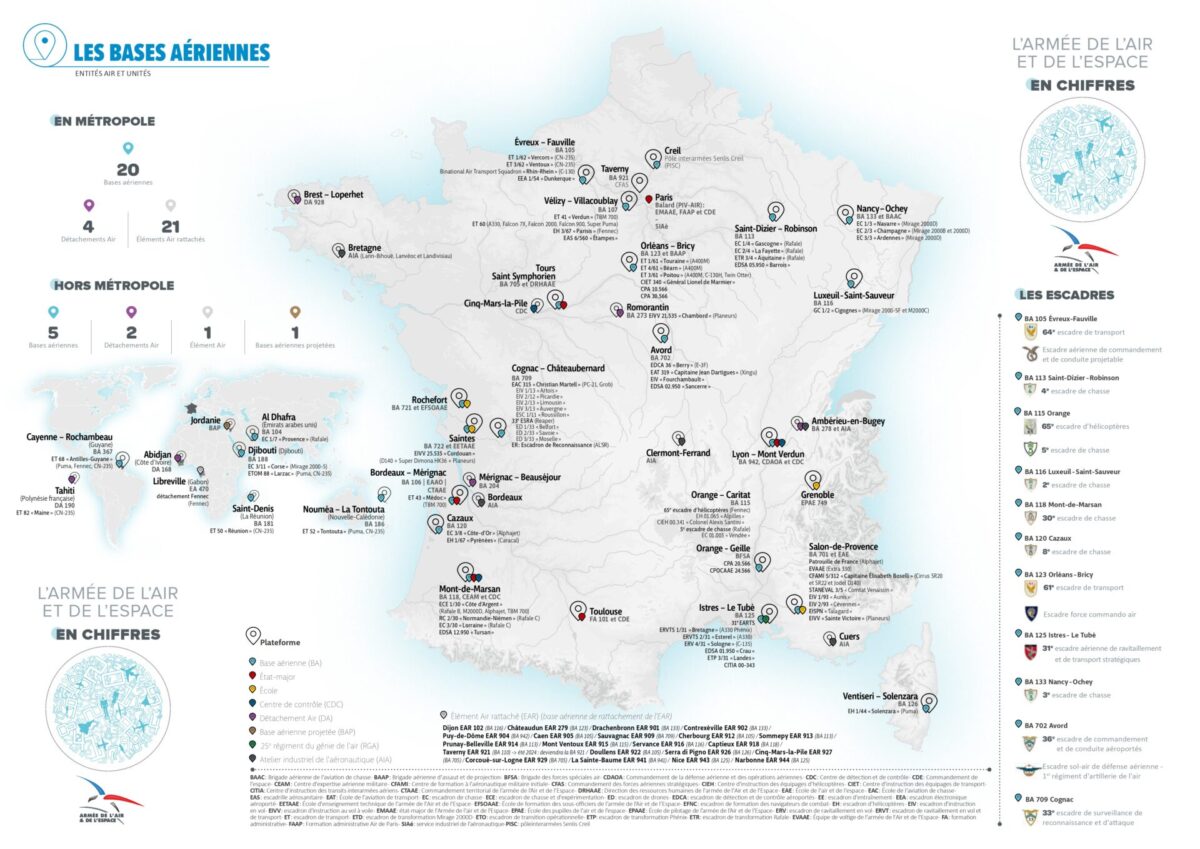
That concentration shapes France’s interpretation of ACE. The French Center for Strategic Aerospatial Studies (CESA) describes French ACE as generating combat power away from main bases with limited personnel and equipment, often in degraded conditions, and with heavier reliance on host-nation and allied support. It also emphasizes a mindset shift requiring more versatile teams, more decentralized decision-making, and a permanent capacity for responsive mobility.
Doctrinally, this pushes France toward an “extended air base” model, a main operating base backed by a network of primary and secondary dispersal sites, military or civilian, domestic or foreign, that can be activated on short notice. The model assumes that access is negotiated in advance, that information systems are interoperable, and that intra-theater lift can keep dispersed nodes supplied.
It is also built to plug into alliance mechanics. NATO’s Aircraft Cross-Servicing (ACS) program aims to reduce footprint and speed regeneration through common procedures and compatible ground equipment. In that context, France has already mapped which Typhoon, Gripen, and F-16 ground equipment can support Rafale operations, and has practiced cross-servicing with Gripen operators during deployments.
How dispersible is the Rafale?
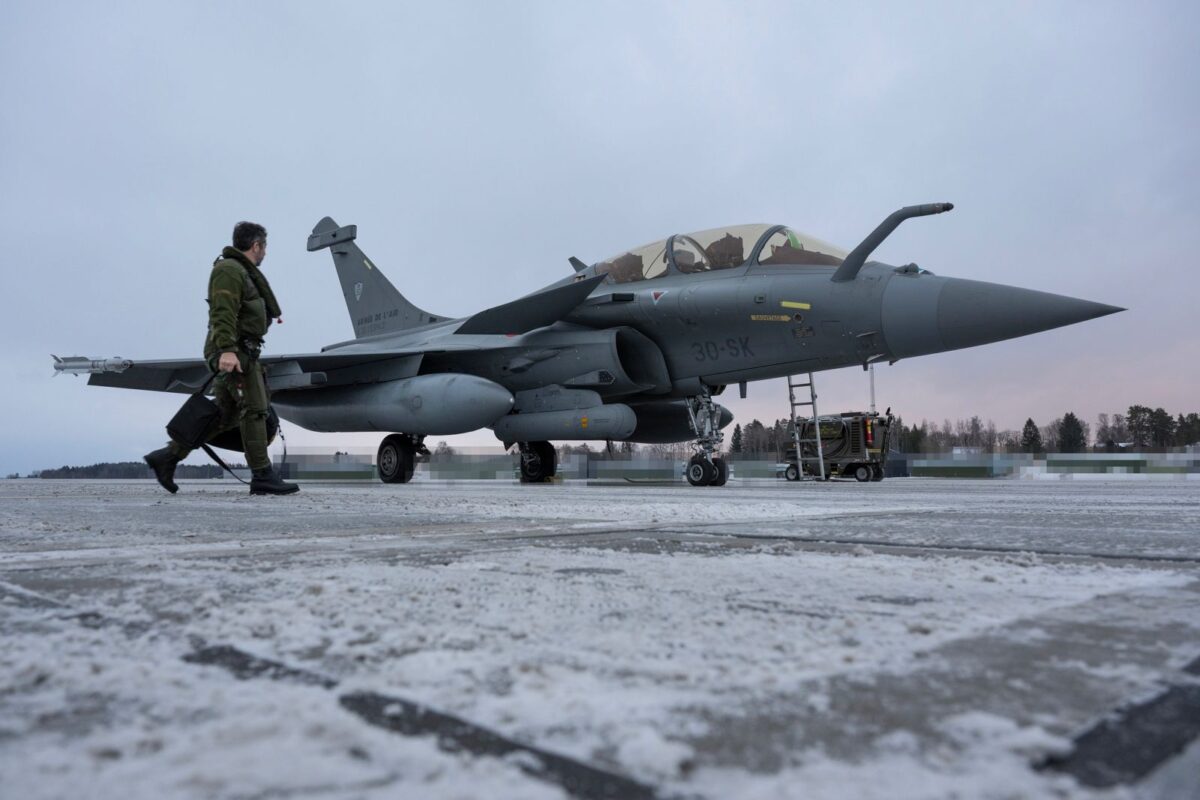
ACE is not platform-dependent. While dispersed operations are often associated with aircraft marketed for austere basing, the decisive factor usually lies less in the airframe than in the support system around it, logistics, ground procedures, and the human capacity to sustain sorties away from fixed infrastructure.
If Sweden is the poster child for a force that built its road base concept around a fighter tailored to that mission, Finland has long practiced dispersed operations with the F/A-18 Hornet and is now carrying that same concept into the F-35 era.
Another practical lesson in contemporary warfare emerged from the war in Ukraine. The F-16 is not an ideal platform for austere strip operations due to its relatively narrow landing gear and low-slung intake, which increase the importance of foreign object debris control and surface preparation. Yet Ukraine managed to turn the aircraft into an agile airpower asset by modifying sections of its highway network, including removing central dividers and preparing road surfaces.
To make that concept sustainable, the Come Back Alive Foundation’s Project 61 developed ground support systems on wheels for the F-16. Instead of relying on fixed airfield infrastructure, support is organized around truck-based mobile servicing units that can follow the aircraft to main or temporary airfields and emergency landing sites. Each of the two servicing units comprises a mobile workshop, two vans for transporting and loading munitions, and a pickup truck for logistics. A separate mission-planning unit includes an operations module and a living module to facilitate relocations and extended shifts.
According to the foundation, this configuration reduces the manpower required to attach a single munition from 10 to 12 personnel to three, while doubling the process speed.
Published manufacturer data suggest the Rafale is not poorly suited to dispersed operations, even if it was not designed with road base employment as explicitly as the Gripen. While Saab states that the Gripen E requires a 600-meter landing ground run, Dassault reports a 450-meter ground run for the Rafale, despite the French jet being larger and heavier overall. And although intake geometry represents only one aspect of foreign object damage (FOD) management, the Rafale’s intakes are not notably lower than the Gripen’s in practical terms, which helps when operating away from pristine, home-base conditions.
More importantly, Dassault advertises the Rafale as requiring limited ground equipment, maintenance that can be performed outdoors or under temporary shelter, and extensive built-in testability, thereby reducing the need for dedicated facilities. Safran’s Rubis 3 auxiliary power unit also reduces reliance on external ground support by providing the pneumatic and electrical power needed for engine start on the ground.
How small can a Rafale detachment get?
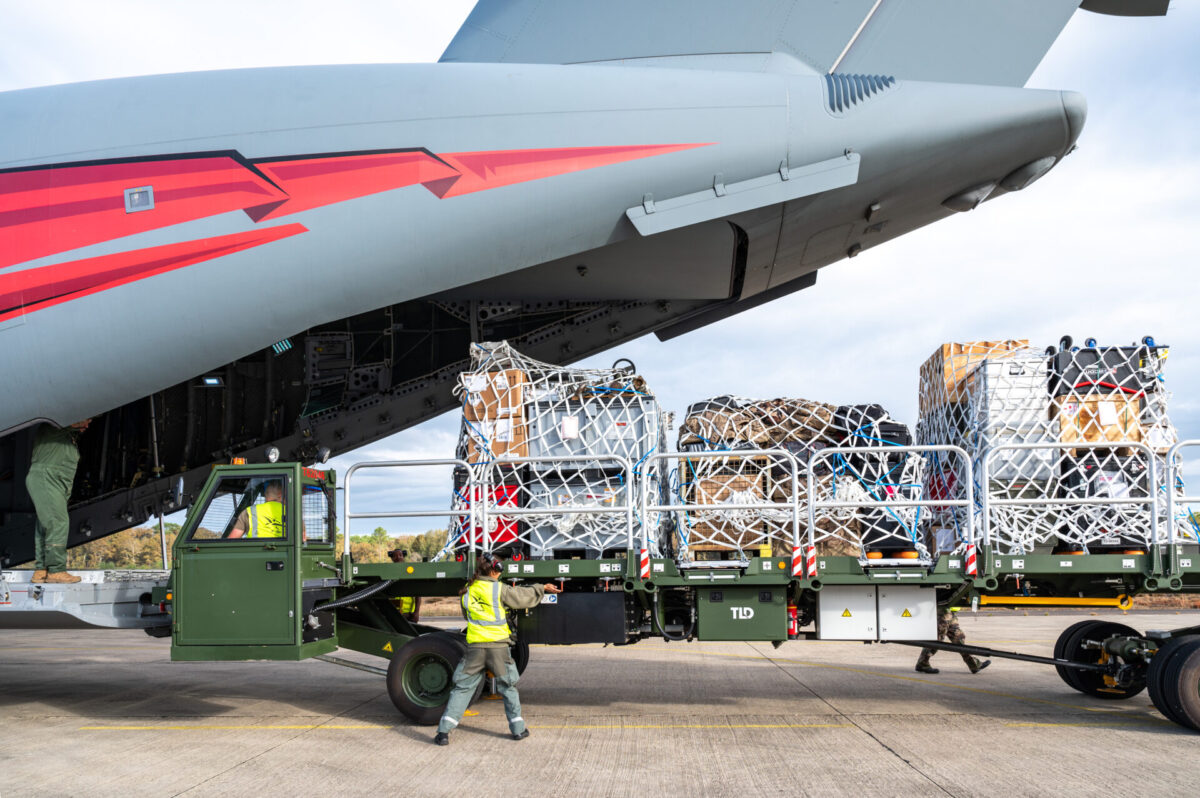
Using NATO’s Baltic Air Policing mission as a benchmark, a four-jet detachment typically brings on the order of 100 to 200 personnel, depending on the nation. That detachment carries much of its own maintenance depth, security, communications, and support functions.
France has been deliberately testing how small a package can get while still keeping Rafale generating sorties away from home. Already in 2014, shortly after Russia’s illegal annexation of Crimea, four Rafale deployed to Malbork, Poland, with an 80-person detachment. Aircraft generation and troubleshooting were handled by 16 mechanics using a technical kit that occupied only 8 cubic meters.
By 2023, this logic was increasingly packaged under the MORANE label, with a steady drumbeat of small-footprint deployments to allied bases designed to validate rapid movement, reduced technical lots, and host-nation integration. One example came in Romania that year, where three Rafale deployed to Fetești with a 33-person detachment and “reduced technical lots” moved in a single A400M, about four tons for 20 cubic meters.
More recently, in January 2026, at Uppsala, Sweden, a two-jet package from the ECE 1/30 experimental unit, with roughly 30 personnel across maintenance, logistics, systems, and communications, arrived quickly, plugged into host-nation routines, and started flying sorties.
Forward deterrence: a political compromise?
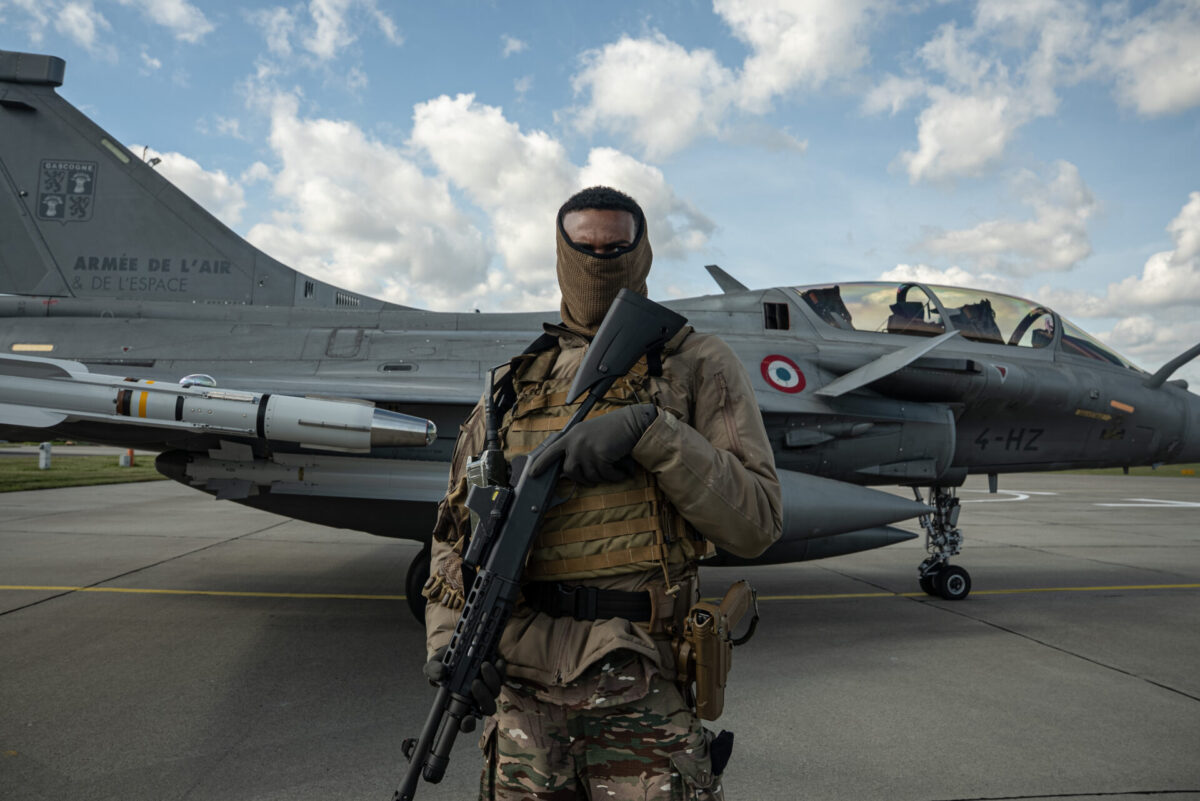
Dispersion also addresses a political constraint: dispersing Rafale for conventional training with a 30-person detachment is one thing, but extending it to the strategic air component, along with its ASMPA nuclear missiles, imposes stricter requirements for security, protected communications, force protection, and host-nation procedures.
Sweden and Finland have signaled they will not host nuclear weapons in peacetime, which effectively rules out anything resembling permanent basing or nuclear sharing as it exists in NATO with the United States. Thus, forward deterrence must remain flexible by design, centered around temporary deployments.
The credibility test will show up in exercises. Operation Poker sits at the top end of the spectrum, a Strategic Air Forces drill that rehearses each step of a nuclear raid four times per year. Macron has already pointed to a precedent in which British representatives were granted access to observe it. The first Poker cycle after his Île Longue speech took place on March 17, 2026, but it is not yet clear publicly whether any foreign representatives were included this time.
🇫🇷📸 POKER 2026-01 en images !
L’opération Poker de ce matin n’est pas passée inaperçue 👀
L’@Armee_de_lair nous régale avec de superbes clichés de ce raid matinal.De magnifiques vues du vecteur nucléaire (sans ogive) des FAS.
📸 Galerie complète en réponse épinglée https://t.co/k6UmtnYy8Y pic.twitter.com/t8LWXekRna
— Trackeur ADS-B 🇫🇷 📡 (@TrackeurADSB) March 17, 2026
Beneath the strategic layer, routine work will focus on MORANE. For forward deterrence to become a reality, France will likely maintain regular agile deployments across the continent to qualify bases, standardize host-nation procedures, and establish dispersal as a European posture.
A natural venue could be Finland’s Baana 26 road base exercise, generally held in early September. France’s first participation with a MORANE detachment would be timely, offering a concrete way to demonstrate agility alongside one of NATO’s most mature dispersal practitioners.
