


“I was very uncertain if it would ever happen when we first looked at the proposal, because I think—and the science center admits this—they really had no idea what was involved in trying to make a vertical display of a space shuttle stack,” said Dennis Jenkins, a former space shuttle engineer who led the preparation and delivery of the orbiters for their museums before becoming the project director for the Samuel Oschin Air and Space Center.
“We weren’t sure that it could be done anywhere other than at a [NASA] specialized facility. Doing it out in the middle of a construction site always seemed a little bit fantastic,” Jenkins told collectSPACE. “Of course, it proved to be extremely difficult yet extremely easy all at the same time. Once we figured out how to do it, it worked well.”
Credit:
California Science Center
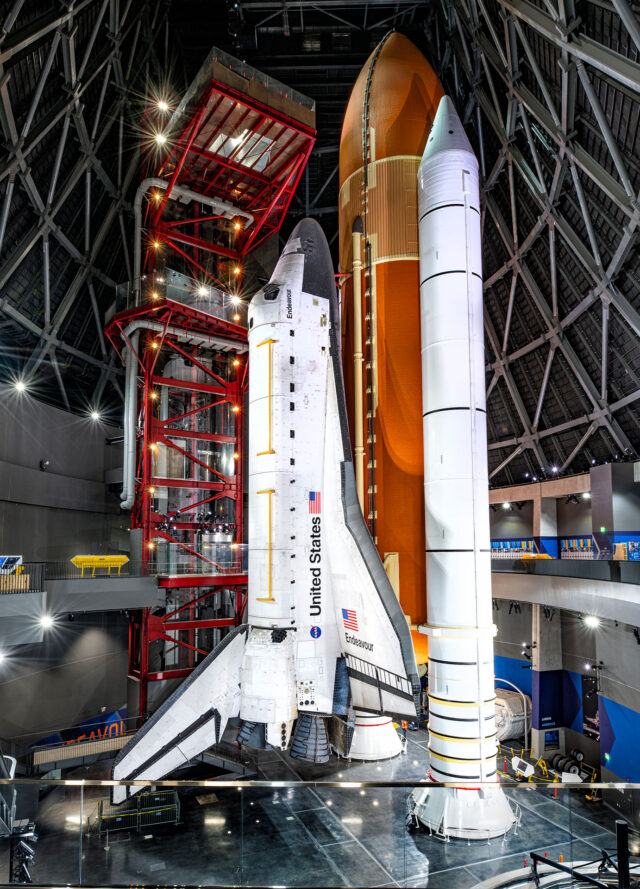
The 184-foot-tall stack, comprising the orbiter Endeavour, external tank, and twin solid rocket boosters, is believed to be the tallest indoor museum exhibit in the world.
Credit:
California Science Center
Now that the countdown has begun, T-minus 142 days to opening, the pressure is on to be ready to launch. In addition to the Samuel Oschin Shuttle Gallery, the Air and Space Center includes the Korean Air Aviation Gallery and Kent Kresa Space Gallery, which will showcase more than 25 aircraft and both historic and modern spacecraft, respectively.
“We’re still installing a lot of exhibits,” said Rudolph of the remaining work. “We’ve got artifacts that are still going in the aviation and space galleries. Quite a few are in, but a lot more are still to go. And we have begun installing the exhibits, but have a lot to install as well.”
Over the past year, a segment of a walkthrough space shuttle solid rocket booster has been lifted into the building by crane, a Hawker Siddeley Harrier T.4 aircraft was installed, a Rocket Lab Electron booster was stood up, and in May, the 70-foot forward section of a Korean Air Boeing 747-400 aircraft fuselage was rolled in.
source
