


The US Navy has conducted two demonstration flights of the Joint Direct Attack Munition Long Range (JDAM LR) variant, with each test covering approximately 200 nautical miles, in what the service describes as a step toward adding a lower-cost standoff strike option to carrier air wings.
The tests, conducted in early April 2026, were intended to validate safe separation from the launch aircraft, compatibility with existing aircraft interfaces, and controlled, powered free-flight and navigation to the target.
“As Naval Air Forces in theater continue to rely heavily on JDAM systems, the program recognizes a critical need to provide the fleet with greater standoff range,” said Captain Sarah Abbott, Precision Strike Weapons program office (PMA-201) Program Manager, in the US Navy’s release. Abbott said the new capability would allow pilots to engage targets from “significantly safer distances” in contested environments.
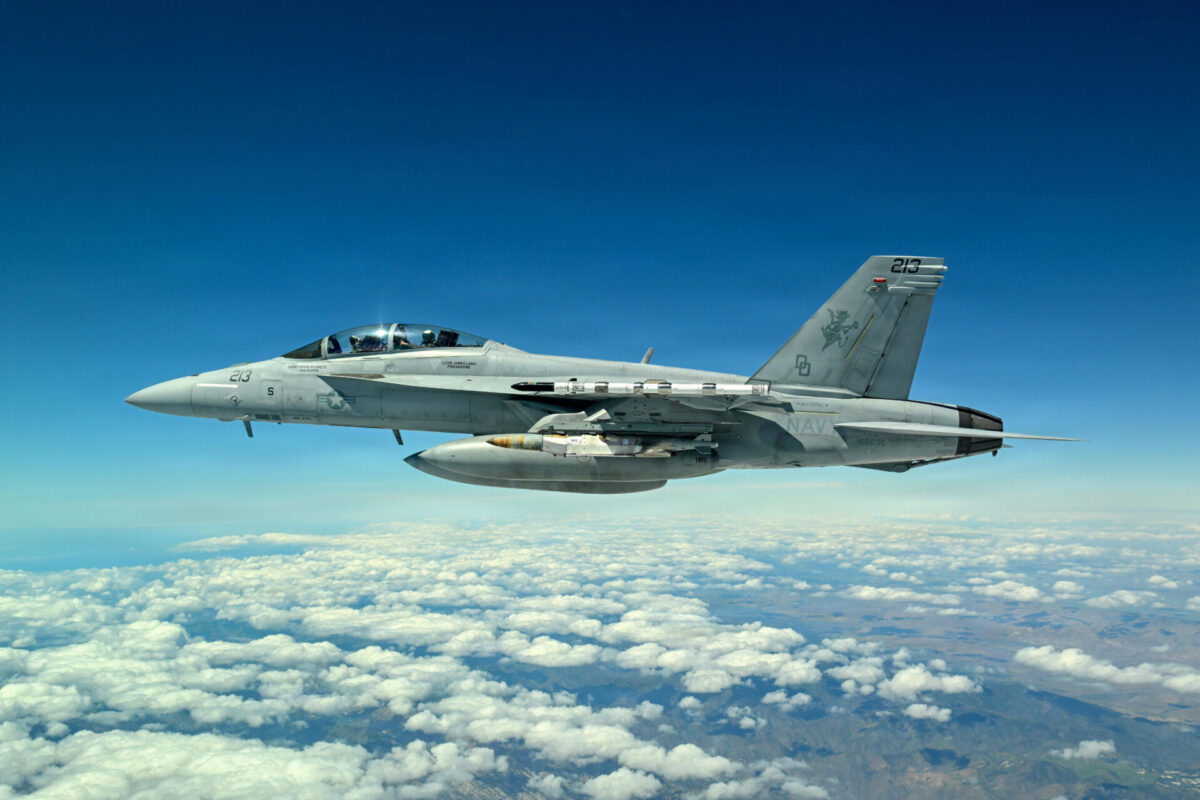
Imagery and footage released with the announcement show the weapon carried under the wing of an F/A-18 Super Hornet. NAVAIR did not disclose the exact test location
A New Era for Precision Strike: JDAM LR Completes Milestone Test Flights
The U.S. Navy has successfully demonstrated the new JDAM Long Range variant, marking a huge step in bringing affordable, long-range standoff capabilities to the Carrier Air Wing.https://t.co/GvMomaPnSp pic.twitter.com/cNgEgnZGXy
— NAVAIR (@NAVAIRNews) April 20, 2026
From gravity bomb to powered munition
JDAM LR is a Boeing product that evolved from a concept the company previously marketed as the Powered JDAM, a designation it retired earlier this year. It builds on the widely fielded JDAM guidance kit by adding a TDI J85 turbojet engine, a fuel tank, and a wing set, all to carry a 500-pound Mark 82 general-purpose warhead. The configuration effectively converts a gravity bomb into a long-range cruise munition while retaining the existing JDAM seeker, aircraft interfaces, and impact control.
Boeing has stated that the baseline JDAM LR is designed to reach approximately 300 nautical miles. A decoy variant, which replaces the warhead with additional fuel, is expected to fly around 700 nautical miles.
At the WEST 2026 conference in San Diego in February, Boeing also presented planned anti-ship and Quickstrike aerial mining configurations for the weapon, pitched for carriage by US Air Force B-52H and B-1B bombers in addition to fighter platforms.
The anti-ship variant extends the logic of the QUICKSINK program, which paired a JDAM-class weapon with a dedicated maritime seeker and was demonstrated by a B-2 Spirit sinking the decommissioned M/V Monarch Countess off Florida during RIMPAC 2024.
The US Navy said the next phase of work will focus on shipboard integration, covering the handling, storage, and loading procedures required to operate the weapon from an aircraft carrier. This is a more demanding environment than land-based qualification, given the space, safety, and materiel constraints of a flight deck and magazine. Neither NAVAIR nor Boeing has disclosed a target date for initial operational capability.
A crowded standoff arsenal
JDAM LR would enter a US Navy strike inventory that already includes the Tomahawk cruise missile, the AGM-158C Long Range Anti-Ship Missile (LRASM), the AGM-158 JASSM family, and the Raytheon StormBreaker small-diameter bomb, each offering different combinations of range, warhead, seeker, and cost. The stated appeal of JDAM LR is lower per-round cost and higher production volume, positioning it as a complement to higher-end missiles.
Anti-ship and Quickstrike configurations would, if fielded, extend a trend visible across other Boeing precision programs, including recent work on munitions wing kits for the P-8A Poseidon, toward converting existing stores into longer-reach, crew-distancing weapons for contested maritime environments.
source
