


The US Air Force is looking for industry partners to develop a low-cost, long-range air-to-surface missile launchable in volume from cargo aircraft, as the service seeks to expand its standoff strike capacity at scale.
The program, designated ‘Family of Affordable Mass Missiles, Beyond Adversary’s Reach’, or FAMM-BAR, was detailed in a Request for Information dated April 17, 2026, with industry responses due by April 29, 2026. The RFI was first reported by Defense News.
Issued by the US Air Force Life Cycle Management Center’s Armament Directorate at Eglin Air Force Base, the notice seeks companies able to design, develop and manufacture an affordable standoff munition “in an affordable and expedited manner.”
The US Air Force says the procurement objective is to build an inventory for both the US government and Foreign Military Sales, with annual orders ranging from 1,000 to 2,000 units per year over five years.
The stated goal is to “streamline the battlespace” by developing a single, common air-to-surface munition that is affordable, adaptable, and offers significant standoff range.
Low-cost missile with long-range ambitions
FAMM-BAR sits at the upper end of a broader US Air Force effort to field cheaper standoff weapons in larger quantities. The service is already developing two shorter-range members of the same family: FAMM-P, designed for palletized launch from cargo aircraft, and FAMM-L, a lugged munition for fighters and bombers. Both are expected to offer ranges of 250 to 500 nautical miles.
The Beyond Adversary’s Reach variant pushes that envelope much further. The RFI calls for a range of at least 1,000 nautical miles, a cruise speed of Mach 0.7 or higher, palletized deployment from cargo aircraft, mid-course navigation updates, and a manufacturing rate of at least 1,000 missiles per vendor per year. The initial target set is maritime, with the document referring to “slow moving maritime” vessels.
The anti-ship focus comes amid a wider push by the Pentagon to expand long-range maritime strike capacity for the Indo-Pacific, where the US military needs weapons that can be bought, stockpiled and launched at scale. The notice also asks vendors how their designs would operate in GNSS-denied environments, including navigation, flight profile and terminal attack logic.
While palletized launch is the primary deployment method, the US Air Force is also asking industry whether the same missile could be adapted for lugged carriage by fighters and other aircraft. The RFI goes further by asking whether proposed designs could also support surface-to-surface launch by US Army and US Navy systems, while stressing this is for information gathering only and does not represent a demand signal from the other services.
The RFI lands as the US defense industry races to offer low-cost cruise missile designs that could complement more capable but expensive weapons such as the AGM-158 JASSM-ER and the AGM-158 XR.
Recent candidates include CoAspire’s Rapidly Adaptable Affordable Cruise Missile, Extended Range, or RAACM-ER, Anduril’s Barracuda-500, Lockheed Martin’s Common Multi-Mission Truck family, Leidos’ Black Arrow, designated AGM-190A, and Kratos’ Ragnarök low-cost cruise missile.
Cargo aircraft as missile carriers
FAMM-BAR also reflects a broader reassessment of what military transport aircraft can contribute to a high-end conflict. The idea is to use cargo aircraft payload capacity and range to launch large numbers of weapons from outside heavily defended airspace.
The US Air Force previously demonstrated this approach under the Rapid Dragon program, including a cruise missile launch from a C-17A in 2021 and a later MC-130J test in Norway in 2022.
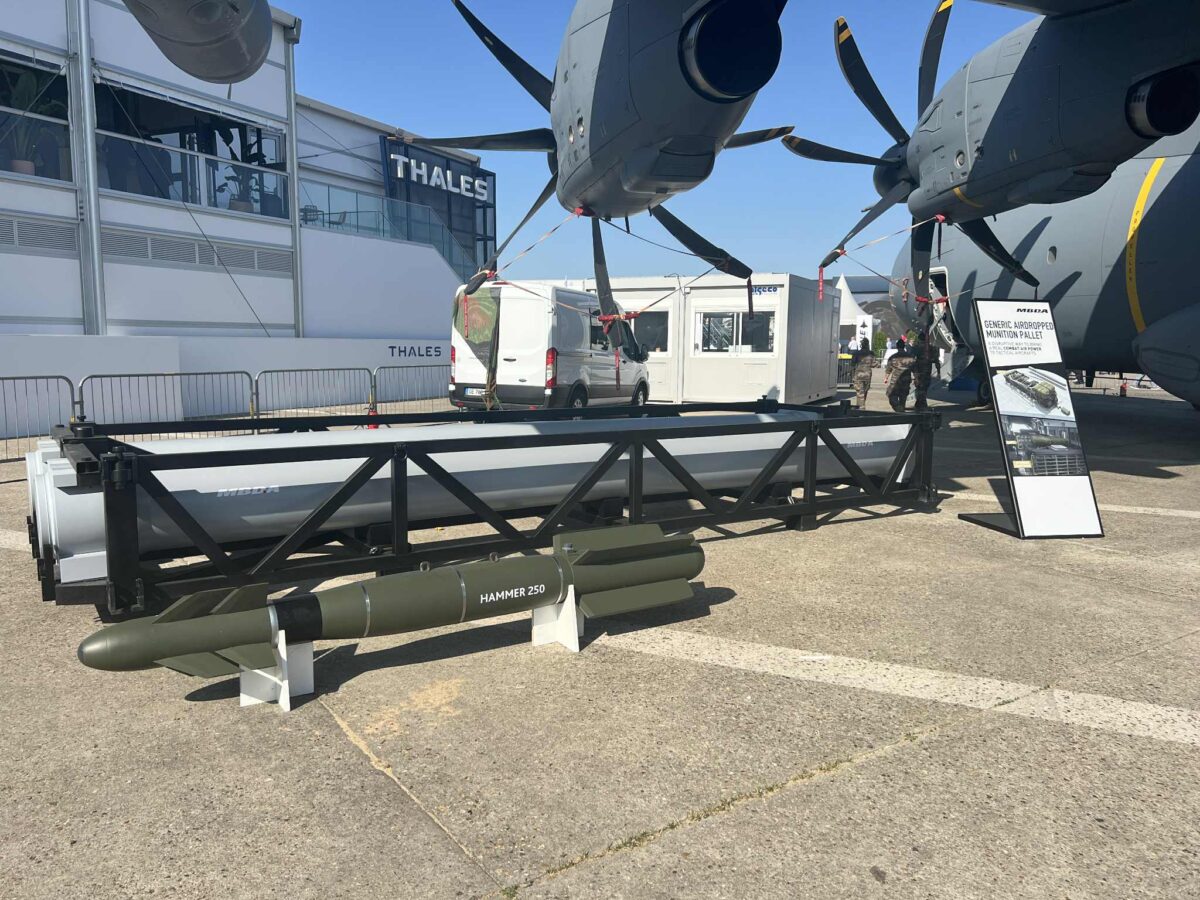
Other air forces are exploring similar ideas. Airbus has discussed an “A400M Mothership” configuration able to deploy up to 50 medium-sized drones or up to 12 Taurus-class cruise missiles from the transport’s cargo hold.
France has also begun experimenting with the concept: in January 2026, the Direction générale de l’armement confirmed that it had released 72 inert drone mock-ups from an A400M to validate simulations, separation dynamics and aircraft safety margins.
Japan has studied a similar role for its Kawasaki C-2 transport aircraft, including the possible launch of long-range missiles such as the AGM-158 JASSM and an air-launched version of the Type 12 anti-ship missile.
source
