


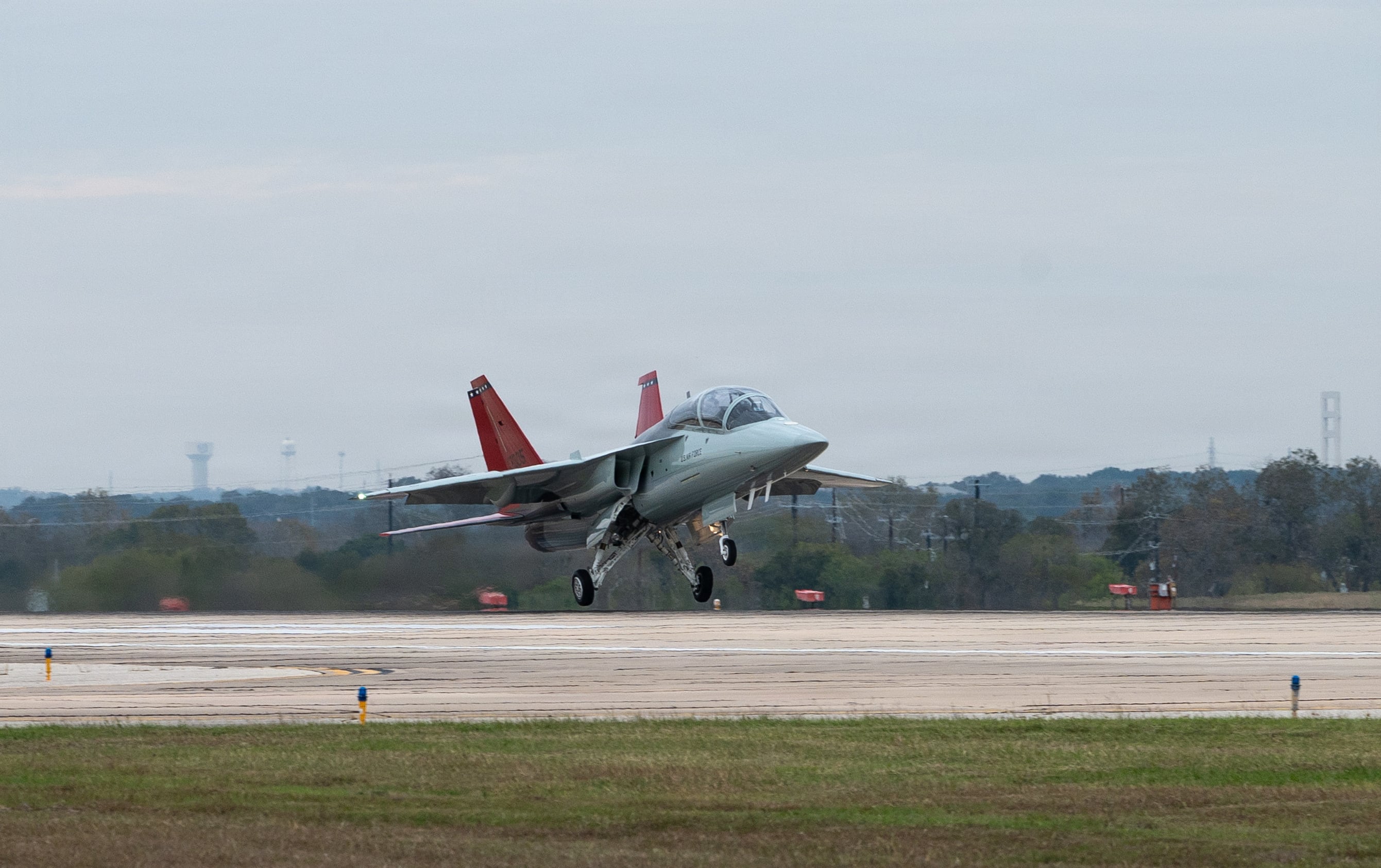
The Air Force’s first T-7 Red Hawk trainer assigned to an operational unit landed at Joint Base San Antonio-Randolph in Texas on Dec. 5, opening the door to the service’s new era of pilot training.
A lot more work remains, however, before the T-7 is officially folded into day-to-day activities to train the next generation of Air Force pilots.
The Boeing-made T-7 is the service’s first new jet trainer in decades, and the first designed to teach new pilots how to fly fifth-generation jets such as the F-22 Raptor and F-35 Joint Strike Fighter. It will also be used to teach pilots to fly the advanced B-21 Raider stealth bomber and F-47 fighter.
Lt. Col. Michael “Hyde” Trott, commander of Randolph’s 99th Flying Training Squadron, first flew the T-7 from Boeing’s St. Louis, Missouri, factory to Sheppard Air Force Base in Georgia on Dec. 3.
Two days later, during a brief period of favorable weather, Lt. Col. Phillip “Clean” Bourquin, the 99th’s director of operations, flew it the rest of the way to Randolph. The Air Force had planned to hold a ceremony when the jet arrived, but the event was postponed due to weather.
Trott told reporters Nov. 25 that while the cadre of instructors at the 99th had not yet flown the T-7, they had already spent “tens, if not hundreds” of hours in simulators to get familiar with how the aircraft flies before its arrival. The 99th and its personnel have also been working with Boeing and the Air Force’s T-7 program office to help shape the jets’ manuals, simulator and course materials, Trott said.
“We have a lot of time with the avionics, the pilot-vehicle interface, and the sim itself,” Trott said. “We have been providing feedback from an aircrew perspective on how those read and what they contain.”
Trott said he and Bourquin were scheduled to travel to St. Louis, where Boeing builds the jets, for ground training, academic training and more simulator time in the days before the actual flights began.
Before the ferrying flight, Trott said he was not concerned that it would be his first time flying the T-7, and said he felt highly prepared by the simulators, which are far superior to the T-38’s.
“The jump from simulator to jet in the T-38 has a gap that needs to be bridged,” Trott said. “The sim prepares you, but it does not exactly replicate how the T-38 flies and feels. With the T-7, that sim is — from what I understand from those who have flown the jet — very representative.”
Trott said the T-7 simulators have a 360-degree enclosure with high-fidelity visuals, which makes for a more lifelike representation of what flying in a real Red Hawk is like. The physical items in the simulator are highly representative of what is in a real T-7 cockpit, which helps with the simulator’s realism, he said.
The simulator has a mechanism that somewhat recreates the sensation of pulling G-forces in an airborne jet going hundreds of miles per hour, Trott added, which helps provide “sensory feedback.”
“Hopping in that sim with no real background knowledge, it’s like a duck taking to water,” he continued.
Next step: Training the trainers
Following the T-7’s arrival, Trott said, the 99th planned to conduct maintenance on it and other activities to swiftly get it ready for flying status. The squadron has also set up a training plan to get its pilots ready to fly the jet, he said.
Maintainers are also being trained on the jet so they can be certified to repair it, he said. Boeing personnel are at Randolph, teaching the squadron’s maintainers, pilots and other personnel how to use the T-7.
Jillian Watson, director of logistics, engineering and force protection at Air Education and Training Command, told reporters in another roundtable on Dec. 1 that the first 39 T-7 maintainers at Randolph will be trained from January to June on all of the jet’s systems, including its engine. But preparations have already been under way for months, she said, so that the Randolph team can quickly start training after the New Year’s holiday.
This T-7 is not a test aircraft, similar to those being flight tested at Edwards Air Force Base in California, Trott said — but it’s also not a fully production-representative aircraft.
“The aircraft is still in development, and this one is going to be a developmental aircraft,” Trott said. “But we are very familiar with its capabilities and what it is bringing when it arrives here at Randolph. And my aircrew and I are very ready to take it to the sky and start getting flights under it.”
The first T-7 flights will be to train the 99th’s instructor pilots, with part of that including taking the T-7 up for basic fighter maneuvers, or “dogfighting” practice.
Trott said the instructors will be watching for several flight characteristics in the first T-7 flights, including how it handles, what speed it should be for maneuvers like break turns and what tactics, techniques and procedures should be codified in the T-7’s manual.
The 99th does not teach students how to fly, but instead teaches instructor pilots how to teach flying, and those instructors then go on to other schoolhouses. The first students are expected to fly in the T-7 in fall 2027, he said.
The T-7 is expected to begin its initial operational test and evaluation process in summer 2027, by validating its performance in an operational training environment before it can reach full operational capability.
The squadron said the Air Force expects the jet will reach initial operational capability in late summer 2027.
The second T-7 is expected to arrive at Randolph by the end of spring 2026 and the Air Force wants to have 14 jets there by August 2027.
Trott noted that having a hand in the beginning of a major new Air Force jet was both humbling and an honor, especially for the 99th.
The squadron dates back to World War II and the 99th Pursuit Squadron — the pioneering Black pilots known as the Tuskegee Airmen. Soon renamed the 99th Fighter Squadron, those pilots flew in red-tailed fighters during World War II to defend Allied bombers over Europe, and inspired the Red Hawk’s name. The Air Force later turned it into a training squadron.
“When you’re a kid, you dream about being a pilot, and then you achieve that dream,” Trott said. “Being able to do something as historical as this is not lost on me.”
Stephen Losey is the air warfare reporter for Defense News. He previously covered leadership and personnel issues at Air Force Times, and the Pentagon, special operations and air warfare at Military.com. He has traveled to the Middle East to cover U.S. Air Force operations.
source
