
Close Menu
  • AVIATION
    • US Airlines
    • Airports & Hubs
    • eVTOL & Urban Air
  • MILITARY
    • Air Force
    • Defense News
  • SPACE
    • SpaceX & Rockets
    • NASA
    • Commercial Space
  • CARGO
  • CORPORATE
  • TECH & OEMS
  • REGULATORS
    • FAA
    • NTSB
    • TSA
What's Hot

Why Chesky Is Building His AI Lab Outside Airbnb

June 17, 2026

Arianespace launches its heaviest payload to date with Amazon Leo flight

June 17, 2026

Ukraine To Help Fulfill Europe’s Long-Range Strike Missile Needs

June 17, 2026
Facebook X (Twitter) Instagram
Demo
  • AVIATION
    • US Airlines
    • Airports & Hubs
    • eVTOL & Urban Air
  • MILITARY
    • Air Force
    • Defense News
  • SPACE
    • SpaceX & Rockets
    • NASA
    • Commercial Space
  • CARGO
  • CORPORATE
  • TECH & OEMS
  • REGULATORS
    • FAA
    • NTSB
    • TSA
Facebook X (Twitter) Instagram
Demo
Home » Towers once planned for California shuttle launches leveled for SpaceX rockets
Space Tech

Towers once planned for California shuttle launches leveled for SpaceX rockets

FlyMarshall NewsroomBy FlyMarshall NewsroomJune 17, 2026No Comments3 Mins Read
Share
Facebook Twitter LinkedIn Pinterest Email

In the end, only the prototype Enterprise was stood up with an external tank and solid rocket boosters on SLC-6 before the Challenger tragedy in 1986 caused the DOD to rethink its reliance on the shuttle. Again, the Air Force walked away from the built-up facility, having never launched a single mission.
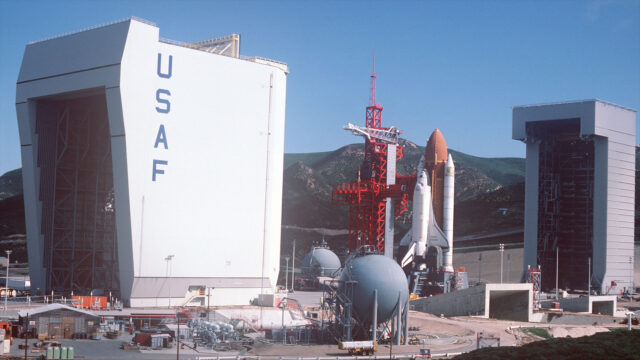
NASA’s prototype space shuttle orbiter Enterprise, stacked with an external tank and two solid rocket boosters, stands at Space Launch Complex-6 (SLC-6), flanked by the assembly building and mobile service tower at Vandenberg Air Force Base (today Vandenberg Space Force Base) in California in February 1985.

Credit:
U.S. Air Force/Tech. Sgt. James Pearson

NASA’s prototype space shuttle orbiter Enterprise, stacked with an external tank and two solid rocket boosters, stands at Space Launch Complex-6 (SLC-6), flanked by the assembly building and mobile service tower at Vandenberg Air Force Base (today Vandenberg Space Force Base) in California in February 1985.


Credit:

U.S. Air Force/Tech. Sgt. James Pearson

After a brief effort to revive SLC-6 for use with the Titan IV in the early 1990s, the site finally saw its first operational use with the launch of Lockheed Martin’s LMLV-1 in 1995, followed by Athena I and Athena II rockets with payloads for NASA and Space Imaging (later GlobalEye) in 1997 and 1999, respectively.

Boeing (later United Launch Alliance or ULA) then leased the site and modified the shuttle-legacy structures, including the assembly building, mobile service tower, and access tower, for a series of 10 Delta IV rocket launches on missions for the National Reconnaissance Office (NRO). The final launch from SLC-6 to date was of a Delta IV Heavy on September 24, 2022.

SpaceX at SLC-6

In 2023, SpaceX signed a lease to use SLC-6 for its Falcon rockets. Tuesday’s demolition advanced the company’s plans toward modernizing the site.

Since 2013, SpaceX has been launching Falcon 9 rockets from Space Launch Complex-4 (SLC-4) at Vandenberg.

In addition to now having access to SLC-6 itself, SpaceX in 2016 acquired the Orbiter Transporter System (OTS) originally developed for the West Coast site. The 76-wheel motorized vehicle is now used to transport flown Falcon 9 first stages from the company’s Cape Canaveral facilities to its Florida launch pads.
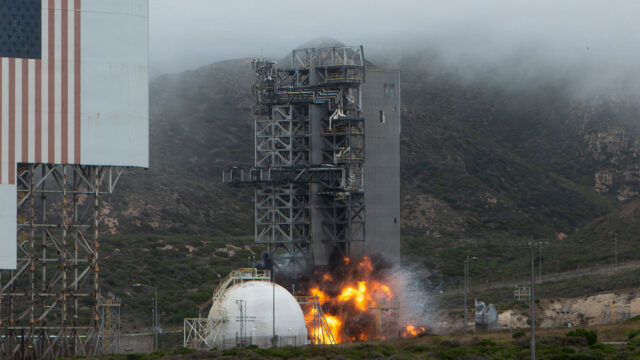
Explosive charges sever the structural supports of the Fixed Umbilical Tower at Space Launch Complex-6 during a controlled demolition on June 16, 2026, at Vandenberg Space Force Base in California.

Credit:
U.S. Space Force/Staff Sgt. Daekwon Stith

Explosive charges sever the structural supports of the Fixed Umbilical Tower at Space Launch Complex-6 during a controlled demolition on June 16, 2026, at Vandenberg Space Force Base in California.


Credit:

U.S. Space Force/Staff Sgt. Daekwon Stith

According to a 2025 environmental impact study, SpaceX expects it will take an additional 18 months to complete modifications to SLC-6, including the construction of two landing pads for the reusable Falcon 9 first stage boosters. Falcon Heavy launches could begin as soon as 2030, pending the NRO’s needs.

“We are not just updating infrastructure,” said Horne. “We are leveraging industry capabilities to field a more resilient space enterprise, ensuring the United States is prepared to protect our national interests and meet future challenges for decades to come.”

Click through to collectSPACE for more photos of the demolition of the SLC-6 support towers.

source

FlyMarshall Newsroom
  • Website

Related Posts

Arianespace launches its heaviest payload to date with Amazon Leo flight

June 17, 2026

SpaceX launches 3 Block 2 BlueBird satellites for AST SpaceMobile

June 17, 2026

Low Water at San Carlos Reservoir

June 17, 2026

NASA’s Webb Catches Exoplanet Getting Roasted

June 17, 2026
Add A Comment
Leave A Reply Cancel Reply

Latest Posts

Why Chesky Is Building His AI Lab Outside Airbnb

June 17, 2026

Arianespace launches its heaviest payload to date with Amazon Leo flight

June 17, 2026

Ukraine To Help Fulfill Europe’s Long-Range Strike Missile Needs

June 17, 2026

Poland weighs joining X-BAT autonomous vertical-takeoff fighter program

June 17, 2026

Subscribe to Updates

Please enable JavaScript in your browser to complete this form.
Loading
About Us

Welcome to FlyMarshall — where information meets altitude. We believe aviation isn’t just about aircraft and routes; it’s about stories in flight, innovations that propel us forward, and the people who make the skies safer, smarter, and more connected.


Useful Links
  • Business / Corporate Aviation
  • Cargo
  • Commercial Aviation
  • Defense News (Air)
  • Military / Defense Aviation
Quick Links
  • About Us
  • Contact Us
  • Disclaimer
  • Privacy Policy
  • Terms and Conditions

Subscribe to Updates

Please enable JavaScript in your browser to complete this form.
Loading
Copyright © 2026 Flymarshall.All Right Reserved
  • About Us
  • Contact Us
  • Disclaimer
  • Privacy Policy
  • Terms and Conditions

Type above and press Enter to search. Press Esc to cancel.

Go to mobile version