

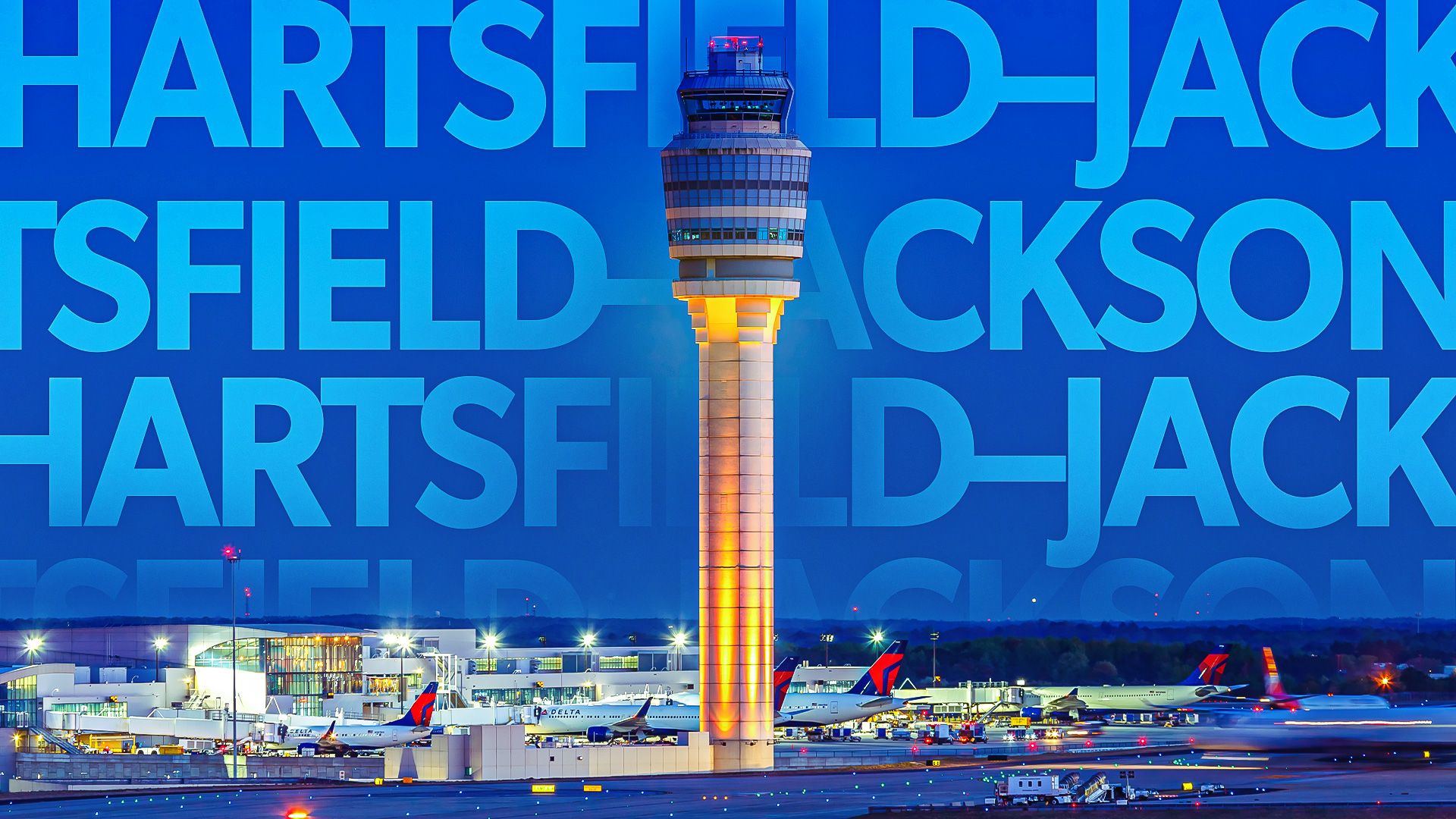
Not surprisingly,  Hartsfield-Jackson Atlanta International Airport (ATL) retains its title as the world’s busiest airport in 2025. The airport has held this position since 1998, except for 2020 due to the COVID-19 pandemic. According to OAG data, ATL had roughly 5.4 million scheduled passenger seats in October 2025. This figure leads its competition (
  Dubai International Airport) by 1.4%, which has been slowly closing the gap with Hartsfield-Jackson over the past few years.
Interestingly, despite being the busiest airport by passenger volume, ATL does not rank among the top 10 airports by land area, either globally or within the United States. Atlanta’s population is also far smaller than that of other major cities hosting the world’s busiest airports, with approximately 520,000 residents compared to populations in the millions or even tens of millions of others on the list. Atlanta is strategically located to serve as a major hub for both domestic and international air traffic. The airport reports that nearly 80% of the US population can be reached within a 2-hour flight, making it an ideal location for implementing the hub-and-spoke model, which Delta clearly leverages.
Delta’s Domination At ATL

Hartsfield-Jackson and  Delta Air Lines are closely connected. Delta serves five continents and operates from all seven concourses. According to the September 2025 monthly traffic report published by the airport, Delta and its regional affiliate, Delta Connection, transported over 225,000 passengers per day. The majority of these passengers connected through Atlanta rather than disembarking there as their final destination.
As expected, Delta holds the majority of the market share at ATL. In September, the airline carried an impressive 80% of all passengers. Specifically, Delta captured 81% of the domestic market share and 77% of the international market. It is noteworthy that only 13% of Delta’s passenger traffic in Atlanta was international, emphasizing the strength of its domestic network. This is evident in Cirium Diio data on Delta’s busiest ATL routes in September, where no international route ranks among the top 25.
Despite this domestic dominance, Delta’s international footprint remains extensive. The carrier connects Atlanta to more than 40 international destinations across Europe, Latin America, Africa, and Asia. Its strategic SkyTeam Alliance partnerships with Air France-KLM, Korean Air, and LATAM airlines strengthen ATL’s role as a global connecting point and Delta’s overall route network.
Exploring Delta’s Most Frequent Routes

Delta’s two busiest routes are also its most frequent, with the most daily departures. Information provided by FlightsFrom.com shows New York LaGuardia Airport (LGA) and  Orlando International Airport (MCO) have up to 15 scheduled departures/arrivals per day (depending on the weekday). Currently, the LGA service is operated exclusively by the Airbus A321, while the MCO service is operated solely by the Boeing 757-200. This differs from the route this past summer, when, up until August 10th, the 757-300 was used on up to 7 daily legs. The -300 variant is unique in that it is the longest single-aisle plane ever built (nicknamed the “Flying Pencil”).
The airline also hosts a massive Boeing 717 base in ATL. 73% of Delta’s daily 717 movements are through Atlanta’s airport. It is one of the last two airlines to continue to operate the 110-seat airframe, and it is essential to Delta’s network. These domestic workhorses primarily operate short, one-to-two-hour flights that demand more capacity than a regional jet but not enough to justify a larger single-aisle aircraft.
Delta has valued aircraft serving the middle market for decades. The airline began its journey in this segment with the McDonnell Douglas DC-9 in the mid-1960s. Over time, these airframes were replaced by the McDonnell Douglas MD-80 and the series of aircraft that followed. The 717 is the last variant in the MD-80 family, originally designated the MD-95 before the Boeing-McDonnell Douglas merger. Currently, with an average fleet age of almost 24 years, Delta will soon need to phase out its 717s. They aim to replace the aging fleet with the Airbus A220 (also formerly known by another name before an industry merger). The A220 offers customers a significantly more comfortable and modern passenger experience.
Other Market Players

The next two market leaders in Atlanta are both low-cost carriers: Frontier Airlines and  Southwest Airlines, which held 6% and 4% of the September market share, respectively. As reported by Aviation Week, Frontier began serving Atlanta as a focus city in early 2015. Frontier continues to expand and challenge Delta with its low-cost strategy.
However, Southwest Airlines has a long history at the airport, stemming from several mergers that trace back to ValuJet, which began operating out of ATL in the fall of 1993. ValuJet was later acquired and rebranded as AirTran Airways. AirTran significantly expanded its operations in Atlanta before being acquired by Southwest, which is now scaling back its Hartsfield operations, CNBC reported. Both airlines serve the majority of Atlanta’s busiest domestic routes.
|
Top 5 Destination Airports from ATL (July 2024 – May 2025) |
|||
|---|---|---|---|
|
Rank |
Airport |
Passengers |
Airlines |
|
1 |
Orlando International Airport (MCO) |
1,401,070 |
Delta, Frontier, Southwest, Spirit |
|
2 |
LaGuardia Airport (LGA) |
1,143,950 |
Delta, Frontier, Southwest, American |
|
3 |
Fort Lauderdale-Hollywood International Airport (FLL) |
1,126,060 |
Delta, Frontier, Spirit |
|
4 |
Tampa International Airport (TPA) |
993,590 |
Delta, Frontier, Southwest, Spirit |
|
5 |
Los Angeles International Airport (LAX) |
987,360 |
Delta, Frontier, Spirit, American |
|
Source: Bureau of Transportation Statistics (BTS) |
|||
At the top of this list stands the Atlanta-Orlando route. Frontier, Southwest, and Spirit Airlines operate on this route, along with Delta. Although Spirit does not rank among the top five carriers at ATL, it still has a medium-sized presence with 2% market share. The more interesting part of this Orlando service is that it not only marks Atlanta’s busiest route, but also the entire country’s busiest domestic airline route of 2024, as analyzed by OAG.
The Other Side Of The Airport: Cargo

There are two main cargo terminals on the airport grounds. The main cargo ramp is located on the far north side of the airport, just north of the northernmost runway, 8L/26R. The smaller ramp is situated between the two southernmost runways, 10/28 and 9R/27L.
Although Atlanta does not have a relatively large cargo operation, it still ranks among the top US airports by cargo landed weight. In 2024, the airport handled 1.46 million tons (1.3 mt) of freight, placing it 15th nationwide, according to the Bureau of Transportation Statistics (BTS). That may sound impressive, but it pales in comparison to dedicated cargo hubs like Anchorage, Memphis, and Louisville, which each handled between 9 and 13 million tons (8.2 – 11.8 mt) during the same period.
|
Top 5 US Airports by Landed Weight of Cargo Operations (2024) |
||
|---|---|---|
|
Rank |
Airport |
Weight (tons) |
|
1 |
Ted Stevens Anchorage International Airport (ANC) |
12.7 (11.5 mt) |
|
2 |
Memphis International Airport (MEM) |
10.6 (9.6 mt) |
|
3 |
Louisville Muhammad Ali International Airport (SDF) |
9.0 (8.2 mt) |
|
4 |
Miami International Airport (MIA) |
5.9 (5.4 mt) |
|
5 |
Cincinnati/Northern Kentucky International Airport (CVG) |
4.9 (4.4 mt) |
However, it is important to note that the BTS statistic above excludes passenger aircraft that also carry cargo. This distinction is notable because, in September, Delta transported more cargo than any other operator at the airport. Delta accounted for 26% of all cargo, followed by FedEx at 13% and UPS at 10%. The majority of Delta’s cargo arrives from abroad. In fact, Delta flies 79% more international cargo into Atlanta than it ships out of the country. Conversely, UPS and FedEx carry more cargo domestically than Delta does, relying on their mega-hubs to route international shipments.
What Lies Ahead For The Airport?

Delta and the Metro Atlanta community continue to pledge their commitment to investing in the airport. When Delta’s CEO, Ed Bastian, was asked about the possibility of a second airport in Atlanta to alleviate congestion and support expansion, he quickly dismissed the idea. He explained that their ongoing investments would continue to enhance Hartsfield-Jackson Atlanta International Airport (ATL), and that a secondary airport would only serve as a distraction.
The ATLNext program, an $11.6B project that debuted earlier this year, aims to improve passenger terminals, parking, airport infrastructure, and cargo facilities. Although construction has already led to increased traffic and detours around the airport, the project is designed to position ATL for future success, aiming to accommodate 120 million passengers annually by 2031. The engineering firm overseeing the project has stated that all terminals will remain fully operational throughout construction.
Even after decades at #1, Atlanta shows no sign of slowing down. The combination of Delta’s operational strength, geographical advantage, and citywide investment continues to solidify ATL as a leading global airport. As air travel grows at unprecedented rates and competition tightens, Hartsfield-Jackson’s ability to adapt while maintaining extreme efficiency positions it well for the future.
source
