

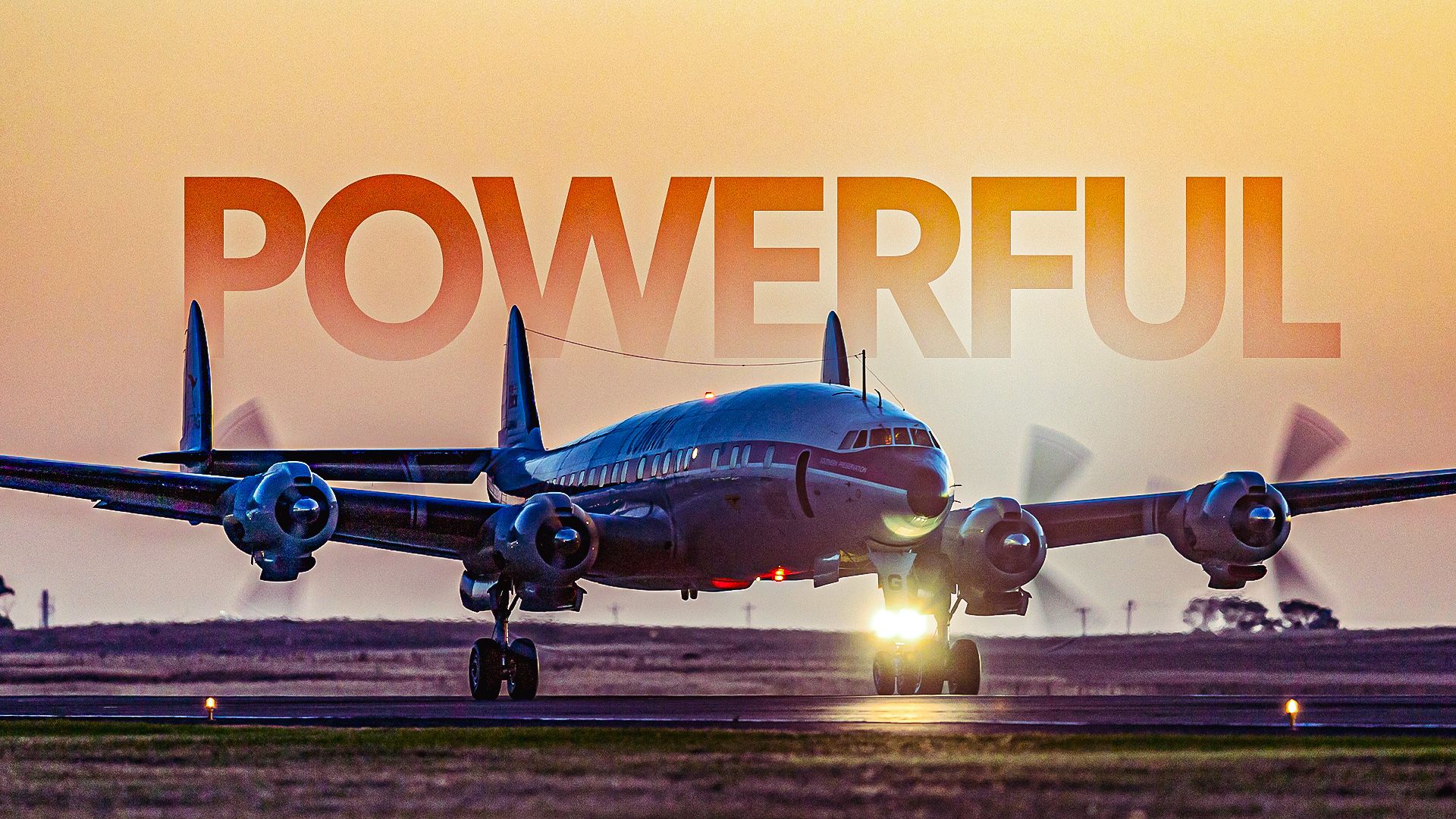
The story of the Lockheed Constellation is one of pioneering design, impressive performance, and an enduring legacy in the golden age of piston-airliners. In our article, we’ll explore just how powerful the Constellation really was, from its engine to its variants, and why it earned its place among the most capable aircraft of its era.
By understanding the evolution of the Constellation or, as it’s known more lovingly among aviation fans, “Connie,” variants, the engine technology that powered them, the other aircraft that shared or adopted those engines, and the reasons why the type found favor with airlines and military users. We will gain a deeper appreciation of how a propeller-driven aircraft could still pack a surprising punch just as the jet age loomed.
A Brief History Of The Lockheed Constellation

The idea of an intercontinental airliner that was more capable and faster than all previous models, filled with the cutting-edge technology of its period, was born just slightly before World War II, to be precise, in 1939, when Trans World Airlines ( TWA) requested a capable airliner that could fly for more than 3,500 mi (5,600 km). Luckily, not even the war disrupted the plan of the legendary Kelly Johnson and Lockheed’s engineers to create a high-performance, pressurized airliner capable of crossing continents and oceans. The prototype made its first flight on 9 January 1943.
Since The Constellation was created amid the war, it began its life first as a military transport, designated C-69, and only once the war was over did it evolve into a post-war airliner that would become a symbol of long-haul commercial flight before the advent of the jet age. Right after the war, the L-049 civil version finally entered service with airlines such as TWA (the launch customer) in late 1945. Of the Constellation series, a total of 856 aircraft were built between 1943 and 1958. With its distinctive triple-tail and streamlined long fuselage, Constellation became synonymous with post-war long-haul flight.
Over the next decade, the design was refined through multiple variants, extended fuselages, increased fuel capacity, and more powerful engine modifications. It served not only in civilian airlines but also in maritime patrol, electronic surveillance, and VIP roles for the US military and its allies. Thus, the Constellation story is one of evolution: starting as a wartime transport, becoming a commercial trailblazer, then morphing into specialized, often military roles again — all thanks to its strong performance and flexible airframe.
Different Constellations

To appreciate Connie’s power, it is helpful to understand the range of variants produced and their evolution. The Constellation series grew steadily: from the earliest L-049 through the L-649 and L-749, to the stretched L-1049 “Super Constellation”, then onward to the L-1649 Starliner and various military derivatives. Below is a table comparing several of the major civilian and military variants by noting length, take-off weight (where available), engine type (briefly), and production numbers.
All Variants Table:
|
Variant |
First Flight |
Length / Key Change |
Approx MTOW / Capabilities |
Engine / Notes |
Production (civil + military) |
|
C-69 / L-049 |
Jan 1943 (C-69) |
Original fuselage (95 ft) |
39 115 kg (86 250 lb) for early L-049A |
R-3350 Duplex-Cyclone |
88 (L-049) built |
|
L-649 |
Oct 1946 |
Improved L-049 |
42 640 kg (94 000 lb) |
Up-rated R-3350 |
14 built |
|
L-749 |
Mar 1947 |
Increased fuel for trans-Atlantic |
46 260 kg (102 000 lb) |
R-3350 upgrade |
60 built (civil) |
|
L-1049 (“Super”) |
Oct 1950 |
Fuselage stretch (18 ft) |
54 400 kg (120 000 lb) for early L-1049C |
R-3350 Turbo-Compound |
24 built of initial 1049; later many more |
|
L-1049G/H |
1954-56 |
Wing-tip tanks, higher MTOW |
Higher weights (e.g., 60 315 kg (133 000 lb) for L-1049D) |
R-3350 Turbo-Compound (3,400 hp) |
102 for L-1049G (largest run) |
|
L-1649A Starliner |
1956 |
Final refined version |
Only 44 built |
R-3350 Turbo-Compound / improved wing |
44 |
|
Military (C-121 / R7V etc) |
1950s |
Cargo / AEW / transport variants |
Varies |
Same engine family |
Many |
Source: Air Vectors
From this table, you can see the evolutionary trend: the airframe grew, take-off weights increased, fuel capacity rose (especially for long-range versions), and engine power increased in step. Many airlines upgraded existing airframes as their requirements changed, which allowed the Constellation to remain competitive for a decade. For example, the L-1049 series largely replaced earlier L-749s as airlines pushed for greater range, capacity, and speed.
Look Inside Its Powerful Engines

A major reason for the Constellation’s performance was the engine technology it used. The dominant powerplant across the range was the Wright R-3350 Duplex‑Cyclone (and its turbo-compound derivatives), which was brand new when Lockheed started designing Connie. These engines delivered vastly improved power compared to earlier piston propulsion, allowing the Connie series to achieve higher speeds, carry heavier weights, and travel longer ranges.
According to the USAF Museum, the R-3350 was an 18-cylinder, twin-row, air-cooled radial engine with a displacement of ~3,350 in³ (≈ 55 L) and power output ranging from around 2,200 hp to over 3,500 hp, depending on the variant. Meanwhile, according to the HARS organization (the one that operates an airworthy Connie), the turbo-compound version used in later Super Constellation models employed three “power recovery turbines” to extract energy from the exhaust and feed it back to the crankshaft — adding roughly 20% additional power and improving efficiency at altitude. For example, the L-1049C used R-3350-DA1 engines rated at 3,250 hp.
But why were these engines so powerful relative to earlier units? First, the twin-row design allowed a large displacement (18 cylinders) while maintaining a manageable frontal area. Second, the supercharging and later turbo-compounding recovered energy that would otherwise be wasted in exhaust, enhancing both maximum take-off and cruise performance.
Third, the engine matured rapidly after wartime development and became reliable, allowing for heavier airframes and higher take-off weights without catastrophic risk. All of this combined meant the Constellation could carry more fuel, a larger payload, fly faster, and farther than earlier propeller airliners. Reports from the Old Machine Press of the L-1049G variant show a top speed of ~370 mph (595 km/h) at altitude, powered by the turbo-compound engines.
Other Aircraft That Used These Engines

This legendary engine didn’t power only the Constellation. The Wright R-3350 and its derivatives were used in a wide array of aircraft, both military and civilian, which further underlines the power and versatility of this engine platform. A total of about 30,000 R-3350 engines were built, highlighting their popularity.
Examples include other legends such as the Boeing B-29 Superfortress, which was one of the first major users of the R-3350 in wartime bomber service. The same engine family powered the Douglas DC‑7 long-range airliner, the Lockheed P-2 Neptune maritime patrol aircraft, and the Douglas A‑1 Skyraider attack aircraft, which was widely and successfully employed during the Vietnam War.
Notable Aircraft That Used R-3350 Engine
|
Aircraft Model |
Engine Variant |
Role |
|
Boeing B-29 Superfortress |
R-3350 Duplex-Cyclone |
WWII heavy bomber |
|
Douglas DC-7 |
R-3350 Turbo-Compound |
Post-war long-range airliner |
|
Lockheed P-2 Neptune |
R-3350 (various) |
Maritime patrol/ASW |
|
Douglas A-1 Skyraider |
R-3350 |
Single-seat attack aircraft |
|
Lockheed Constellation (L-1049 etc) |
R-3350 Turbo-Compound |
Long-haul airliner |
Essentially, it powered many aircraft across every weight and size category, from the relatively small single-engine Grumman F8 Bearcat to the huge four-engine Martin Mars. That cross-application underscores Constellation’s performance pedigree.
Why The Lockheed Constellation Was So Popular

One of the most common questions is: “If jets were already around, why did airlines keep using the Constellation?” The answer involves several factors: performance, range, reliability, and timing. From a performance perspective, the Constellation provided speed and range that outperformed many of its contemporaries.
For example, the L-749 increased fuel capacity, boosting its trans-Atlantic range, which made it a top choice for airlines establishing long-haul routes soon after the war. Its pressurized cabin and four powerful engines also offered better comfort and speed compared to older piston-powered aircraft. In terms of reliability and support, the proven R-3350 engine family and Lockheed’s mature production process helped build confidence.
In short, airlines utilized high-performance and very reliable piston airliners at a time when turboprops and jets were still in their infancy and less proven, requiring significantly more maintenance and thus being more expensive to operate.
Furthermore, militaries also valued the Constellation’s versatility. Variants such as the C-121 and the WV/EC-121 series were designed for long-range transport, airborne early warning (AEW), and electronic surveillance roles. This dual civil-military success boosted the type’s reputation, helped supply chains, and maintained support viability, all of which contributed to airline confidence in the type. The combination of a graceful airframe, powerful engines, good range, and solid operational track record made the Constellation a favorite well into the mid-1950s.
A Fabulous Aircraft For Its Era

The Lockheed Constellation stands as a compelling example of how piston-driven aircraft reached the peak of power, sophistication, capability, and performance just as the jet age dawned. The union of an elegant airframe with the potent Wright R-3350 engine family, along with its continual evolution through variants, ensured that the Constellation kept pace with growing demands for speed, payload, and range.
For airlines and militaries, the Constellation delivered a performance package that was hard to beat in the late 1940s and early 1950s: high power, good reliability, long range, and flexible design. Its popularity was no accident but the result of engineering, timing, and commercial need aligning.
As piston-propeller airliners faded into history, the Constellation remains a touchstone, reminding us that before jets took over, aircraft like the Connie were at the cutting edge. For aviation enthusiasts, engineers, and historians, it offers a rich case study in how power, design, and practicality can come together in a truly iconic aircraft.
source
