

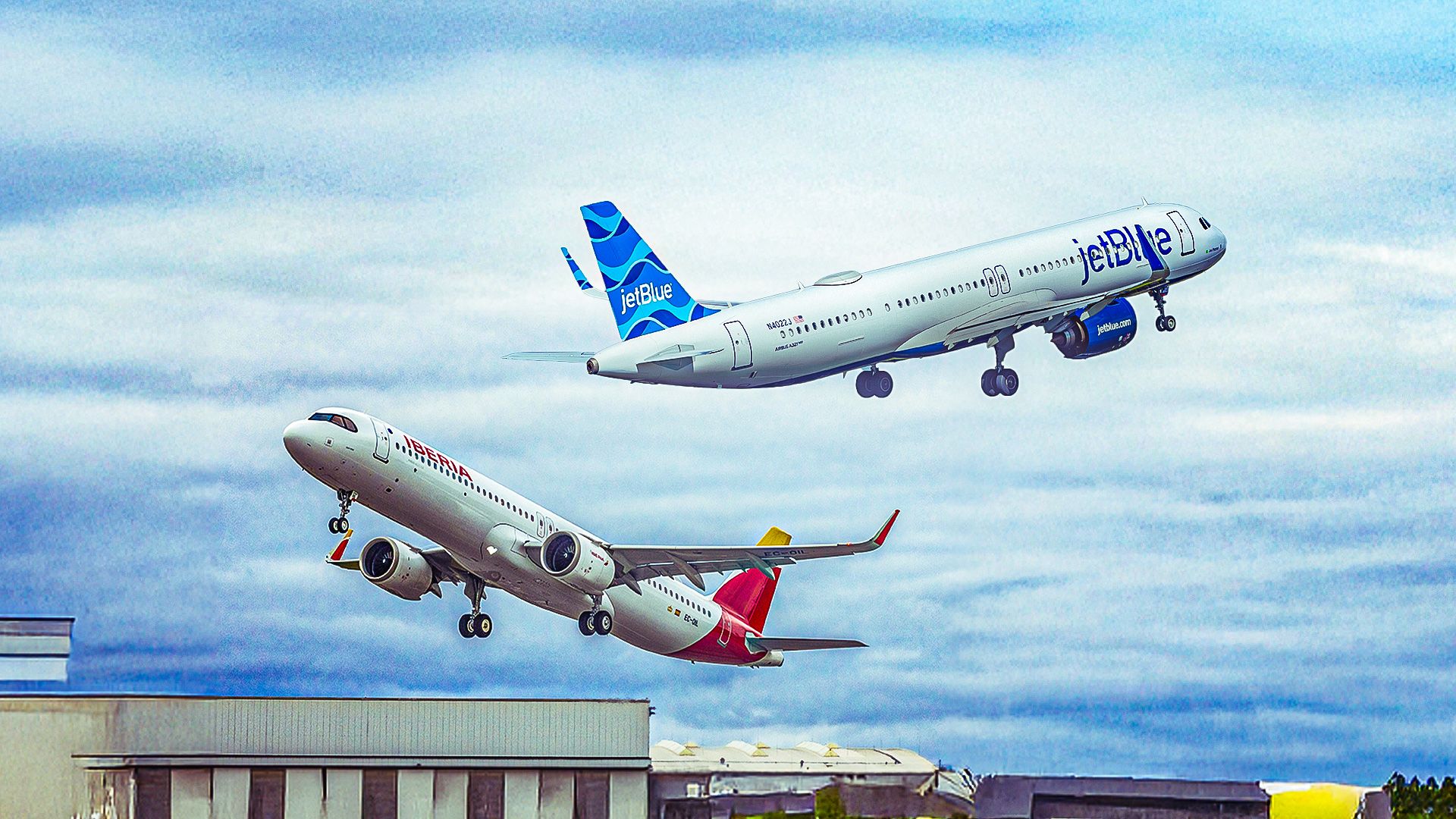
The Airbus A321neo has emerged as one of the most popular commercial jets on the market. Airbus is currently receiving many more orders for the larger A321neo than for its smaller A320neo counterpart, with some airlines converting A320neo orders to A321neos. The A321neo comes with two subvariants, the A321LR (Long Range) and the A321XLR (Xtra Long Range). The XLR is a continuation of the increased structural reinforcement and extra tanks needed to extend the range.
While the differences between the LR and the XLR are modest, the impact on the world’s available commercial routes is significant. Airlines can connect lower-density routes where demand is insufficient to support larger widebody aircraft. They are also enabling low-cost carriers to significantly expand their network. The XLR was central to Wizz Air’s now-abandoned plans to develop routes to India and Pakistan.
Extending The Range

The baseline Airbus A320neo has an advertised range of 3,400 nautical miles. The stretched A321neo extends this to around 4,000 nautical miles, depending on the fuel tanks fitted. The A321LR has a range of around 4,000 nautical miles, while the XLR has a range of 4,700 nautical miles. These are advertised ranges, and actual ranges vary in the real world due to various factors like payload, engine option, and more.
By comparison, Boeing advertises its MAX family with a maximum range of 3,800 nautical miles. However, that range is only offered by the small MAX 7 which is still awaiting its type certificate. The diminutive MAX 7 is not a very popular variant with Southwest being its primary customer. The longest-range in-service 737 MAX is the MAX 8 with a range of 3,500 nautical miles.
The short range of the MAX family means it is unable to fill the mid-sized aircraft market, bridging the gap between narrowbodies and smaller widebody variants like the 787-8 Dreamliner. This was a niche filled by the Boeing 757, but that aircraft has been out of production for two decades, and Boeing has failed to produce its much-rumored Boeing 797. Airbus has been able to fill much of the vacuum by fitting extra tanks on its A321neo.

The baseline A321neo comes with a maximum takeoff weight (MTOW) of around 89 tonnes, with an optional 97-tonne MTOW. The LR configuration has an MTOW of around 97 tonnes. The LR comes fitted with up to three removable Additional Centre Tanks (ACTs). Meanwhile, the XLR has an MTOW of 101 tonnes and is fitted with a permanent Rear Centre Tank (RCT). A321neos built with the 97-tonne MTOW option and pre-wired for ACTs can be converted into A321LRs.
The XLR’s permanent Rear Centre Tank and optional forward ACT add another 12,900 liters (3,400 US gallons) to the aircraft’s fuel capacity of around 32,940 liters (8,700 US gallons). The XLR incorporates the extra tank as part of the aircraft’s frame. The XLR’s novel RCT design triggered the scrutiny from the FAA/EASA during certification and had to undergo some tweaks. After that, it got the green light and entered service with Iberia in late 2024.
|
Select narrowbody ranges |
Nautical miles (per Boeing, Airbus) |
|---|---|
|
Boeing 737 MAX 8 |
3,500 |
|
Boeing 737 MAX 7 |
3,800 (not certified) |
|
Airbus A321LR |
4,000 |
|
Airbus A321XLR |
4,600 |
The seating capacity of these A321neo variants does not change. They all have a typical seating capacity of 206 and a maximum seating capacity of 240. The engines and overall flight characteristics of the aircraft remain the same, as do the aircraft dimensions (e.g., wingspan and fuselage length).
The Airbus A321XLR’s Weight Penalty

Having the tanks fitted permanently in the XLR has the advantage of increasing the fuel capacity of the aircraft without incurring the packaging and weight penalties that come with ACTs. But the XLR also requires structural reinforcements with stronger landing gear, reinforced wings, and some adjustments to the fuselage. This means that the XLR has a greater empty weight than the baseline A321neos.
With that greater extra weight comes with a fuel burn penalty. Airlines that operate the XLR will have a slightly higher fuel burn per seat, so they are less efficient on short-hauls. This was one of the reasons cited by Wizz Air’s CEO as to why the airline is significantly cutting back its planned XLR purchase. With the Abu Dhabi hub closed, Wizz Air has lost most of the longer routes it wanted to operate, leaving the XLR mostly as an overweight NEO without many justifiable routes.
The Wizz Air CEO also said the real-world range of the XLR was disappointing compared with its advertised range, but did not elaborate. It’s also worth noting that Wizz Air operates NEOs with the troubled Pratt & Whitney GTF engine, not the CFM International LEAP-1A. The LR is more difficult to assess, as it is mostly an A321neo with a higher MTOW option and removable ACTs, with less structural change. It’s unclear how many have been sold, as they are often counted among NEOs, unlike the XLR.
The XLR’s Lack Of Flexibility

As stated, the structural changes needed to achieve increased MTOW are little more than deadweight on short-haul flights. Engineering fixes to the XLR saw it add more weight in 2023, which reduced its range and initially advertised empty weight. The extra weight can not be avoided by simply not filling the aircraft up as much, as this is the aircraft’s empty weight. Additionally, the market price of the aircraft is higher, approaching $70 million for a new aircraft.
The Airbus A321XLR is still a smaller aircraft than the Boeing 757 it is largely replacing, but it also has a longer range. Airbus emphasizes the A321neo family’s fuel efficiency, saying that the LR burns between 15% and 30% less fuel per seat than the Boeing 757-200. This makes it a great aircraft for longer-haul thin routes, but not ideal for thick routes or for short-haul routes. In other words, the aircraft has a medium-haul, thin route niche for which it is well optimized.
In Australia, the XLR opens the possibility of direct flights from Perth to India’s Bengaluru (Delhi is too far) as well as various routes in Southeast Asia and to island nations in the Pacific and New Zealand. In Iceland, Icelandair’s incoming fleet is to replace its 757 fleet. Adding more context to Wizz Air’s decision to move away from the XLR, the airline also lacks ETOPS that would allow it to operate across large bodies of water like the Atlantic. Without ETOPS, the number of potential XLR ranges is significantly reduced.
Number Of XLRs Ordered

The NEO family has so far attracted a very healthy order book of more than 11,200 aircraft. These are split into around 4,000 orders for the smaller A320neo and over 7,000 orders for the A321neo. Airbus has a backlog of around 460 XLRs as it has only recently started deliveries; this may not include the 32-37 examples that Wizz Air is planning to slash and convert to shorter-ranged NEOs.
From January 2025 to the end of October, Airbus has received 86 new orders for the A320neo and 84 cancellations, resulting in a net increase in orders of just two examples. By contrast, the A321neo family has received a total of 395 new orders and no cancellations. These numbers do not itemize LR and XLR subvariants. The leading XLR customers are IndiGo (69), American Airlines (50), United Airlines (50), Wizz Air (47, to be reduced to 10-15), Air Canada (30), Air Arabia (20), AirAsia X (20), and Qantas (20).
By contrast, only 69 examples of the LR are reported to have been ordered, although it’s unclear if some have not been distinguished from regular A321neos. The LR has been in service for longer than the XLR, and there have been hundreds of LR-type conversions in recent years. But as stated, these numbers can just blend with the A321neo tally.
Airbus LR & XLR Fill The Vacant Mid-Sized Market

For now, Airbus has been able to fill the mid-sized airplane gap, thanks in part to Boeing’s dithering in producing its mid-sized 797. The dithering was due in part to Boeing’s MAX crisis and to much more pressing concerns, like repairing its image, restoring faith with the FAA, improving quality control, and critically getting its existing 777X, MAX 7, and MAX 10 aircraft certified. This is not to mention Boeing’s current lack of cash.
The window of opportunity may have already foreclosed for Boeing, as Airbus has already filled much of the market and demand for a 757 replacement. At the same time, JetZero is working to develop its mid-sized Z4 blend-wing-body airliner to disrupt the market. JetZero says the aircraft could cut fuel burn by as much as 50% and would come with a range of 4,000 nautical miles with 250 seats. This would make a competitor to the A321neo.
The XLR and LR are mostly the same aircraft with some structural reinforcement changes and additional fuel tanks. The XLR is notable for incorporating a permanent new fuel tank with the option for more removable tanks. The LR is an A321neo with the option of adding more removable fuel tanks. These options make the A321neo the most in-demand commercial passenger jet in service.
source
