

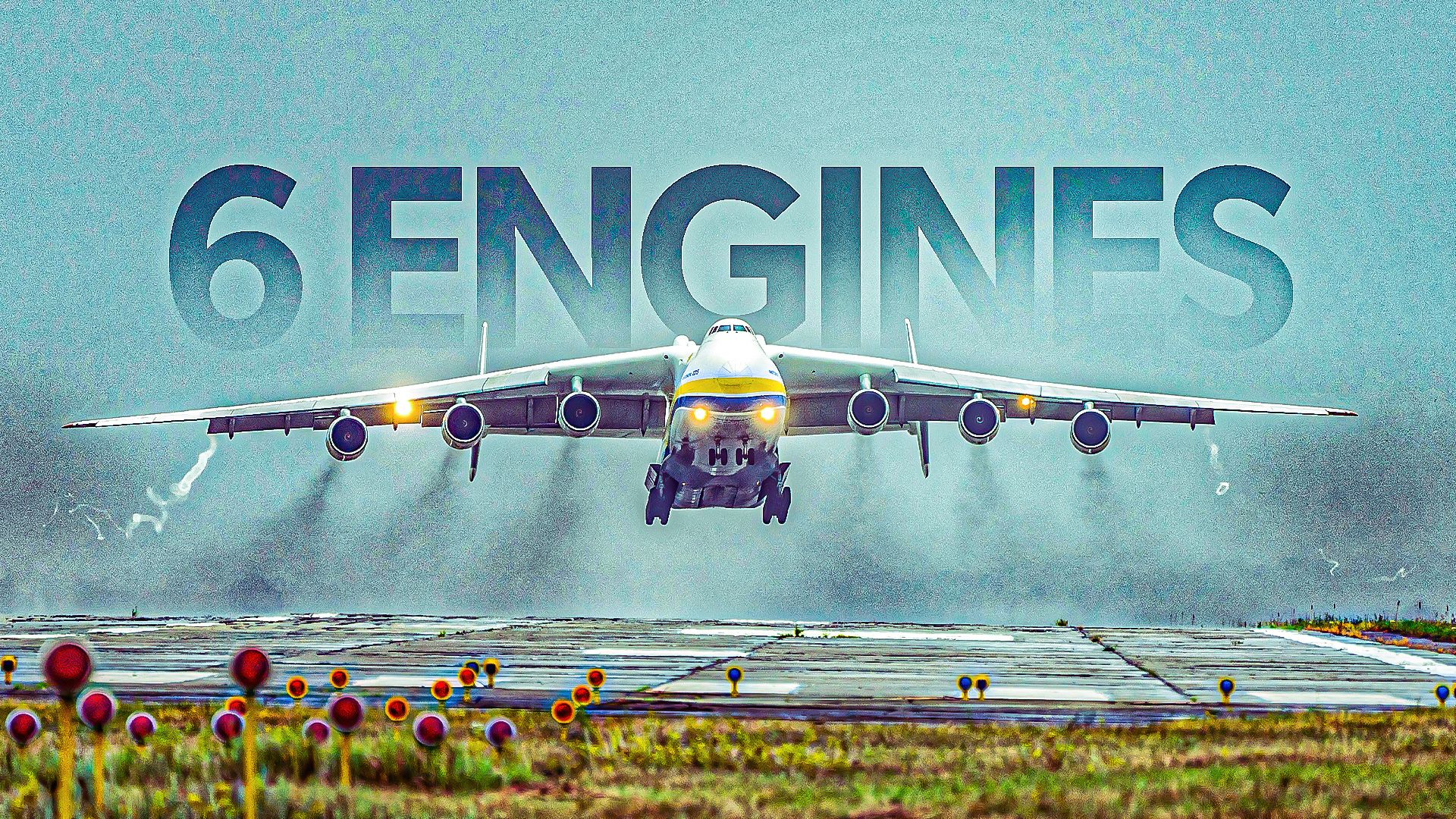
The Antonov An-225 Mriya stands as one of the most ambitious engineering feats in aviation history, conceived during the Cold War to meet highly specialized mission requirements. From the outset, its designers faced challenges far beyond those of conventional transport aircraft: unprecedented payload targets, unusual mission profiles, and structural considerations that pushed the limits of aeronautical design. These demands shaped every aspect of the aircraft, especially its propulsion system.
Understanding why the An-225 ended up with its distinctive six-engine layout requires exploring the design environment in which it was created. Factors such as available engine technology, mission flexibility, and aerodynamic constraints all played a role. Each of these pressures influenced Antonov’s engineers as they sought a balance between power, reliability, and practicality, ultimately leading to a configuration that was as iconic as it was necessary, even if the reasoning behind it isn’t immediately obvious.
A True Giant Of The Skies

The Antonov An-225 Mriya was the largest and heaviest aircraft ever built, originally designed in the 1980s by the Antonov Design Bureau in Ukraine. The original production led to one An-225 being completed, with a second airframe that was started but unfortunately never finished. It was first flown in December 1988 and operated commercially by Antonov Airlines.
The aircraft was created to transport the USSR Buran space shuttle and components for the Energia rocket. After the cancellation of the Buran program, the An-225 was repurposed to transport cargo, specifically focusing on massive, oversized/overweight loads. The true scale and might of this aircraft is hard to imagine or put into words.
The An-225 measures in at an impressive 275 feet 7 inches long (84 meters), a wingspan of 290 feet (88.40 meters), and a maximum take-off weight of 1,410,958 lbs (640,000 kg). 551,000 lbs (250,000 kg) of this could be comprised of payload capacity. The design, engineering, and manufacturing of this aircraft required unprecedented engineering solutions, one of the most defining being its six-engine configuration.
Enormous Thrust Requirements

In order to facilitate the massive maximum take-off weight of the aircraft, significant thrust was required. The An-225 demanded far more thrust than existing four-engine configurations could produce, hence the main reason behind the six-engine design.
Antonov utilized Ivchenko Progress D-18T turbofans, each delivering a staggering 51,672 pounds of thrust, just over 310,000 pounds of thrust combined. For comparison, the Airbus A380 produces around 280,000 pounds of thrust across its four engines, varying slightly by engine option.
Six engines provided the required total thrust not only for take-off, but for maintaining safe climb rates, handling drag, and ensuring adequate performance on long runways or in hot-and-high conditions. The additional thrust also helped counteract the massive aerodynamic penalties caused by carrying large loads on the aircraft’s back, which created turbulence and drag that needed brute-force power to overcome.

The Unfinished Second Antonov An-225: 5 Key Factors In Determining Its Future
With the war raging on, Ukraine is determined to build a second An-225 but its future remains uncertain.
Engine Technology Limitations

One of the main reasons for the application of six engines was the technological limitations of engines in the 1980s. The Soviet Union did not have larger, more powerful turbofan engines comparable to those of modern large high-bypass engines (such as the GE90 or Trent 800). For example, the Airbus A380, although slightly smaller than the An-225, can utilize modern advances in engine technology by using four engines.
Even if it was possible to develop new engines to increase performance or reduce the number of engines required, it is unlikely this would’ve happened. Rather than design a new engine from scratch, engineers used six of the already proven Ivchenko Progress D-18Ts from the Antonov An-124.
|
Parameter |
Ivchenko Progress D-18T |
Rolls-Royce Trent 900 |
|---|---|---|
|
Engine Type |
Three-spool, high-bypass turbofan |
Three-shaft, high-bypass turbofan |
|
Thrust (per engine) |
51,672 pounds (229.85 kilonewtons) |
75,152–84,098 pounds (334–374 kilonewtons) |
|
Compressor Stages |
15-stage axial: 1 fan, 7 intermediate-pressure, 7 high-pressure |
8-stage intermediate-pressure compressor, 6-stage high-pressure compressor |
|
Turbine Stages |
6-stage: 1 high-pressure, 1 intermediate-pressure, 4 low-pressure |
1 high-pressure, 1 intermediate-pressure, 5 low-pressure |
|
Overall Pressure Ratio |
27.5:1 (typical published value) |
37:1 to 39:1 |
|
Bypass Ratio |
5.6–5.7:1 |
8.5–8.7:1 |
|
Length |
17.717 feet (5.40 meters) |
17.97 feet (5.48 meters) |
|
Diameter / Width |
9.160 feet (2.792 meters) |
Fan diameter: 9 feet 8 inches (2.95 meters) |
|
Dry Weight |
9,039 pounds (4,100 kilograms) |
13,770 pounds (6,246 kilograms) |
This approach reduced development time, which was paramount in the development of the An-225. Alongside this, using existing engines reduced cost while delivering the required performance. The Ivchenko Progress D-18Ts were a proven design and product, thus reducing the risk of issues further down the line. Having previous experience with the engine type also meant any issues that did develop could be ironed out quickly.
Redundancy and Safety Margin

Another key factor in using six engines was the improved redundancy they provided. With more engines available, the aircraft could remain controllable and maintain sufficient thrust even if one failed. This level of backup was essential for an aircraft operating at extreme weights and under demanding mission profiles.
The An-225 was built long before modern ETOPS standards, but more specifically for this aircraft, before widespread confidence in operating aircraft with only the minimum number of engines physically required. While the An-225 would never have been feasible as a twin-engine jet, additional engines greatly enhanced safety margins during long flights, takeoff, and climb-out.
This emphasis on redundancy was especially critical for a strategic heavy-lift aircraft carrying unique or irreplaceable cargo such as the Buran space shuttle. In such missions, mission failure or in-flight emergencies could have been catastrophic. The six-engine configuration ensured that the An-225 could continue flying safely even under unexpected conditions, reinforcing its role as a reliable super-heavy transporter.

Antonov An-225 Mriya: 5 Facts About The Largest Aircraft Ever Built
Discover what makes Antonov’s “Dream” so amazing.
Aerodynamic And Structural Design Needs

Whilst the need for six engines was clear, one issue this presented was with the aerodynamic and structural components of the aircraft. With its already long-extended wingspan, mounting three engines to each wing, with a dry weight of approximately 4,100 kg (9,039 lbs), became a huge undertaking. One main adaption was to heavily reinforce the wing section to support the weight and thrust loads of the six D-18T turbofan engines.
The An-225 wing was heavily based off of the wings of the An-124, which meant changes had to be made to accommodate the requirement for extra thrust. Instead of redesigning the engines themselves, Antonov extended the wing root and outer wing structure to provide six evenly distributed engine pylons. The wing design ensured smooth airflow over the engine inlets despite the increased number of nacelles, preventing stall or surging. Proper spacing between engines also reduced aerodynamic interference and ensured stability at high lift and high angles of attack.
Whilst not entirely as a direct result of the engine requirements, one interesting change, and a key difference from the An-124 was the aircraft’s twin-tail. This was one of the most distinctive aerodynamic changes was the move from a traditional single vertical stabilizer to a twin-tail configuration with two large vertical fins connected by a horizontal stabilizer. This was crucial because the An-225 was designed to carry oversized external loads, such as the Buran space shuttle, on its back, loads that severely distorted airflow over the tail. The twin-tail ensured adequate directional stability even when airflow was disrupted by large upper-fuselage cargo.
The End Of An Icon

The An-225’s six-engine layout was not a matter of inefficiency but a practical solution to unprecedented engineering demands. It balanced available technology, the need for massive thrust, redundancy for flight safety, and the unique structural and aerodynamic challenges of carrying oversized loads. Together, these factors made the An-225 a one-of-a-kind aircraft whose engineering achievements remain unmatched even decades later.
From its maiden flight on December 21, 1988, to its devastating destruction in February 2022 during the conflict at Hostomel Airport in Ukraine. The Antonov An-225 was truly an impressive feat of engineering. It became the longest and heaviest aircraft ever produced, with the title of the longest wingspan going to the Stratolaunch 351. Whilst it no longer flies, its legacy lives on in the pure might of this aircraft.
There is, however, a small chance we may see the An-225 take to the skies again one day. There is currently a plan, announced by Antonov in November 2022, to utilize the second, never-completed An-225 airframe, but this time to finish its construction. The project is currently still in the fundraising stage, with an estimated cost to rebuild of $500 million (€434 million), but it is unclear about when or even if the rebuild will take place. Irrespective of this, the Antonov An-225 Mriya will also go down as an aviation icon, loved by enthusiasts worldwide.
source
