

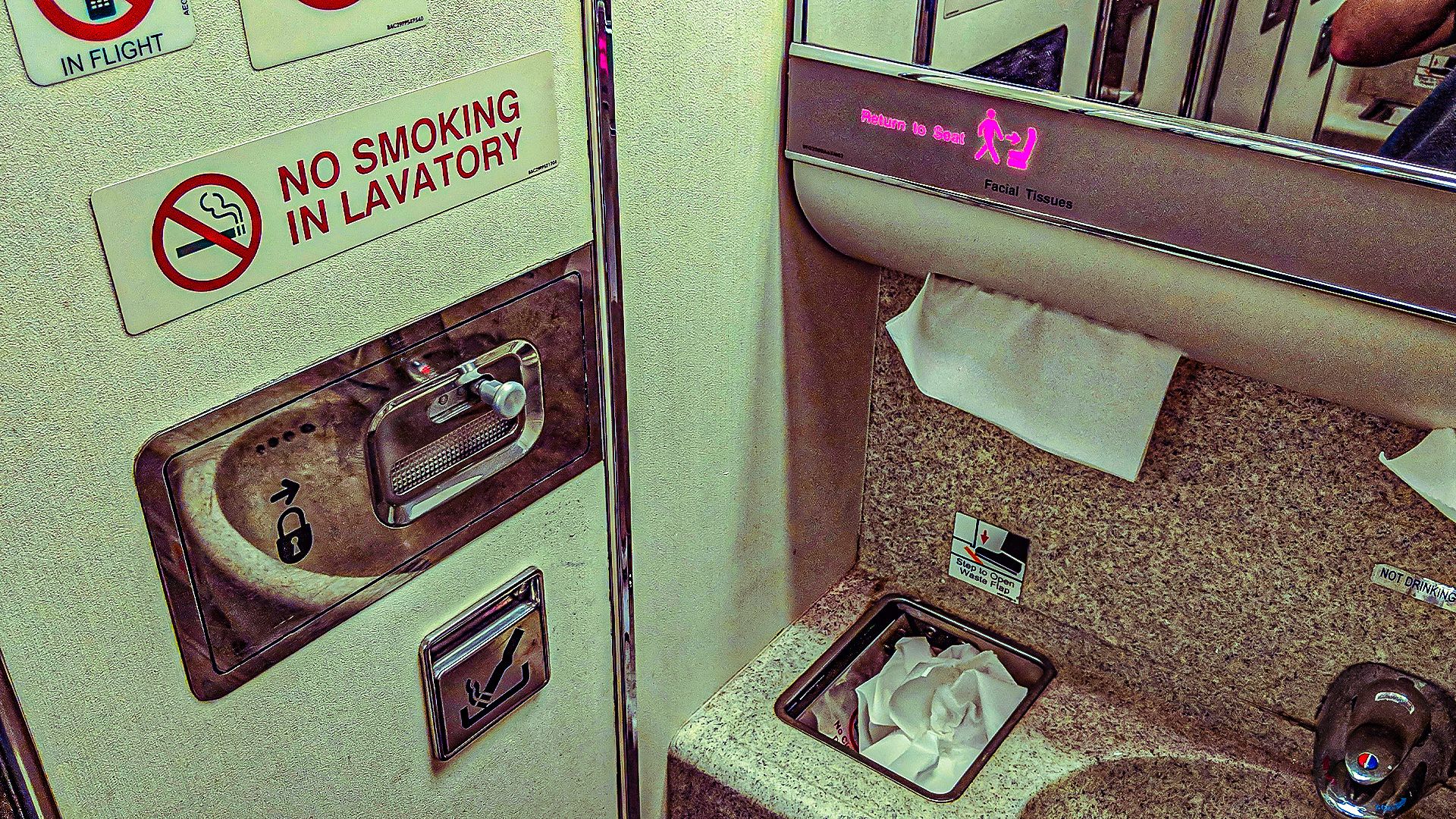
Step into any modern airliner lavatory, and you’ll notice two things side by side: a “No Smoking” sign and, curiously, an ashtray. In an age when lighting up on a plane can cost you thousands in fines or even get you arrested, this little metal cup seems absurdly out of place. Why would aircraft designers still install an ashtray in 2025, decades after smoking bans took hold worldwide?
This isn’t nostalgia or oversight. It’s about regulation and safety. The ashtray’s continued existence tells a story about how aviation handles risk, human error, and lessons learned from tragedy. In our guide, we’ll uncover the layered reasons these small fixtures remain mandatory, drawing from history, regulation, and the fine details of Aircraft certification.
Regulation Before Logic: Why The Rule Still Exists

The survival of the airplane ashtray is not a design whim; it’s a regulatory requirement. For example, under 14 CFR § 25.853, the US Federal Aviation Administration (FAA) explicitly mandates that:
“Regardless of whether smoking is allowed in any other part of the airplane, lavatories must have self-contained, removable ashtrays located conspicuously on or near the entry side of each lavatory door.”
And similar laws exist in all other countries. This clause dates back to the era when onboard smoking was the norm, but it remains in force even though airlines have banned cigarettes for decades. Why? Because aviation safety planning assumes the worst-case scenario, i.e., that someone will ignore the rules and light up anyway.
If that happens, the regulation ensures there’s a designated place to extinguish a cigarette safely. Without it, the smoker might flick the butt into a paper-filled trash bin, an act that has, historically, led to catastrophic results.
The rule is taken so seriously that a missing or broken lavatory ashtray can delay or even ground a flight. It’s listed by both the FAA and EASA and, subsequently, on all airlines’ Minimum Equipment Lists (MELs), a checklist of required items for dispatch. Even the most modern Boeing 787 or Airbus A350, designed many years after the international smoking ban on board, must have this small, outdated metal component to fly legally.
In short, the ashtray is not an accessory. It’s a required safety device written into international airworthiness standards.
From Smoke-Filled Skies To No-Smoking Signs

To understand why the rule endures, we need to revisit a time when cigarette smoke was part of the cabin atmosphere.
For much of the 20th century, smoking was integral to air travel. If you traveled by air in the 90s and earlier, you probably remember smoke-filled passenger cabins. Some airlines even proudly offered complimentary cigarettes, and “smoking sections” were standard, even on short-haul routes. Flight attendants routinely walked through a haze that was as much a part of aviation as the inflight meal.
There were even times when pilots smoked in the cockpit, as you can see from this video. But these times are long gone, and now pilots risk being fired for lighting a cigarette or vaping in the cockpit, as reported by the BBC.
But by the late 1970s and 1980s, pressure from health authorities, unions, and passengers began to mount. The US banned smoking on flights under two hours in 1988, then extended the ban to all domestic and most international routes by 2000. The rest of the world soon followed; AFAR describes the timeline of the prohibition.
Still, aircraft already had certified designs with built-in ashtrays. Removing them would require regulatory amendments and the recertification of lavatory assemblies, an expensive process for something that posed no safety threat. On the contrary, not having an ashtray on board is a safety risk. So, manufacturers like Boeing and Airbus left them in place, continuing to comply with FAA and EASA certification standards.
Even new aircraft built today include lavatory ashtrays, not as a holdover from the past but as a concession to reality: regulators can’t assume every passenger will obey. The aviation industry’s philosophy is “assume failure, mitigate risk,” not “trust perfection.”
Lessons Written In Smoke: The Disasters That Shaped The Rule

The insistence on keeping ashtrays stems from tragic history, specifically, two fires that revealed how deadly improperly discarded cigarettes can be.
Probably the most notorious case happened in 1973 with Varig Flight 820. VARIG’s Boeing 707 was flying from Rio de Janeiro to Paris when it suffered a cabin fire after a cigarette was thrown into a lavatory waste bin. Smoke quickly filled the cabin. The pilots made an emergency landing near Orly Airport, but 123 of the 134 people onboard died, many from smoke inhalation. Investigators concluded the fire likely started from a discarded cigarette butt.
A decade later, Air Canada Flight 797 caught fire in the rear lavatory of a DC-9 in 1983. The crew landed in Cincinnati, but 23 passengers died after smoke and flames engulfed the cabin during the evacuation. While the source was uncertain, among the possible causes was an unlit cigarette in the lavatory, as cited in the NTSB report and published by Skybrary. The accident led directly to the installation of mandatory lavatory smoke detectors and fire-resistant trash bins.
Those two accidents reshaped how regulators thought about onboard fires. They mandated redundant systems: smoke alarms, self-smothering bins, flame-retardant materials, and yes, ashtrays. Each served as a layer of defense. Even if smoking was banned, the assumption was that someone might break the rule, and the aircraft had to survive it.
These tragedies remain etched into regulations, reminding designers that many aviation safety rules are written in blood, in response to real accidents, not only hypothetical situations.
How It Works Today: The Smallest “No-Go” Item In The Sky

Despite the global smoking ban, ashtrays are still treated as essential safety equipment, and their placement is anything but random. Ashtrays must be “conspicuously located” on or near each lavatory door, usually on the outer surface where passengers can see them before entering. Some aircraft even mount them beside the “Occupied” indicator light.
The logic is simple: if a passenger has already lit a cigarette in defiance of the rules, the ashtray gives them a clear place to extinguish it safely before entering, or at least before tossing it into the waste bin.
Inside, lavatories are engineered like miniature fire zones. They have:
- Smoke detectors wired directly to the cockpit and crew panels
- Self-closing, fireproof waste bins with halon extinguishing systems
- Non-flammable surfaces and insulation materials
Together, these systems create a multi-layered defense. The ashtray might never be used, but if it prevents even one fire in a million flights, it justifies its existence.
And yes, airlines really do treat them seriously. In 2009, one British Airways flight was delayed because an ashtray in one lavatory was broken. The flight couldn’t depart until maintenance completed the repairs. In the eyes of regulators, a missing ashtray is as critical as a faulty seatbelt.
Why They Can’t (And Shouldn’t) Be Removed

You might think the easiest fix is to delete the rule, but aviation doesn’t work that way. Eliminating a required safety feature triggers a complex process involving multiple authorities, design changes, and fresh certification.
Aircraft are certified as “type designs”: blueprints frozen in time. If Boeing or Airbus wanted to remove ashtrays, they’d have to prove to both the FAA and EASA that safety wouldn’t be compromised. That could mean proposing alternate mitigations, such as upgraded smoke detection or fireproof disposal points. Until regulators rewrite the rule globally, ashtrays stay.
There’s also a redundancy philosophy at play. Aviation safety depends on layers: detect, contain, extinguish, and prevent. Removing even a minor element weakens the safety chain. Engineers prefer redundancy to overconfidence.
Finally, there’s a commercial reason. Aircraft change hands throughout their lifespans and must always comply with the rules and regulations worldwide. Keeping a consistent, globally compliant configuration avoids costly modifications later.
What Passengers Should Know And What It Says About Aviation

The next time you’re in a cramped airplane lavatory, take a look at that ashtray. It’s more than a throwback: it’s a tangible symbol of how aviation manages risk.
From a passenger’s perspective, it’s simple:
- Do not smoke. Tampering with detectors can result in fines of up to several thousand US dollars, aircraft diversion, or arrest on landing.
- Respect the safety rules. Every fixture, from the bin lid to the ashtray, exists because of lessons learned the hard way.
- Understand the mindset. Aviation doesn’t remove something because it’s outdated; it removes it only when it’s provably unnecessary.
Basically, we have airplane ashtrays not because someone should smoke, but because someone might. That sentiment defines modern air safety: it’s not about trusting passengers; it’s about designing against human error.
In that sense, the airplane lavatory ashtray is one of aviation’s most modest but meaningful safety devices. It’s a silent witness to history, a memorial to those lost in past fires, and a small but crucial detail that ensures today’s aircraft remain as safe as possible, even when someone breaks the rules.
source
