

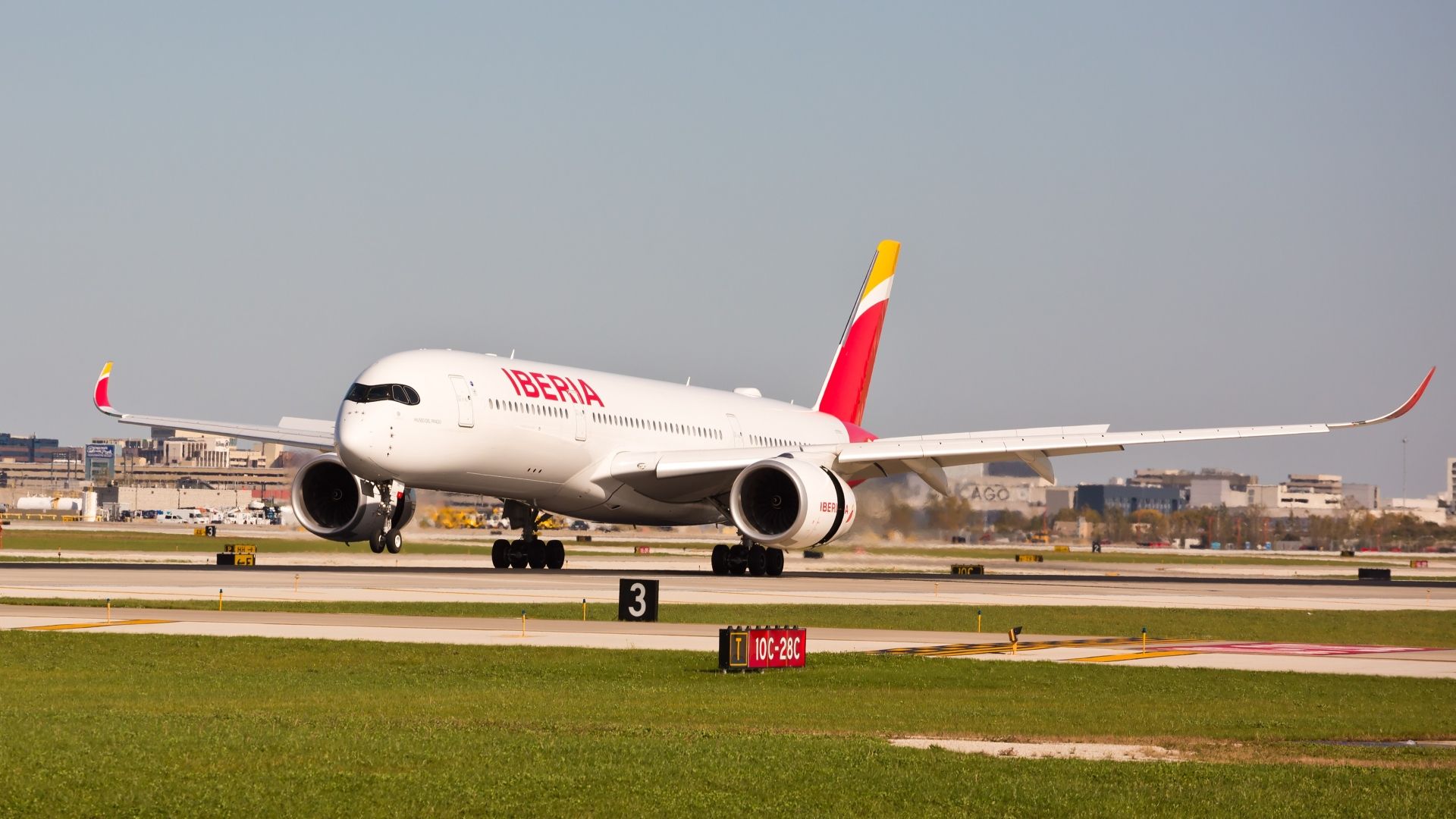
Spanish flag carrier and  oneworld member Iberia is the proud operator of an all-Airbus fleet. According to present fleet data made available by ch-aviation, the Madrid-based IAG airline has a grand total of 129 aircraft at its disposal, all of which are twinjets from the multinational European planemaker.
These aircraft are 10.4 years old on average, and, going forward, the national airline of Spain also has another 25 twinjets from the Airbus portfolio on order. Let’s take a closer look at the exact makeup of Iberia’s fleet, focusing on the models operated, their ages and configurations, and what the future looks like.
Iberia & The A321XLR

The biggest fleet development at  Iberia in recent years has been the rollout of the Airbus A321XLR. According to ch-aviation’s data, the Spanish flag carrier currently has four of these long-range narrowbody twinjets at its disposal, with these modern single-aisle aircraft clocking in at an average age of just 0.5 years old. Going forward, Iberia plans to double the size of its sub-fleet of Airbus A321XLR jets, with orders for another four examples.
Current fleet data made available by aeroLOPA shows that Iberia configures its Airbus A321XLR jets in a two-class configuration that has space for a grand total of 182 passengers onboard. This figure is split between 14 lie-flat business class seats in an angled two-abreast 1-1 layout and 168 economy class seats in the standard six-abreast 3-3 setup. Marco Sansavini, Iberia’s CEO and Chair, said at the time of the first A321XLR delivery:
“We are very proud to be the launch airline for this new aircraft. The A321XLR will allow us to reach new destinations, operate transoceanic routes, [and] do so in a more efficient way.”
Other Narrowbodies

As it happens, the A321XLR is the latest in a long line of Airbus narrowbodies operated by Iberia. These popular single-aisle twinjets form the backbone of the Spanish flag carrier’s fleet, and, alongside the long-range A321XLR, the airline also has 12 examples of the standard A321neo at its disposal. These stretched-fuselage narrowbody twinjets have an average age of 3.5 years old, and are used to fly under the Iberia Express brand.
The Iberia Express A321neos have 232 seats in a flexible two-class configuration that can accommodate various premium loadings by blocking middle seats and moving the dividing curtain towards the front of the aircraft. This is the case for all of Iberia’s Airbus narrowbodies, and is common among European legacy carriers. Interestingly, however, its older A321-200 jets, of which it has 13 at its disposal, only have 217 seats onboard.
Moving down in terms of size, Iberia flies both the older A320-200 and the newer A320neo models. There are 24 examples of the former variant in its fleet, of which 13 operate under the Iberia Express brand, compared to 20 A320neos (plus 13 on order). The latter model has an extra row of seats, with space for 186 guests compared to the A320-200’s 180. Finally, Iberia also flies three A319-100s (17.5 years old on average) with 141 seats.
Iberia’s Widebodies

While the Airbus A321XLR is playing an important role in unlocking secondary long-haul routes for Iberia, the Spanish flag carrier also relies on a small but mighty fleet of widebody twinjets from the Airbus stable in order to serve more distant and high-demand destinations. As pictured above, it is a big fan of the A330 family, with 20 A330-200s and 10 A330-300s in its fleet. These aircraft have respective average ages of 9.6 and 12.3 years old.
The former model has 288 seats across two classes, while the latter, despite being larger, only has four more seats. However, its 292 guests are accommodated in a lower-density layout with a more premium-heavy emphasis. Meanwhile, its A350-900s, of which it has 23 examples at an average age of 4.7 years old with another eight units on order, have either 348 or 352 seats in a three-class layout or 33 seats in a two-class setup.
source
