

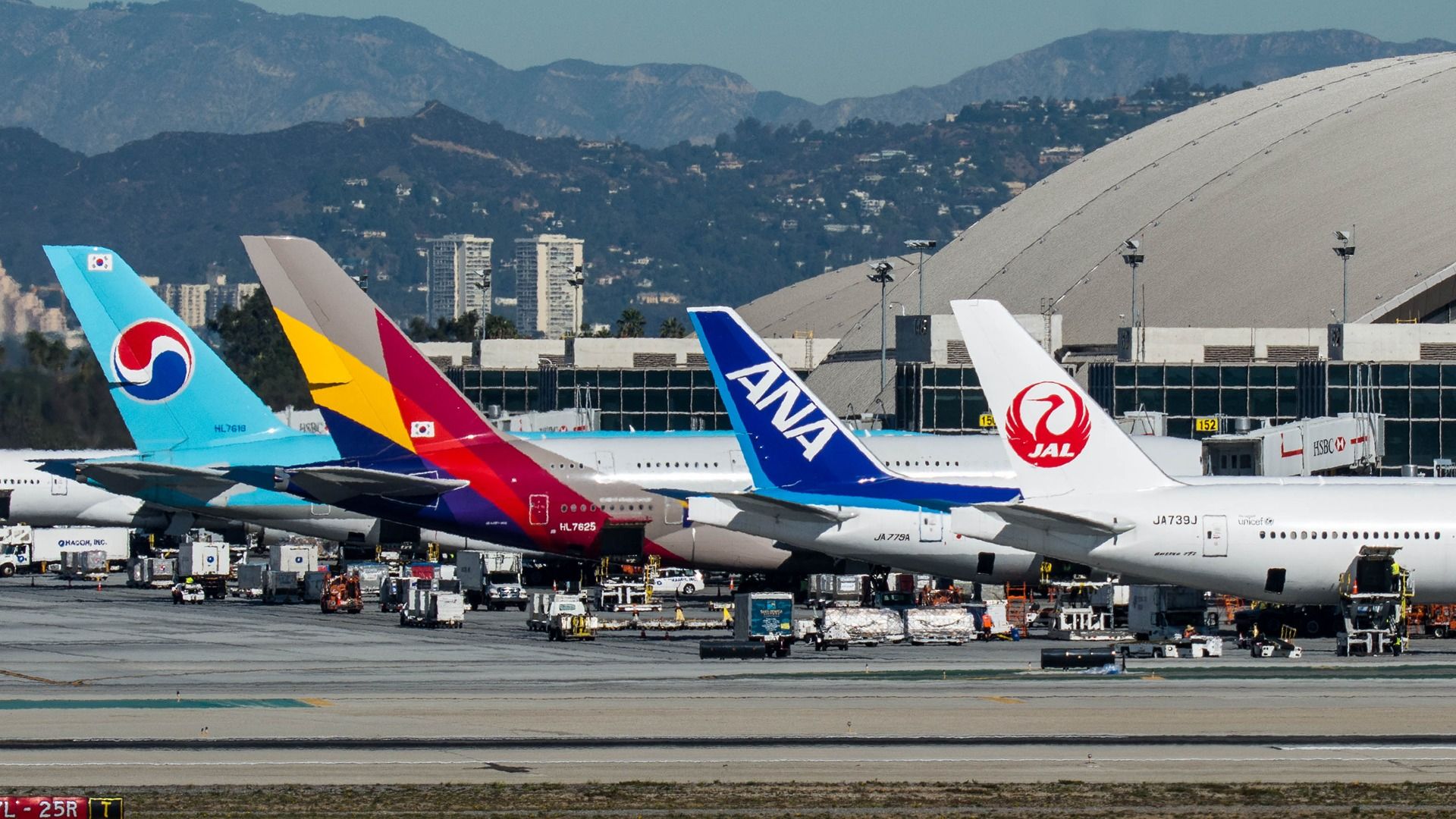
The United States has one of the largest aviation networks in the world, with hundreds of airports handling millions of travelers every month. Over the past few years, the industry has moved from the disruption of the COVID-19 pandemic to a period of steady recovery. Passenger traffic is climbing back faster than in many other regions as major hubs return to full capacity and both domestic and international travel demand strengthens.
California is home to several of the nation’s busiest airports, which together serve as vital links for travelers moving across the country and around the world. In June 2025, nearly 20 million passengers passed through the ten busiest airports in California, with domestic flights accounting for about 80% of the total, according to Visit California. The three largest –  Los Angeles International Airport (LAX),
  San Francisco International Airport (SFO), and
  San Diego International Airport (SAN) – handled more than 14 million passengers in that single month.
Los Angeles Is The Busiest Hub In California

LAX is the busiest airport in California by scheduled departures. In the first half of 2025, it welcomed 35.7 million passengers. The airport opened in 1928 and has grown through decades of expansion, from the Tom Bradley International Terminal in 1984 to the landmark light towers on World Way in 2000. Notably, it serves as a hub for many domestic carriers and welcomes a wide range of major international airlines on a daily basis.
All three major US carriers,  Delta Air Lines,
  United Airlines, and
  American Airlines, consider LAX a hub. They maintain large domestic networks from Los Angeles and schedule regular services to major international cities. According to aviation analytics provider Cirium, the airport has approximately 20,632 departures scheduled for this month. Delta Air Lines is the largest operator by aircraft movements, with 3,215 departures planned.
Its busiest route is Atlanta, with 322 flights in September offering up to 11 daily services, followed by New York-JFK at up to ten daily flights. The  SkyTeam member also operates nonstop long-haul routes from LAX to Paris, Tokyo Haneda, Sydney, and Shanghai. Meanwhile, United has 2,622 departures scheduled this month, with frequent services to Newark, Chicago, Houston, San Francisco, Las Vegas, and Boston.
The airline also connects Los Angeles to several international cities, including Hong Kong, London Heathrow, Sydney, Tokyo Narita, and Tokyo Haneda. American Airlines also has more than 2,000 scheduled departures in September. Alongside its extensive domestic network, the carrier operates multiple daily flights to London and Tokyo Haneda, as well as daily flights to Sydney, Vancouver, and Mexico City.
Regional & International Operations
Furthermore, regional operations for all three carriers are handled by SkyWest Airlines, which adds significantly, about 3,000 flights to their overall footprint at LAX. Southwest Airlines likewise maintains a strong base at the airport, focusing on its domestic network. In September, it has around 2,622 departures scheduled.
Other US carriers, including JetBlue, Alaska Airlines, Frontier, and Spirit, also maintain sizable operations. The international presence is equally strong.  Air Canada leads foreign carriers at LAX with about 340 departures this month. Lufthansa, British Airways, Air France, Virgin Atlantic, ANA, EVA Air, Copa, and KLM also operate multiple daily services.
United’s Transpacific Gateway Is The Second Busiest

SFO is the second-busiest airport in California. It is the leading gateway for Northern California and connects the Bay Area to the world. More than 50 airlines operate at SFO, and in the first half of 2025, it handled more than 26 million passengers. In September, the airport has more than 15,000 scheduled departures. United, of course, dominates and holds about 45% of the market share. The airport is the carrier’s primary transpacific hub and the backbone of its West Coast operations.
Domestically, United connects San Francisco to New York, Chicago, Boston, Houston, and Las Vegas, feeding passengers into its Asia and Oceania flights. At the same time, its international routes extend to Europe, Latin America, and the Pacific. This month, the airline has 6,214 mainline flights scheduled and offers more than one million seats. The carrier also has more than 1,600 regional departures this month.
Meanwhile, Alaska Airlines, which counts San Francisco among its key hubs, has 852 mainline flights and 784 regional flights operated by SkyWest Airlines. Delta also connects San Francisco to Atlanta, Los Angeles, New York-JFK, Minneapolis, Boston, Seattle, Salt Lake City, and Detroit, and has 1,141 flights in September. American has about 973 flights and links the airport to Dallas/Fort Worth, New York-JFK, Chicago, Miami, Philadelphia, and Los Angeles.
In addition, Southwest, JetBlue, and Frontier also account for several hundred departures. Besides, Air Canada leads foreign carriers at SFO with 231 departures scheduled in September. Other major international airlines include Aeromexico, Hawaiian, EVA Air, Lufthansa,  British Airways, Japan Airlines, ANA, Virgin Atlantic, and Singapore Airlines, each offering multiple daily services.
San Diego International: The Nation’s Busiest Single-Runway Airport

SAN is the third-busiest airport in California, and is also the busiest single-runway airport in the US. Like many other airports across the country and worldwide, passenger traffic at San Diego International dropped significantly during the pandemic. It handled only 4.62 million travelers in 2020, less than one-third of the figure from the previous year. But the airport recovered quickly and handled 7.2 million travelers in 2021 and posted stronger results in the years that followed.
In the first half of 2025, SAN welcomed nearly 12 million passengers, a 23% increase compared to the same period last year. San Diego is one of the key bases for  Southwest Airlines and Alaska, which together carry a large share of domestic traffic. This month, the airport has about 8,357 flights scheduled. Southwest leads operations with 2,856 departures to cities, including Las Vegas, Sacramento, San Jose, Oakland, San Francisco, Denver, Dallas Love Field, Chicago Midway, Austin, Baltimore, and Nashville.
Many of these routes see multiple daily flights. Meanwhile, Alaska Airlines has about 1,000 mainline departures this month. Its busiest routes include Seattle, with up to nine daily flights, Portland, with up to five daily flights, and Phoenix, with three daily flights, along with regular transcontinental services to New York-JFK, Newark, and Boston, among others. United also has 886 scheduled departures, while SkyWest has 880 on behalf of Alaska Airlines.
Delta and American also contribute more than 700 flights each. In terms of international operations, they are smaller in scale than at Los Angeles or San Francisco but continue to expand. British Airways has scheduled 55 flights in September. In addition, Air Canada, Japan Airlines, and Lufthansa also provide daily flights, further strengthening San Diego’s international reach.
Sacramento International Schedules Over 5,000 Flights in September

Apart from Los Angeles, San Francisco, and San Diego, Sacramento is also one of the key airports in California, which connects the state capital to major US cities and regional destinations. Sacramento International Airport (SMF) opened in 1967 as Sacramento Metropolitan Airport and became the first public-use airport west of the Mississippi to be built entirely from the ground up.
Today, it has grown to include two terminals and is served by around 12 airlines, including American, Delta, United, Air Canada, Alaska, Frontier, Hawaiian, JetBlue, Southwest, and Spirit. Southwest Airlines is the largest operator at Sacramento and holds more than half of the airport’s market share. Its busiest routes from Sacramento are San Diego, Las Vegas, and Burbank.
This month, the airline operates up to 12 daily flights to San Diego, ten to Las Vegas, and nine to Burbank, in addition to frequent services to Santa Ana, Ontario, Denver, Long Beach, and Phoenix. Furthermore, United Airlines has scheduled 373 mainline flights and 204 regional flights, while Delta has 328 flights this month, covering Salt Lake City, Atlanta, Minneapolis, Detroit, and Los Angeles, in addition to its regional services.
|
Sacramento International Airport SMForward Project |
|
|---|---|
|
Planned Project |
Notes |
|
Pedestrian walkway |
New walkway connecting facilities |
|
Terminal B parking garage |
Multi-level structure (Completion expected Fall 2026) |
|
New Terminal A exit road |
Improved access infrastructure |
|
Terminal A expansion |
Additional gates, ticketing area, baggage claim, and office space (Completion expected Winter 2027) |
|
Concourse B expansion |
New gates and dining options on the west side |
|
Ground transportation center |
It will be located right outside the Terminal A garage, and will centralize taxi, ride-share, and off-site shuttles. |
American and Alaska also contribute heavily with both mainline and regional operations. Besides, international traffic is limited but growing. Air Canada is the only foreign carrier at SMF this month, scheduling 14 flights, while Jazz Aviation adds 60 regional services on Air Canada’s behalf. Currently, the airport is undergoing an expansion. In 2023, it launched a $1.3 billion program called SMForward, which includes the Concourse B and Terminal A expansion.
In addition, the airport is preparing for a new air traffic control tower. The current 1967-built tower is among the oldest in the country. A replacement 192-foot tower will be built on the airport’s north side at an estimated cost of $60–80 million, which federal infrastructure grants will fully fund. Construction is projected to begin in 2026.
San Jose Mineta Is The Bay Area’s Second-Busiest Airport

Several other California airports also play a crucial role in connecting the state to domestic and regional destinations. San Jose Mineta International Airport (SJC) is one of the most prominent airports in the area and serves as the second-busiest in the Bay Area. Despite San Jose being the region’s largest city, the airport has a smaller network than San Francisco International.
Its only intercontinental route is operated by ZIPAIR Tokyo to Tokyo Narita. In the first half of 2025, the airport welcomed 5.2 million passengers. The vast majority were domestic travelers, while just 279,664 were international. Southwest Airlines dominates the San Jose market and accounts for nearly 57% of all traffic. In September, the airline has 2,259 flights scheduled out of 4,025 total departures at the airport.
SkyWest Airlines follows with a 9.5% share through operations on behalf of Delta and Alaska. Spirit and Alaska each hold just over 7% of the market, while Delta accounts for about 5%. United and American also maintain a steady presence. The airport’s sole long-haul route, ZIPAIR Tokyo’s service to Narita, will see 21 scheduled departures this month.
Orange County & Oakland Airports Handle Over 7,000 Flights Combined In September

Two other California airports also play a key role in connecting large volumes of domestic traffic: John Wayne Airport (SNA) in Orange County and Oakland San Francisco Bay Airport (OAK) in the Bay Area. Both handle more than 3,000 departures this month and continue to serve as important regional gateways. The former is located in the center of Orange County and provides an alternative to the larger Los Angeles Airport.
In September, airlines have scheduled 3,986 flights from John Wayne. Southwest leads operations with about 1,300 departures, linking the airport to other California cities such as San Jose and Sacramento, as well as Las Vegas and Phoenix. American, Delta, and United also have a strong presence, with each operating more than 500 flights this month. Besides, international traffic at the airport remains small, with Air Canada offering 30 flights to Vancouver in September.
Meanwhile, which recently rebranded as Oakland San Francisco Bay Airport in a bid to raise its profile, is one of three major airports serving the Bay Area. While San Francisco and San José attract most of the long-haul traffic, Oakland continues to provide a large share of domestic flights.
This month, the airport has about 3,138 scheduled departures, with Southwest accounting for nearly half. Oakland’s international services are limited to Mexico and El Salvador. VivaAerobus has 22 flights to Guadalajara and nine to Monterrey this month, while Volaris El Salvador operates 12 flights to San Salvador.


- IATA Code
-
LAX
- City
-
Los Angeles
- Designation
-
Major-International
source
