

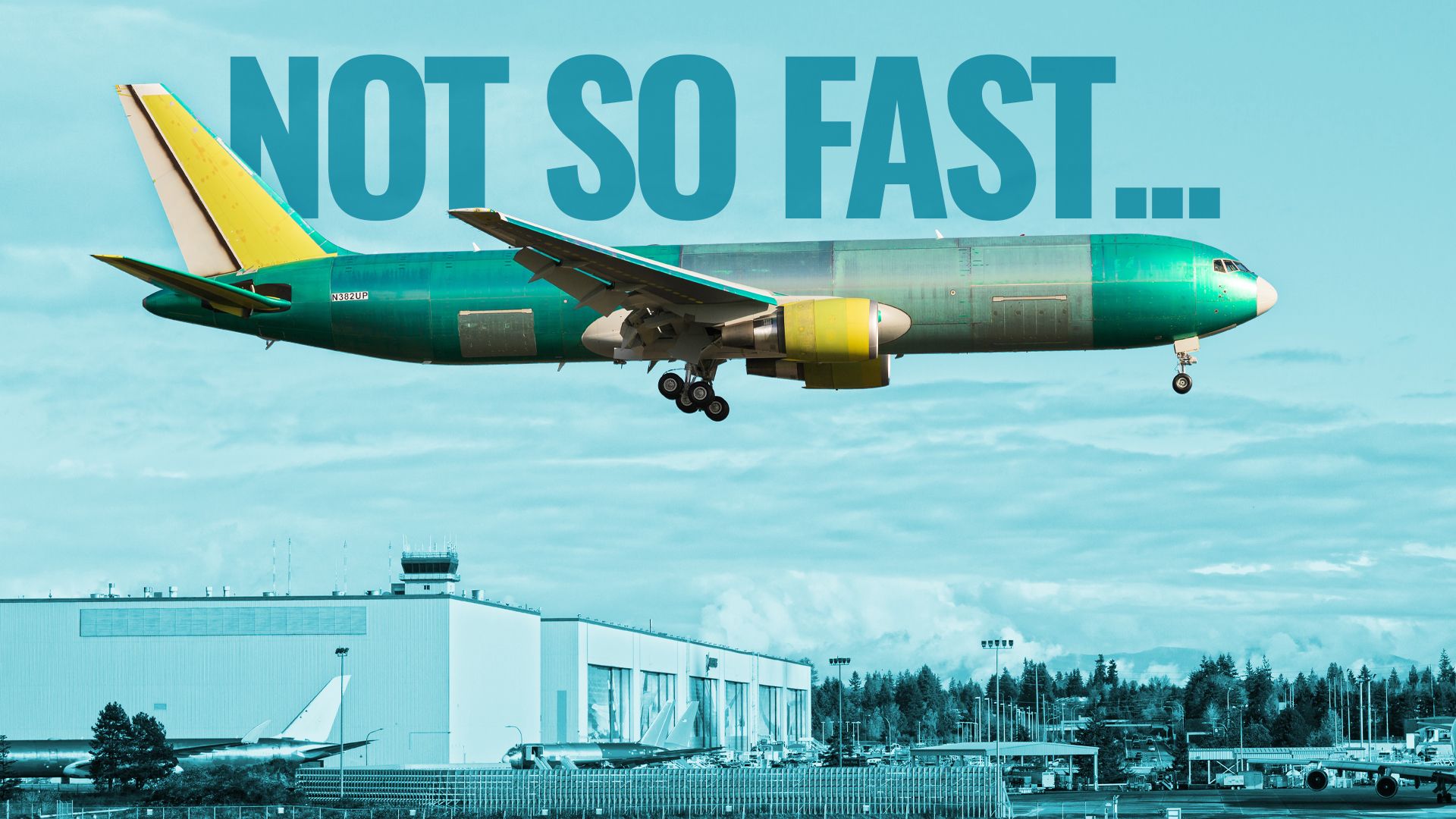
The Boeing 767-300 Freighter has been a very popular, dependable workhorse of the world’s air cargo fleets for decades. Sitting neatly between narrowbody freighters and large-capacity widebodies, it’s the aircraft that defined a generation of express logistics. But as environmental regulations tighten and the aerospace industry shifts toward next-generation, fuel-efficient designs, a new chapter is on the horizon.
Despite its age (the first freighter variant of a 767 aircraft entered service in 1995), the 767-300F isn’t fading just yet. Boeing confirmed production will continue until 2027, giving cargo operators like UPS, DHL, and FedEx a little more breathing room before transitioning to newer models, according to FlightPlan Forecast International.
However, Boeing will continue the 767-2C subvariant production beyond 2027 to support KC-46A tanker needs. This continued production run shows that the 767 essentially remains part of global cargo and military operations. Still, there is a definitive timeline for its eventual replacement, at least the civil variant, giving current operators extra time.
The State Of The Boeing 767-300F

The Boeing 767-300F remains a remarkably relevant aircraft. According to Boeing’s commercial freighter portfolio, it still sits proudly between the 777F and 737-800F as an active production model. The type’s versatility and proven efficiency make it a preferred choice for mid-range, medium-payload routes – the lifeblood of cargo carriers like FedEx, UPS, DHL, and Atlas Air.
The aircraft’s production continuation until 2027 stems primarily from congressional exemptions that allow it to bypass stricter emissions standards for a limited time. While those extensions keep it viable in the short term, the countdown to its retirement has started. Industry observers note that Boeing is already allocating resources toward newer freighter programs, including the 777-8F.
With 767F backlog deliveries still active, Boeing isn’t in a hurry to turn the lights off. According to The STAT Trade Times, Boeing reported 93 freighters in its backlog as of 2025, including 28 767Fs and 59 777-8Fs. The 767’s strong demand demonstrates that airlines value its balance of cost, performance, and reliability. But those same customers are preparing for a generational shift.
Why A Replacement Is Needed

The 767’s reputation as a beloved workhorse among many cargo airlines doesn’t change the fact that it’s an aging platform. Environmental compliance is the primary reason for its upcoming discontinuation. By 2028, the ICAO will apply more demanding CO₂ and NOx standards to newly built jets, effectively grounding the production of older airframes like the 767-300F. Boeing’s exemption only extends through 2027, after which its manufacturing certificate is unlikely to meet international emissions criteria.
Maintenance and fuel economics play a major role as well. As older jets accumulate cycles, maintenance checks and D-checks become increasingly expensive. At the same time, their fuel burn and noise performance lag behind new-generation aircraft. These factors make it difficult for cargo carriers to justify keeping older freighters beyond their current lifecycles, particularly as newer options promise up to 20% better fuel efficiency per tonne.
Comparison Table:
|
Aircraft |
Typical Payload |
Range |
Fuel Efficiency |
Production End/Start |
|---|---|---|---|---|
|
Boeing 767-300F |
58–60 tonnes |
~3,255 NM |
Baseline |
Ends 2027 |
|
Boeing 777-8F |
112 tonnes revenue / 118 tonnes structural |
~4,410 NM |
20–25 % better / GE9X engines |
Starts 2028 |
|
Boeing 787F (Concept) |
70–80 tonnes (expected) |
~4,000–5,000 NM (projected) |
>25 % better |
Early 2030s potential |
However, the operational transition will be bumpy. As 767 production winds down and 777-8F deliveries begin, operators must overlap training, maintenance, and spare parts pipelines. Fleet modernization isn’t only about a technological shift; it’s also a logistical one. The phase-out of 767Fs will require overlapping fleets and careful route realignment to prevent network disruptions.
The Boeing 777-8 Freighter: Boeing’s Successor Of Choice

Among Boeing’s future lineup, the 777-8 Freighter (777-8F) stands out as the most direct and deliberate successor to the 767F. Boeing officially began production of the first type at its Everett facility in mid-2025, according to AIN Online. The model is the first new-build freighter developed since the 747-8 F and shares many features with the upcoming 777X family, from which it is derived.
According to Boeing’s technical brochure, the 777-8F will offer 112.3 t of revenue payload and a range of approximately 4,410 nmi (8,167 km). Powered by advanced GE9X engines and featuring composite wings, it promises substantial fuel savings and quieter operations compared to legacy jets.
The model’s sales performance underscores the market’s confidence. Boeing has booked 59 firm orders for the 777-8F from major carriers like  Qatar Airways, Lufthansa Cargo, Cargolux, and Silk Way West. Production officially commenced in 2025, with entry into service expected in 2028.
For operators already using 777F or 777 passenger variants, the 777-8F brings logistical simplicity. Training, maintenance tooling, and spare part inventories carry over with minimal adjustments. In that sense, the 777-8F isn’t just a 767 replacement: it’s a fleet unifier, allowing carriers to reduce complexity and optimize long-haul cargo economics while phasing out the mid-sized 767.
The Boeing 787 Freighter: The Next Logical Step

While the Boeing 777-8F is widely seen as the long-term successor to the 767-300F at the upper end of the capacity spectrum, many experts within the industry believe the Boeing 787 Dreamliner may soon take on the 767’s mantle in the mid-size freighter segment. Boeing itself has done little to dispel this speculation. In 2022, Boeing’s vice president of commercial sales and marketing confirmed that a 787 freighter is “a natural place for us to look” when evaluating future replacements for the 767F fleet, as described in the Air Data News. Later, then-Boeing CEO Dave Calhoun reinforced that message, telling FreightWaves that the 787 “is high up in the list” of aircraft that could evolve into a dedicated freighter platform.
These statements marked the first open acknowledgment from Boeing that a 787 Freighter (787F) is under serious internal consideration. This move could futureproof the company’s mid-size cargo offerings once the 767 line closes in 2027.
At the same time, conversion programs are advancing independently and more quickly. In early 2024, Kansas Modification Center (KMC) revealed it was developing a passenger-to-freighter (P2F) conversion for the 787 Dreamliner, explicitly calling it a “direct replacement” for the 767F, as per Air Cargo News. According to KMC, the goal is to provide a bridge between the medium-payload 767F and the heavy-payload 777-8F while retaining the 787’s 20–25% fuel-burn advantage.
787 Freighter Development and Conversion:
|
Category |
Details & Sources |
|---|---|
|
Boeing 787F (factory build) |
Under an internal Boeing evaluation, executives confirmed it’s being studied as a 767F successor. Possible earliest entry: mid-2030s. |
|
KMC 787 P2F Conversion |
Announced in 2024, it aims to offer a payload and range similar to 767-300F with 20–25% better fuel burn. Prototype expected by late 2028–2030. |
|
Other MRO programs (IAI Bedek, Etihad Engineering) |
Assessing structural feasibility; potential collaboration partners for composite airframe support. |
|
Feedstock availability |
Early 787-8/-9 airframes (2011–2015 vintage) now entering midlife; ideal candidates for P2F work. |
|
Comparative performance |
The 787 P2F is expected to exceed the 767-300F payload (52 tonnes) and offer ~20% lower fuel burn. |
|
Environmental compliance |
Fully compliant with ICAO CO₂ standards applicable from 2028; ensures production viability beyond 2030. |
Sources: Air Cargo News, Air Data News, ICAO
However, the 787’s composite fuselage makes the task technically demanding. Unlike aluminum structures, carbon-fiber fuselages require new techniques for cutting a cargo door and reinforcing the main deck floor beams. Still, for operators seeking to modernize ahead of ICAO’s stricter post-2028 emissions standards, the engineering challenge may be worth the payoff.
As conversion technologies mature, the 787F could emerge as a timely bridge between legacy metal freighters and the new generation of composite, low-emission cargo aircraft. Boeing’s 777-8F will dominate the heavy-lift sector, but for express and regional cargo carriers, a 787-based freighter, either converted or factory-built, may soon become the logical heir to the 767F’s long-held throne.
You can also express your opinion on whether the Boeing 787F is a good idea and a suitable replacement for the 767 in one of our threads.
Interim Options: Conversions And Hybrid Solutions

Even as Boeing develops new-build freighters, many operators will rely on converted freighters (P2F) as bridging solutions. Converting existing widebodies, such as the Boeing 767-300ER or Airbus A330, provides a cost-effective stopgap while awaiting next-generation freighters directly from the factory.
The 767 P2F program remains popular because of its lower acquisition cost and ample feedstock of passenger 767s. However, as passenger variants disappear, conversion feedstock will dry up – pushing airlines toward newer designs.
Table – Bridging Strategy Overview:
|
Strategy |
Time Frame |
Key Aircraft |
Notes |
|---|---|---|---|
|
Maintain 767Fs + Conversions |
2025–2030 |
767-300ER P2F |
Short-term bridge until 777-8F EIS |
|
Introduce 777-8F |
2028–2035 |
777-8F |
Replaces high-capacity 767 routes |
|
Develop 787F |
2030–2035 + |
787F or 787 P2F |
Mid-range replacement tier |
|
Retire 767F fleet |
2035+ |
– |
Final phase-out of legacy types |
This multiphase strategy ensures continuity and minimizes financial strain. Operators can retire aging aircraft gradually while integrating new-generation models over time. In essence, the 767F’s replacement will not be a single aircraft—it will be a series of options evolving over a decade.
The Road Ahead: The Future Of Boeing’s Freighter Lineup

Looking ahead, Boeing’s freighter roadmap signals a shift from legacy platforms toward a unified, high-efficiency lineup. The 777-8F will likely anchor the heavy end, while a 787F (if ever launched) will assume the mid-range role. Together, they’ll define Boeing’s response to future cargo demands by mirroring how the 767F and 777F once complemented each other.
But the transition comes with logistical challenges. Replacing hundreds of 767Fs worldwide will require fleet overlaps, crew retraining, and upgrades to maintenance infrastructure. Boeing and operators are already preparing phased retirements and lease extensions to prevent sudden capacity shortages. As AIN Online reports, the production timeline for the 777-8F will be critical to avoid a mid-decade capacity gap.
Still, the long-term outlook is optimistic. Boeing’s freighter backlog remains strong, the global cargo market continues to expand post-pandemic, and the company’s design roadmap aligns with stricter efficiency standards. For an aircraft entering its final two years of production, the 767-300F leaves behind a remarkable legacy, and its replacements are poised to build upon it for decades to come.
source
