

U.S. Special Operations Command wants a small, jam-proof, fire-and-forget missile that can be launched from medium-sized drones.
The goal of the Symbiotic UAS Delivery System, or SCBDS, project is to develop a missile small enough to “allow special operations soldiers to conduct multiple fire and forget kinetic strikes” from a Group 2 or 3 drone that has advanced target recognition capabilities, according to the Army Small Business Innovation Research solicitation. This means launch UAVs with a maximum takeoff weight between 21 and 1,320 pounds.
“The munition will have a range of [greater than] 4 kilometers, be self-propelled, and be capable of conducting kinetic anti-personnel and/or anti-material strikes without post-launch guidance input from the Group 2/3 platform it was launched from,” said the solicitation, which closed last month.
The missile would be small, with the system’s total weight not exceeding five pounds, including two pounds of “useful kinetic payload,” the SBIR said. It should also have a minimum speed of 100 kilometers per hour, and an accuracy of within five meters of the target, even in a GPS-denied environment.
A major goal of SCBDS is to develop a weapon that can function amid the cacophony of jamming that already has proven highly disruptive in the Ukraine war. Heavy Russian jamming of GPS, in particular, has sharply reduced the effectiveness of GPS-guided munitions such as ATACMS, HIMARS and Excalibur. British experts estimated that Ukraine was losing 10,000 drones per month in 2023, largely due to Russian jamming.
Thus, the imperative for fire and forget.
“After initial targeting data is provided to munition, the munition must be capable of guiding to designated target without RF [radio frequency] control or satellite PNT [position, navigation and timing],” the SBIR specified. “Means of communication and control can be included with the munition but it cannot be dependent on a data link to successfully prosecute a target.”
The SBIR suggests that computer vision — in which AI interprets visual data — will be key to the project. The U.S. Army Special Operations Command’s Science and Technology team “anticipates that the solution will incorporate low-SWAP IMU [a small inertial navigation unit] in coordination with a computer vision/pixel lock technology,” the SBIR noted.
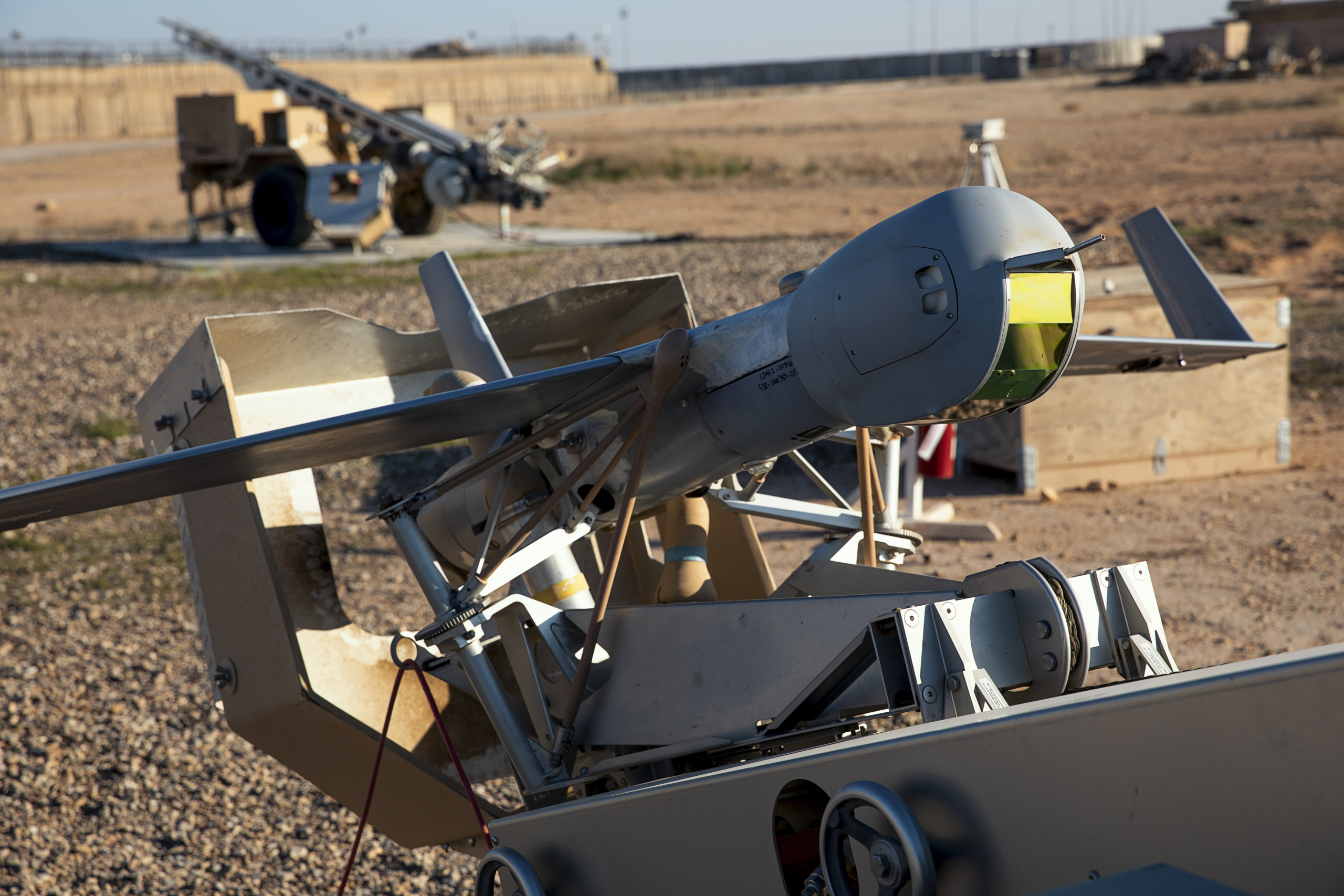
Ukraine and Russia have responded to jamming by fielding drones guided by fiber-optic cables that can’t be jammed. But a fire-and-forget missile with onboard guidance — and compact enough to be carried by a smaller drone like the 40-pound MQ-27 ScanEagle — would be very useful, not least to special operations troops who might not have easy access to air support. A Hellfire missile, for example, weighs around 100 pounds, which requires larger launch UAVs such as the Group 5 MQ-9 Reaper.
SCBDS appears to reflect “lessons drawn directly from the war in Ukraine,” Kelly Grieco, a researcher at the Stimson Center think tank, told Defense News. “In today’s electronic warfare environment, small drones with ATR [advanced target recognition] are increasingly being developed and deployed to help identify and home in on targets, especially in the last mile of attack.”
“The real challenge is making those algorithms reliable under battlefield conditions, particularly against a thinking adversary who uses deception,” Grieco added.
Phase I of the project will involve a feasibility study, followed by a Phase II prototype and Phase III commercialization of the technology.
“With the proliferation of UAS-based delivery in the commercial markets, this technology has potential application in that space,” the SBIR said.
In addition, the SBIR predicts that the project will enable improved commercial drone-based bridge inspection. SCBDS “has potential use cases in UAS-based infrastructure inspection and hazardous substance detection “due to the anticipated computer vision requirements associated with this technology.”
source
