


PARIS — German defense giant Rheinmetall unveiled a new concept for inundating battlefields with scores of loitering munitions: having them streak by the dozens out of 20-foot shipping containers.
Company officials presented the idea at the Eurosatory defense exhibition outside of Paris on June 15, pulling the cover off a mockup model in a mini ceremony that served as an ode to the combat punch of massed kamikaze drones, complete with glasses of cold beer and water on a warm Paris day.
One container can hold 18 of the company’s FV-014 munitions, meant to plop out of the container by way of rocket-assisted start. Following a post-launch tumbling phase, the munition is designed to spread its stabilizer fins and rush toward coordinates fed to its by the sensors of what Rheinmetall calls a “reconnaissance and strike” network.
Potential applications include driving the loaded containers to the front line on the back of trucks, where they would discharge their cargo to hit targets with their 4 kilogram warhead up to 100 kilometers away.
RELATED
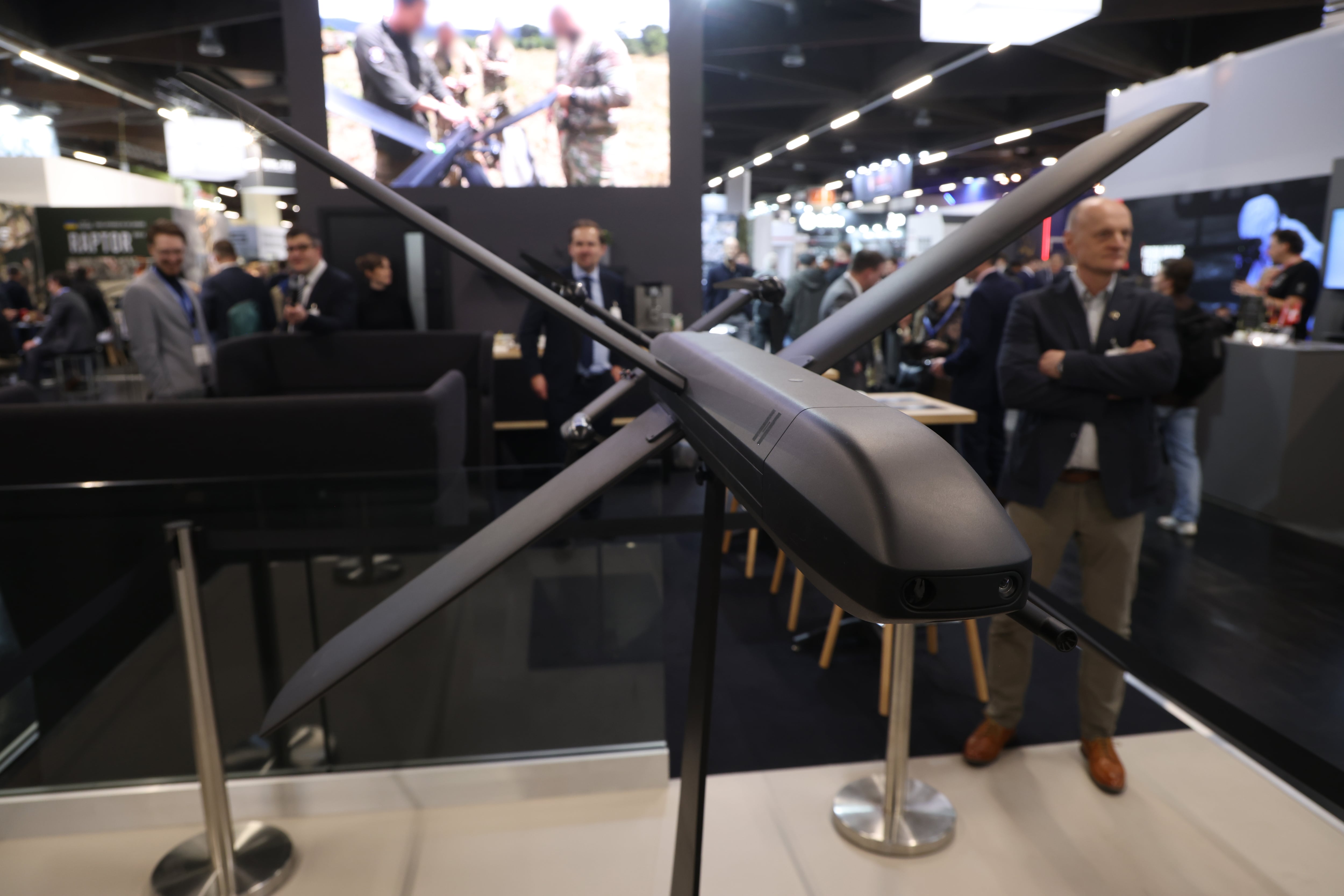
The loitering munitions have a maximum flight time of 70 minutes, meaning they can circle a general target area for a while until ground commanders call for a strike.
Another application could be arranging a number of the containers along a border, perhaps camouflaged, to spring into action when an enemy approaches, Timo Hass, CEO of Rheinmetall’s Digital Systems division, told reporters.
Haas said Rheinmetall will disclose the architecture of the drone launch interfaces inside the container — the physical slots and the electronic connectors — so that other companies could in theory design alternative, better munitions.
Whether it will come to that remains to be seen, as Rheinmetall only recently celebrated the award of a contract by the German armed forces, the Bundeswehr, for its brand new FV-014 loitering munition type.
German lawmakers in February authorized roughly $320 million each in funding for domestic loitering munitions makers Stark Defence, offering the Virtus, and Helsing, offering the HX-2.
They added Rheinmetall with the FV-014 as a later-comer a few weeks thereafter, leading to an April contract with the Düsseldorf-based defense company to the tune of roughly €300 million, or $348 million.
All three companies stand to make billions more in business if the Bundeswehr ends up finding their loitering munitions useful.
Sebastian Sprenger is associate editor for Europe at Defense News, reporting on the state of the defense market in the region, and on U.S.-Europe cooperation and multi-national investments in defense and global security. Previously he served as managing editor for Defense News. He is based in Cologne, Germany.
source
