

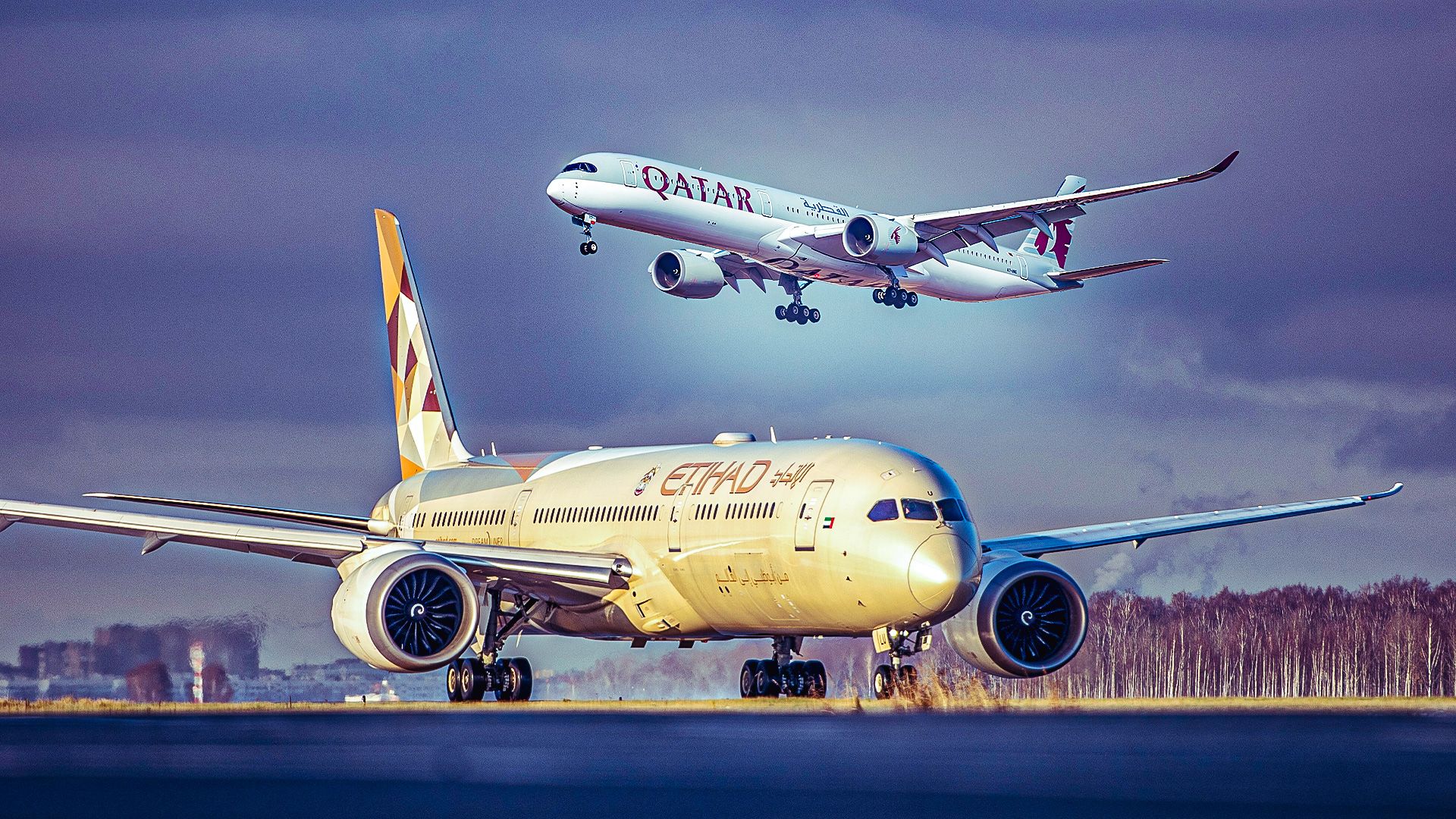
In the heart of the Middle East, both  Qatar Airways and
  Etihad Airways have the ideal geographical location for long-haul widebody aviation. It is perfect for flights to Europe, Africa, and the US to the west, and Asia and Australasia to the east. Although they don’t have widebody exclusive fleets, such aircraft are a clear focus, particularly as it concerns premium products.
There is no single answer to the question of which widebody fleet wins. Qatar’s larger fleet is indicative of a higher capacity and more profitable airline. Etihad has a more modern fleet, but its smaller order sheet means that Qatar will catch up as its fleet modernizes in the coming years. Meanwhile, their layover products are highly comparable. As such, it all comes down to personal preference and one’s own experience with the airlines’ respective products.
Which Widebody Fleet Wins?

One way to measure which carrier has the better fleet is to compare their respective sizes. By this metric, Qatar Airways is the clear winner. It has 212 widebody jets to Etihad’s comparatively small 76 (61 Boeing and 15 Airbus) jets. This pattern is set to continue in the immediate and distant future. Qatar Airways has an impressive order sheet of 289 widebody aircraft to Etihad’s 71.
However, such an analysis alone is incomplete, as the modernity and quality of the aircraft must also be considered. With this in mind, Etihad has a much younger fleet on average. That is because Qatar Airways still operates a substantial number of A330s, 777-300ERs and -200LRs. However, Qatar has proven its ability to operate these aircraft effectively for a number of years, and its sizable order sheet is set to go beyond replacing these aging jets.
It is also worth considering the product beyond the widebody aircraft that each carrier offers. Both airlines offer a stopover accommodation deal in their respective capitals. With Etihad’s Abu Dhabi stopover, customers can enjoy a complimentary two-night stay at recognizable hotel chains. Etihad goes further with 15% of local attractions and tours, and a free local SIM card. Qatar Airways offers a similar perk for Doha stopovers, with up to four nights in impressively affordable hotels. You can also book onto a host of tours and attractions.
Comparing The Boeing Aircraft

With just 61 Boeing widebody jets, Etihad has fewer than half as many as Qatar Airways. Etihad’s focus remains on modern Boeing widebody jets with 47 Dreamliners. Qatar Airways has more jets of this type at 55, but the overall focus remains on older aircraft with 62 passenger 777s and 28 777 freighters.
Despite its age, the 777-300ER continues to define Qatar Airways’ widebody services. It has built its reputation on the aircraft’s reliability, allowing it to be used on the highest-traffic long-haul routes while still offering premium products onboard. Simple Flying’s Josh Eyre states that the 777-300ER “continues to hold its ground as one of the most capable and profitable twin-engine jets ever built.”
The table below compiles ch-aviation data to directly compare the two carriers’ widebody Boeing fleets:
|
Aircraft variant |
Qatar Airways |
Etihad Airways |
|---|---|---|
|
777-200F |
28 |
5 |
|
777-200LR |
6 |
|
|
777-300ER |
56 |
9 |
|
787-8 |
31 |
|
|
787-9 |
24 |
37 |
|
787-10 |
10 |
|
|
Total |
135 |
61 |
Looking at this data, it is also interesting to consider what is missing from Etihad’s fleet, namely, the 777-200LR. Etihad has retired its five-strong fleet of this jet. The same can be said for 18 of its 777-300ERs. The average age of 14.6 years for the carriers’ remaining 777-300ERs suggests that the remainder will soon share this fate. Meanwhile, Qatar has made modest retirements of just three 777-200LRs and no 777-300ERs despite the average age of both jets being well over a decade.
Comparing Their Present Airbus Fleets

The significantly smaller size of the Etihad fleet is starker when we look at its Airbus widebody aircraft. With 15 jets, Etihad’s widebody Airbus fleet is over five times smaller than Qatar’s. The latter has some incredibly old Airbus widebody aircraft. Its A330-200s average 17.4 years old, while its A330-300s average 16.8. However, there is a clear intention to move away from such jets in the immediate future, as Qatar has already retired 16 A330-200s and 5 A330-300s. Meanwhile, five aircraft in the family are inactive. As such, the majority of Qatar’s widebody Airbus fleet comes from the A350 family.
The focus is similar for Etihad. This carrier has eight active A350-1000s with an average age of just 3.6 years old. Both carriers also operate modest A380 fleets. Qatar has three of these aircraft listed as inactive, whereas Etihad has already retired two.
The table below compiles ch-aviation data to directly compare the two carriers’ active widebody Airbus fleets:
|
Aircraft variant |
Qatar Airways |
Etihad Airways |
|---|---|---|
|
A330-200 |
3 |
|
|
A330-300 |
10 |
|
|
A350-1000 |
25 |
8 |
|
A350-900 |
33 |
|
|
A380-800 |
7 |
7 |
|
Total |
77 |
15 |
Another key difference between the two airlines’ Airbus fleets, is that Etihad has invested in substantially younger aircraft (although the two carriers’ A380 fleets are both slightly over ten years old). This can be seen by comparing the carriers’ A350-1000s. For Etihad, these aircraft average just 3.6 years old. Meanwhile, Qatar’s A350-1000s average 5.4 years old, while its A350-900s average 8.5 years old.
What Will The Future Hold

Both Qatar Airways and Etihad have substantial widebody aircraft order sheets. They are comparable to Airbus jets, with Qatar having ordered slightly more A350-1000s, and Etihad looking to boost its cargo capacity with 10 A350Fs.
The table below compiles ch-aviation data to directly compare the two carriers’ widebody orders:
|
Aircraft variant |
Qatar Airways |
Etihad Airways |
|---|---|---|
|
A350-1000 |
17 |
12 |
|
A350F |
10 |
|
|
777-200LR |
1 |
|
|
777-300LR |
1 |
|
|
777-8F |
34 |
|
|
777-8 |
8 |
|
|
777-9 |
90 |
17 |
|
787-10 |
75 |
20 |
|
787-9 |
61 |
4 |
|
Total |
289 |
71 |
There is much more to be said about the carrier’s Boeing order sheets, suggesting maintained confidence in the US manufacturer despite a litany of issues in recent years. Qatar Airways has a significantly larger order sheet, suggesting that the airline will continue to have a far greater capacity. Notably, both carriers also have significant 777X orders, showing a commitment to the idea of operating this enormous twin-jet outside the US market, where it has failed to break ground.
On The Ground – The Doha Stopover

Airlines like Etihad and Qatar Airways offer a product that extends far beyond the usual boundaries of air travel. One unique opportunity passengers aboard Qatar Airways can enjoy is the Qatar Stopover, designed for those spending 12 to 96 hours on a Doha layover. The airline has partnered with Discover Qatar to offer packages for up to four nights of hotel accommodation, tours, and “memorable experiences.”
Passengers can choose between 4-star, 5-star, “Premium Beach”, and “Luxury” hotels. All of these options offer fantastic value. For a four-night package, passengers will pay $76 for “standard” 4-star accommodation, $111 for “premium” 5-star accommodation, $138 for Premium Beach accommodation, and $348 for “Luxury” accommodation. Further fees apply to book tours and experiences. Passengers can pay extra to visit theme and water parks, tour the desert or Doha, enjoy cultural experiences, and take part in water sports.
The Qatar Stopover option is available for many passengers aboard Qatar’s widebody aircraft who are changing flights in Doha. This includes those flying from Australia, Germany, France, Japan, the United Kingdom, the United States, and many more.
How Do Their Narrowbody Fleets Compare?

Qatar Airways has 27 Airbus A220s and 2 Airbus A321neo. It also has 40 A321neos and 10 A321LR on order. The carrier has no Boeing narrowbody aircraft. The carrier previously committed to an order of 25 Boeing 737 MAX 10s to facilitate short-haul expansion. This followed trouble with Qatar’s A350 fleet, for which it was seeking $600 million in compensation, leading Airbus to cancel 50 of its A321neo order. However, Qatar canceled this order in May 2025 following delays and a decision to make peace with Airbus shifting its focus to the European manufacturer’s products.
The Etihad narrowbody fleet is comparable in size, if not modernity, to Qatar’s. The carrier has 15 A320-200s, 1 A320neo, 9 A321-200s, 6 A321neo and at least 1 A321LR. The modernization of Etihad’s narrowbody fleet will come with its firm order of 20 A321LRs. The carrier has bigger plans than that alone, anticipating that it will eventually operate 30-40 A321LRs.
Etihad hopes to use the jets to unlock new markets, adding destinations like Medan, Phnom Penh, and Krabi to its network.
In some ways, the differences between Qatar and Etihad’s narrowbody fleets are the opposite of their widebody fleets. Qatar has the more modern fleet, but Etihad hopes to catch up with significant A321LR plans. Yet, with a greater number of modern Airbus narrowbody jets on order for Qatar, it should have a significantly bigger narrowbody fleet in a decade.
source
