



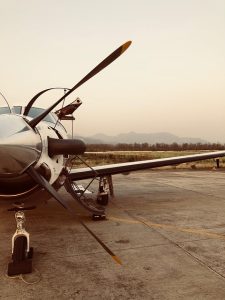
Turboprops are one of the most common types of aircraft engines. Research shows they power about half of all short-range airplanes. Conventional jet engines like turbofans still dominate the long-range market, but many short-range airplanes use turboprops.
Turboprops are gas turbine engines that spin a propeller blade. Like conventional jet engines, they feature a combustion chamber in which fuel and air is burned. While conventional jet engines produce jet exhaust through this combustion process, though, turboprops spin a propeller blade.
Overview of Reverse-Flow Turboprop Engines
A reverse-flow turboprop is a special type of turboprop that forces air inside of its combustion chamber before it drives the turbine. Normally, air follows a straight path from the front of a turboprop to the back. Reverse-flow turboprops are different in the sense that the air changes direction within the engine itself.
The air intake is essentially at the rear. Air moves backward from the rear of a reverse-flow turboprop to the front. This “reversed” design allows for both advantages and disadvantages.
Pros of Reverse-Flow Turboprop Engines
When compared to traditional straight-through turboprops, reverse-flow turboprops are typically more compact. Routing air from the rear to the front shortens the engine’s length. The end result is a smaller and more compact design.
Reverse-flow turboprops are highly reliable. They’ve been around for well over a half-century. During that time, they’ve logged hundreds of millions of flight hours.
They may sound complex, but reverse-flow turboprops are relatively easy to maintain. Many of them consist of two main sections: a gas generator and a power turbine. Engineers can work on these sections independently to address specific issues.
Cons of Reverse-Flow Turboprop Engines
There are also some drawbacks to reverse-flow turboprops, such as air routing. The airflow path requires careful aerodynamic design to prevent pressure loss. With a straight-through turboprop, air follows a linear path from the front to the back. Reverse-flow turboprops change the direction of airflow, so they must be designed to maintain proper pressure.
Another potential disadvantage of reverse-flow turboprops is thermal zones. As previously mentioned, reverse-flow turboprops are compact. This compact design creates thermal pockets where heat can accumulate. Engineers must address these thermal pockets with cooling solutions.
In Conclusion
Reverse-flow turboprops are characterized by a design in which the air moves backwards. Rather than flowing from the front of the engine to the back, air moves from the back to the front. Advantages of reverse-flow turboprops include a more compact design, reliability and ease of maintenance. Disadvantages of reverse-flow turboprops include air routing complexity and the potential for thermal zones.
