



By Karl Sinclair
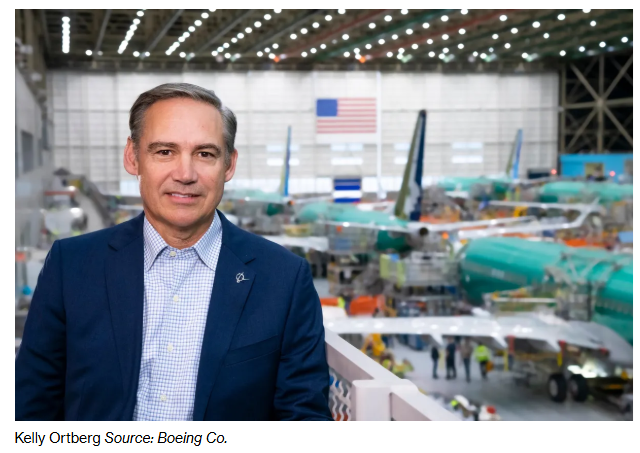
Boeing CEO Kelly Ortberg at the 737 production plant in Renton (WA). Credit: Boeing.
May 14, 2026, © Leeham News: “We’d like to get someday to 63 a month rate [on the 737 MAX], and so we’re looking forward to that. The market will support those higher rates. We’ve just got to get ourselves and our supply chain in a position to do that,” said Boeing CEO Kelly Orberg, speaking at the Bernstein Strategic Decisions Conference today.
Boeing recently completed a capstone review with the FAA and is producing at 47/mo in its Renton (WA) production facilities. Ortberg said it will take months to stabilize production at the new rate before seeking to boost it to 52/mo. This was the rate in March 2019 when the MAX was grounded by regulators following the second of two fatal crashes five months apart. The grounding would last 21 months.
However, in order to move beyond 52/mo, which Ortberg targets as the next review point, the North Line in Everett (WA) will have to be brought on line.
Previously, the Renton FAL had been able to produce at 57/mo, and was preparing to boost production to this rate when the grounding happened. Ortberg is no longer willing to push the facilities to that limit.
“We don’t think we can sustainably with our current safety and quality processes do that in Renton. That’s why we brought the additional line on. It’ll give us the capacity of an additional line. It also gives us flexibility,” he said.
North Line provides flexibility
The flexibility Ortberg refers to is the ability to produce “nose-to-tail” the 737 MAX 10 variant, the largest member of the family.
Boeing needs these higher production rates to improve profitability at Boeing Commercial Aircraft (BCA), which has not been out of the red since 2018.
“Margins will be improving as we go forward at the higher rates. There’s a lot of dynamics in that, and I think Jay [Boeing CFO Jay Malave] has laid these out in the earnings call. We have headwinds associated with late penalties with current deliveries that will burn off over the next couple of years,” he explained.
Ortberg elaborated further, “The North Line initially will be at a low rate and will actually be a drag on us initially. Once we get it up to the same rate performance as Renton, then it will be a contributor to the margins. Whether we get back to the exact level of margin on the program, we’ll see. We’ll definitely be improving the margin here over the next three years on the 737 program.”
Final Certification Stages
After a prolonged certification process fraught with many challenges, Boeing is finally seeing the light at the end of the tunnel.
“The 737 MAX 10 and MAX 7 cert [certification] programs [are] clearly getting to the final stages. It’s clearly light at the end of the tunnel here, and we’re going to get these certification programs done. We’re roughly a little better than 80% done with the certification flight test program. I got a note from our team that we were flying three 777s and two 737s simultaneously for certification score. We’re really banging this down, and it’ll get to the end of the year where we’ll get the certification so we can really support next year’s deliveries. We’re building MAX 10s, so we need to get that cert done so that we can start those deliveries,” he said.
Ortberg expects the smaller MAX 7 to be certified first, due to the complexity and added work involved on the MAX 10.
He also foresees the 737 process being completed long before the 777X widebody has finished its certification work.
Full certification of 777-9 will finish in 2027
“We’ll be done with the MAX well before we’re done with the 777 flight test program. Our flight test organization is common, so it’s the same team who supports all the airplanes. Once we get done with the 7 and the 10 flight test program, we will be able to apply more resources to the 777-9. But you should expect that we’ll hopefully be done with our flight test program by the end of the year, with the exception of ETOPS. ETOPS is the final test that you go through with the twin-engine aircraft, wide-body aircraft, and now ETOPS is going to extend into next year. We’re building the airplanes and getting ready to start the deliveries next year,” he explained. ETOPS is the extended operations over water certification required for a twin-engine airliner.
The long-awaited 777X program has been delayed since 2020, when the first handovers were expected. As a result, the program has been a black hole of losses for the company, costing the company $15.729bn in write-offs.
Expectations are for an additional $2bn cash burn for the program through 2026 and 2027, with the hope of a turnaround in 2028, when the bulk of the deliveries are expected to begin.
Down the road, the 777X-F freighter variant is expected to enter into service a further two years behind the passenger version.
Interiors dragging down Dreamliner deliveries
As Boeing expands its 787 production facilities in Charleston (SC), it is having difficulty handing over aircraft to customers due to delays and certification issues with aircraft interiors.
“The seating configurations have been very complex,” Ortberg said. “Getting the certifications done on the seats has actually not impacted production as much as they’ve impacted deliveries. You’ve seen our deliveries a little bit lumpier than what I’d like to see because we’ve got airplanes done, ready to be shipped, but we don’t have the cert paperwork”.
Boeing is producing at 8/mo on the 787 family, but is hamstrung by suppliers.
“We have airplanes sitting for customers, completely done, waiting for seat certifications. We’re working to get that process done. But every new airline type goes through a new certification process, and we just have quite a few of those yet to go through here this year. From a delivery perspective, we’ll be fighting seats throughout the year just getting through the seat certification. We’re working with the FAA and EASA and the seat manufacturers to try to improve that, but we’ve got a lot of work yet to do on that,” he elaborated.
Boeing is working toward a rate of 10/mo on the program, with a further increase expected once the factory expansion is complete in 2028.
Engines from GE have also been a sticking point, but there is a plan in place to resolve that and reach 10/mo by the end of the year.
Ortberg is also wary about interiors certification becoming a recurring problem for other aircraft, in particular the 737 MAX 10 and 777X programs, which would hamper future deliveries and much-needed cash flows.
Wichita (KS) Revival
Ortberg said he was pleased with the reintegration process of what was once Boeing Wichita, then the HQ of Spirit Aerosystems, and is now once again part of the Boeing family.
“They’ve made great progress in streamlining their production process and building a higher quality with fewer defects, so they’re not repairing and doing a lot of rework, which is allowing them to flow fuselages better. I was just at a big event in Wichita about a week ago. We announced a $1bn investment over the next three years, which is in our plan. We announced it publicly where we’re going to invest in the facilities as well as people and training to make sure that our team in Wichita is ready for the next production rate,” he said.
Ortberg also elaborated that there was a buildup of 737 MAX fuselages in Wichita and that he had no concerns about any future rate increases regarding that facility.
Getting the supply chain to accommodate the rate increases will be the biggest hurdle moving forward.
“Loser” Defense Contracts
Perhaps the statement in the interview was eloquently and definitively made by Ortberg when he summed up all the current fixed-price Boeing Defense & Space (BDS) contracts the company was suffering through. “The VC-25, the President’s airplanes, we’ll celebrate the day we hand the keys to the president, and that’s done.” This contract was approved by former CEO Dennis Muilenburg.
Boeing is looking forward to working its way through the spate of previously negotiated agreements, then never signing another one.
“The road to profitability on those programs is to get them behind us and go to the next phase,” he said. “The KC-46 (tanker) as an example. That’s been a lost program. It’s been a challenging program for us. We have one more lot for the existing firm-fixed-price KC 46 production. That’ll happen at the end of this year. Then the follow-on quantity will all be repriced. So, in that case, we have no ability to improve margins with the existing contract. We just need to manage the risk so there’s no further nonrecurring write-downs.” Former CEO Jim McNerney approved this contract.
Losses are approaching the $10bn mark on the KC-46 program, and the company is keen not to repeat the same mistakes.
No more loss-making contracts to win business
Ortberg is adamant that he would not bid on a contract solely to secure the business for the defense segment.
“We’ve walked away from some jobs that we historically would have taken on and said we can probably get this done. And we’ve looked at it and said there’s too much risk for the fixed-price contract type, so we’re not going to do it. One of the things that’s really key as we return that defense business to this high single-digit profitability is that we don’t enter into new loser contracts. We’re really focused on making sure the team’s disciplined around that,” he said.
While the defense budget may surge through $1.5tr in the near future, whether it is a follow-on contract to a current BDS program, an R&D investment into a new technology, or the launch of a new program, Ortberg is determined not to make the same mistakes of the past.
He underlined his position a third time when he said, “We’ve got to get through these programs that we’re underwater on, and get those behind us. There’s no reason this business doesn’t deserve to perform at a high single-digit margin business and return back to those classic cash flow rates that we’ve seen in the past. We have a nice mix of domestic and international. International generally has more upfront payments and higher cash, better cash terms than the DOD contracts or DOW contracts. We have to get these challenged programs executed and behind us. You’ll see better performance out of that business.”
Chinese Springboard
As always, though, the Boeing Company will go as Boeing Commercial Aircraft goes.
When asked about where, in the $1bn-$3bn range, the projected 2026 FCF will land, Ortberg simply said, “How many airplanes we deliver probably will be, in the end, the determining factor.”
Finally, on the subject of the MOU for 200 commercial aircraft from China, Ortberg was upbeat on the implications.
“The China trip was super successful. My primary objective was to reopen that market to our narrow- body. We hadn’t had an order in nearly a decade. We accomplished that, which is a major, major accomplishment. I think people focus a little bit too much on the initial quantity. This is opening the market,” he said.
Ortberg expects that the MOU will be converted into confirmed orders amongst various Chinese airlines now that the government has green-lit to process.
Down the line, he expects further orders to materialize in a market that requires about 500 new aircraft per year.
For perspective, a 737 production rate of 52/mo is 624 aircraft a year. At the peak, China accounted for 25%-33% of Boeing’s annual deliveries, or 156 to 206 aircraft per year (excluding widebodies in this example, which would inflate these figures somewhat).
Airbus hopes to achieve a production rate of 75/mo for the A320neo family by 2028. This is 900 a year. If Airbus likewise allocated 25%-33% of its deliveries to China, 25% is 225 to 297 a year, or 381 to 503 a year at 33%. China’s home-grown manufacturer, COMAC, wants to produce 150 C919s, its competitor to the A320 and 737, a year by the end of the decade. It’s an ambitious goal, but it illustrates that neither Airbus nor Boeing can count on exclusively filling the need for 500 narrow-bodies annually.
No deferrals so far from Mid-East war
Briefly touching on higher jet fuel prices and the potential for deferred orders, Ortberg was confident the company would weather the storm.
“I’ve had more customers call me saying, if you have that situation (of an order deferral), I’ll take the airplanes, than I have had customers saying, I want to give up any slots,” he said.
If a customer wants to defer an order, Boeing can switch out a slot with 12 months notice on a narrowbody and 18 months notice on a 787 without a problem.
He also detailed that commercial aircraft are sold out until the 2030s.
Now all that remains is to get the company back to profitability.
Related
