

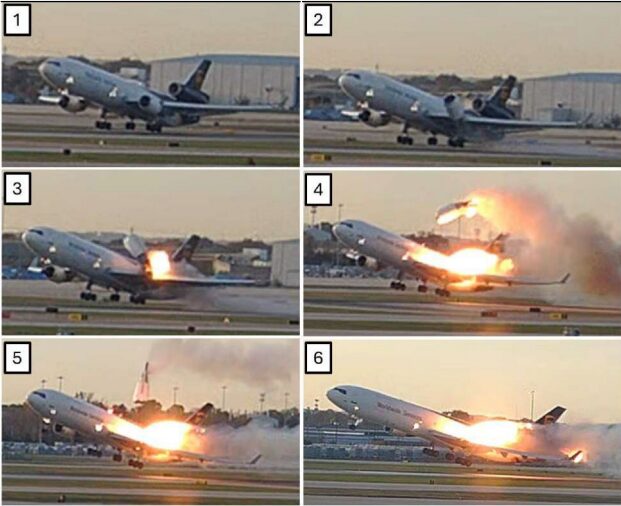
US federal investigators probing the deadly crash of a UPS MD-11 in Louisville have released a preliminary report showing that the airplane’s left engine was operating normally at the time of the tragedy and did not fail or fall from the freighter to the runway. Instead, the report says the engine and pylon were torn from the wing during the takeoff rotation, vaulting up and over the fuselage as the trijet lifted off on the late afternoon of November 4, 2025.
The National Transportation Safety Board (NTSB) released its preliminary report on November 20, 2025, providing the clearest picture yet of what may have caused the crash of UPS Flight 2976, an MD-11F that went down in flames shortly after liftoff from Louisville’s Muhammad Ali International Airport. The crash killed all three crewmembers and eleven people on the ground. Twenty-three others on the ground were injured. The aircraft, operating on a would-be flight to Honolulu, was destroyed by impact forces and fire.
The investigation’s early findings appear to confirm that the accident began with a structural failure during takeoff. According to airport surveillance video and flight data, the left engine and its pylon separated from the wing just after rotation. The engine, a GE CF6 mounted on the No. 1 (left) position, broke free with its pylon assembly intact and traveled up and over the fuselage before falling to the ground beside the runway. A fire ignited on the detached engine as it tumbled, and a second fire broke out at the pylon’s attachment point on the wing.
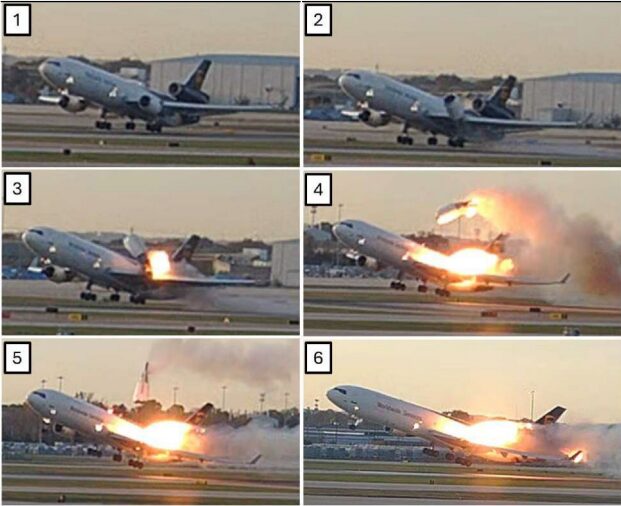
The airplane briefly became airborne, climbing no higher than about 100 feet above ground level, according to flight tracking data. It cleared the blast fence beyond the end of Runway 17R, but the left main landing gear struck the roof of a UPS warehouse located just south of the airport boundary, the report said. The MD-11 then descended into a storage yard and two additional buildings — including a petroleum recycling facility — before coming to rest roughly 3,000 feet southeast of the initial impact point. Most of the structure and cargo were consumed by fire.
Airport surveillance images included in the preliminary report show a dramatic and revealing sequence in the first seconds of flight. As the MD-11 rotated for takeoff, the left engine and its pylon can be seen breaking away from the wing, then arcing upward over the fuselage with flames trailing behind. A second fire erupts at the point where the pylon tore free from the wing, burning intensely as the aircraft tries to climb. The visuals make clear that the engine did not detach downward or separate cleanly — it broke away with enough force to travel up and over the airplane, consistent with a structural failure in the pylon assembly rather than for some other reason, such as an uncontained engine failure.
Investigators are now focusing attention on the pylon structure that holds the engine to the wing. The NTSB’s structures group documented that both the forward and aft lugs of the left pylon’s aft mount had fractured. The lug fractures showed evidence of fatigue cracking on several surfaces, along with areas of overstress failure indicating a final, sudden break. The NTSB noted the spherical bearing inside the aft mount was also found with its outer race fractured circumferentially, leaving the bearing’s ball exposed. Portions of the left-wing clevis and the pylon attachment hardware remained connected to a wing fragment found in the debris field near the runway.
The right engine and pylon separated from the wing during the accident sequence but were found together at the site. Unlike the left side, the right pylon remained attached to the wing clevis. Investigators recovered fragments of engine fan blades from the No. 1 engine along the runway, but the NTSB has not cited any evidence of an engine failure before separation.
Both the cockpit voice recorder (CVR) and flight data recorder (FDR) were recovered and contained usable data. The CVR held just over two hours of audio, including the entire accident flight. The FDR recorded parameters for 24 flights over roughly 63 hours, including the accident flight.
Maintenance history reviewed by investigators shows the aircraft had accumulated 92,992 hours and 21,043 cycles. Required visual inspections of the left pylon aft mount had last been completed in October 2021. The NTSB said UPS performed required maintenance on the pylon components in October 2025, including routine lubrication on the parts that connect the engine pylon to the wing. Two cycle-based special detailed inspections — one for the pylon aft mount lugs and another for the wing clevis — were not yet due and had not been performed.
The NTSB also noted similarities between this incident and a DC-10 crash in the late 1970s. In the preliminary report, investigators said the circumstances echo key elements of a 1979 American Airlines Flight 191 accident in Chicago, when a DC-10 lost its left engine and pylon during takeoff. In that case, the engine separated along with part of the wing’s leading edge, causing the aircraft to roll left and crash shortly after liftoff.
Following the accident, UPS voluntarily grounded its MD-11 fleet on November 7 at Boeing’s recommendation. The FAA then issued an emergency airworthiness directive on November 8 prohibiting further flight of MD-11 and MD-11F aircraft until inspections and corrective actions could be completed. A second emergency directive issued November 14 expanded the grounding to include DC-10 series aircraft because of their similar pylon design.
source
