

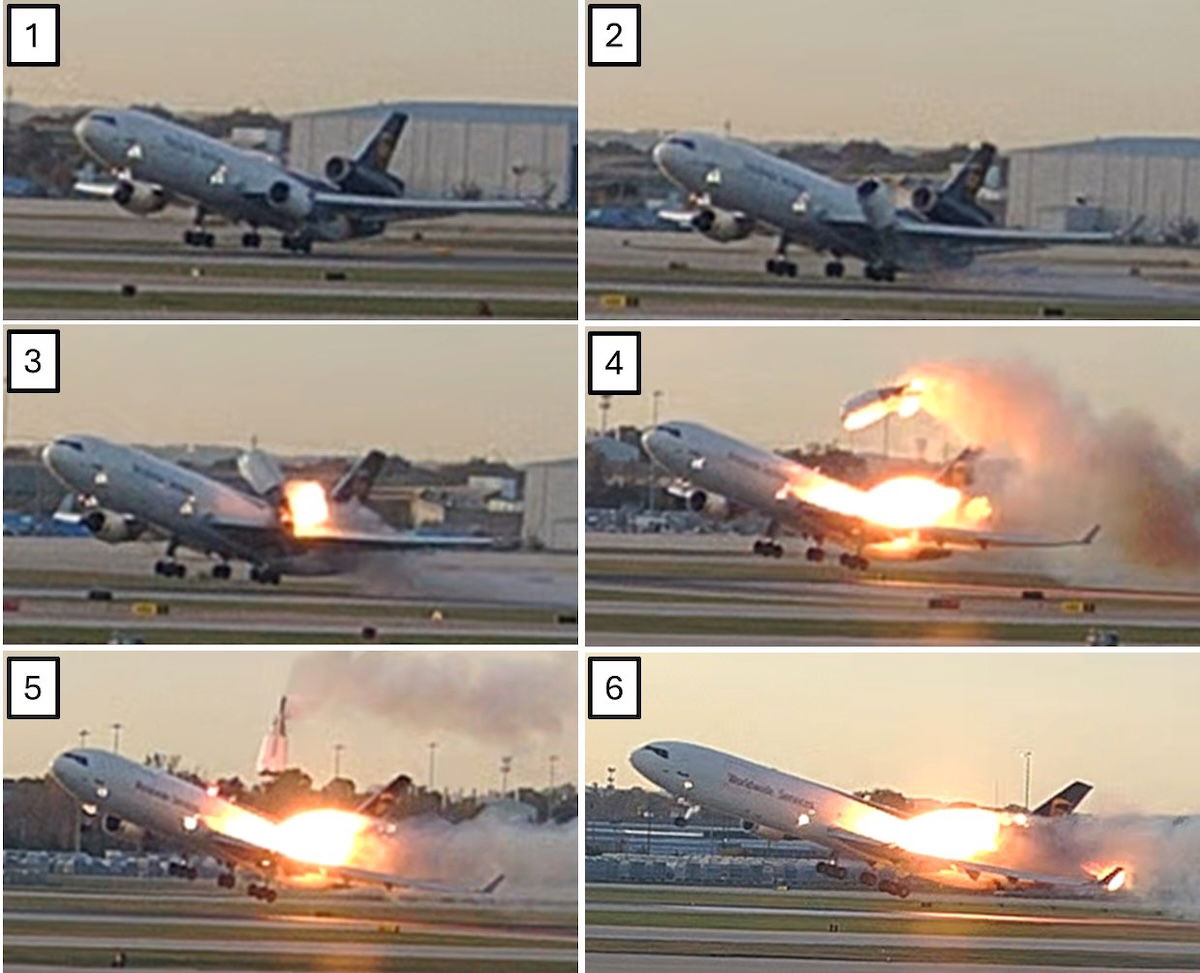
On November 4, 2025, we saw a horrific accident, whereby a UPS McDonell Douglas MD-11 crashed while taking off from Louisville (SDF), killing the three pilots onboard, plus 11 people on the ground.
Just over two weeks after the accident, the National Transportation Safety Board (NTSB) has released its preliminary report, and the findings confirm what most people had suspected.
UPS MD-11 had fatigue cracks on engine pylon mount lug
Since there was video of the UPS MD-11 crash, we had a sense of what happened. Specifically, we know that the plane’s left engine separated from the plane during the takeoff roll, and the left wing when caught fire, putting the pilots in an impossible situation.
The NTSB’s preliminary report gives us a good sense of what happened. Of course it’s worth emphasizing that this isn’t the final report, but it definitely clears some important things up. Specifically, the NTSB found fatigue in the left pylon aft mount lug, which connects the engine to the wing.
According to the report:
After initial cleaning of the fracture surfaces, examination of the left pylon aft mount lug fractures found evidence of fatigue cracks in addition to areas of overstress failure. On the aft lug, on both the inboard and outboard fracture surfaces, a fatigue crack was observed where the aft lug bore met the aft lug forward face. For the forward lug’s inboard fracture surface, fatigue cracks were observed along the lug bore. For the forward lug’s outboard fracture surface, the fracture consisted entirely of overstress with no indications of fatigue cracking.
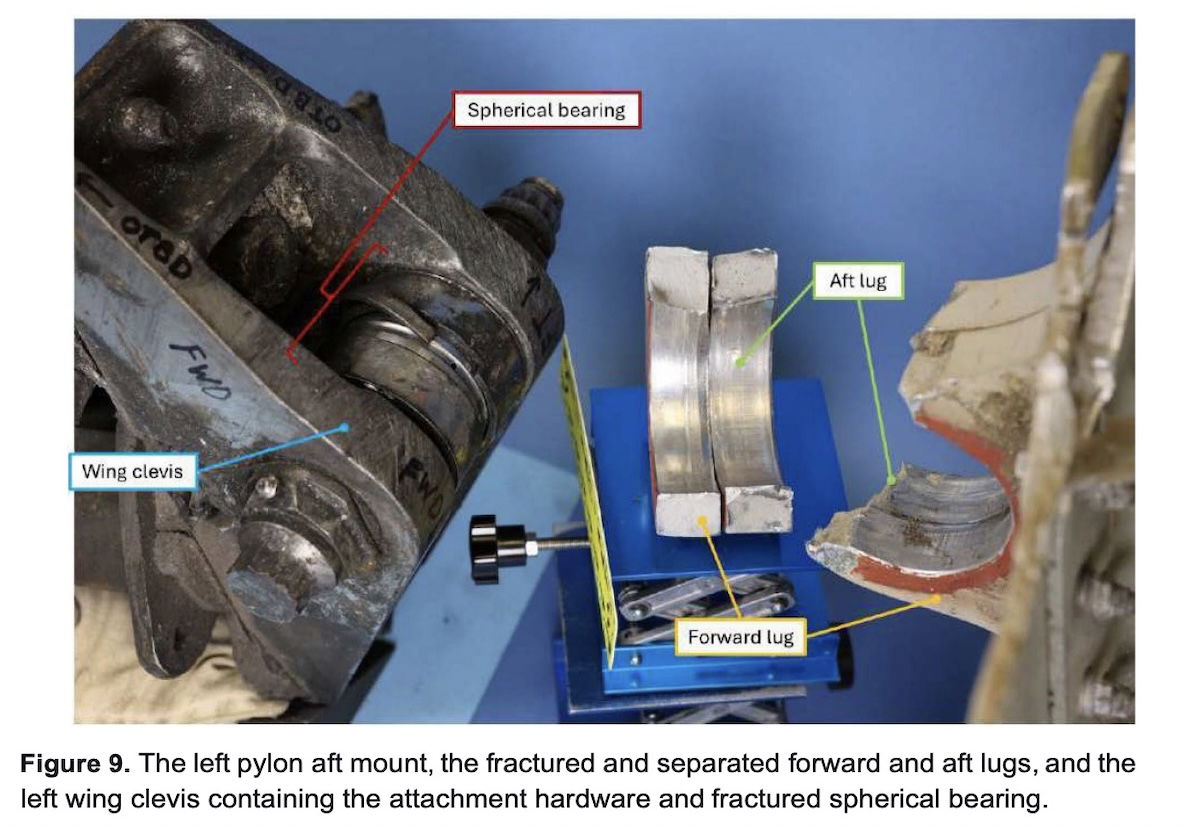
Now we know there were fatigue cracks, so the next big question in the investigation is what caused the fatigue cracks. All the required maintenance had been performed on the aircraft, so was the MD-11 maintenance program just not sufficient, did this plane just have too many cycles, or what?
All MD-11s in the US have been grounded following this incident, so let’s see if the planes fly again, or if something bigger is determined to be an issue. After all, these planes were presumably getting pretty close to retirement anyway.
NTSB draws parallels to 1979 crash of AA191
As many of us noted when this accident happened, this had some striking resemblances to the 1979 crash of American Airlines flight AA191, which is the deadliest air crash to ever happen in the United States. The flight was operated by McDonnell Douglas DC-10 (a prior version of the MD-11), and the plane also lost its left engine on takeoff, and immediately came crashing down.
The NTSB addresses similar events in its reports, and specifically references this accident:
On May 25, 1979, about 1504 central daylight time, American Airlines flight 191, a McDonnellDouglas DC-10-10 aircraft, crashed into an open field just short of a trailer park about 4,600 ft northwest of the departure end of runway 32R at Chicago-O’Hare International Airport, Chicago, Illinois. Flight 191 was taking off from runway 32R. The weather was clear and the visibility was 15 miles. During the takeoff rotation, the left engine and pylon assembly and about 3 ft of the leading edge of the left wing separated from the airplane and fell to the runway. Flight 191 continued to climb to about 325 ft agl and then began to roll to the left. The airplane continued to roll to the left until the wings were past the vertical position, and during the roll, the airplane’s nose pitched down below the horizon.
Flight 191 crashed into the open field and the wreckage scattered into an adjacent trailer park. The airplane was destroyed in the crash and subsequent fire. Two hundred and seventy-one persons on board Flight 191 were killed; two persons on the ground were killed, and two others were seriously injured. An old aircraft hangar, several automobiles, and a mobile home were destroyed. The NTSB investigated American Airlines flight 191 accident, see NTSB No. DCA79AA017 and aircraft accident report AAR-79-17.
Sadly, it appears that history may have repeatedly itself with this accident…
Bottom line
The NTSB has released its initial report into the recent crash of a UPS MD-11, which claimed 14 lives (three people onboard and 11 people on the ground). The NTSB found fatigue cracks in the left pylon aft mount lug, which connects the engine to the wing.
That explains how the engine separated from the plane during takeoff, causing a fire, and then putting the pilots in a situation where the plane couldn’t be saved. What a horrible tragedy, especially given the parallels to the 1979 accident of a similar aircraft. Now the question is just what caused these fatigue cracks, because that’s what regular aircraft maintenance is intended to address.
Also, massive credit to the NTSB for the speed, quality, and transparency of the investigation. We know more about this accident in two weeks than we know about the crash of Air India flight AI171 after several months.
What do you make of the NTSB’s preliminary report?
source
