


Northrop Grumman will integrate its uncrewed and autonomous technologies onto Kratos’ Valkyrie for the USMC’s MUX TACAIR Collaborative Combat Aircraft program.
Northrop Grumman and Kratos announced that they will work together on the U.S. Marine Corps’ Marine Air-Ground Task Force Uncrewed Expeditionary Tactical Aircraft (MUX TACAIR) Collaborative Combat Aircraft (CCA) program. The two have been competitively awarded to integrate Northrop Grumman’s uncrewed and autonomous technologies with Kratos’ Valkyrie Uncrewed Aerial System (UAS) to work alongside crewed fighters to provide air dominance in high-threat environments.
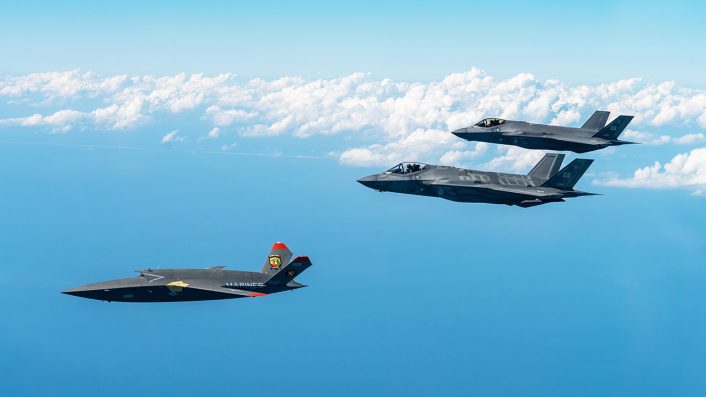
Notably, the selection follows multiple tests by the Marines with the XQ-58 Valkyrie and the F-35 Lightning II. According to the joint press release by both companies, more than 20 successful flight demonstrations were conducted in operationally relevant environments.
The Contract
Krys Moen, Vice President of Advanced Mission Capabilities at Northrop Grumman, told us in an emailed statement that the contract for the MUX TACAIR CCA is an Other Transaction Agreement (OTA) with an initial value of $231.5 million. While a timeline is not available at the moment, the contract has an initial Period of Performance of 24 months.
The press release states that Northrop Grumman will develop and rapidly deliver platforms that include an Advanced Mission Kit, an Open-Architecture Autonomy Software and the Valkyries Uncrewed Aerial System from Kratos.
“Northrop Grumman remains at the forefront of advanced sensing capabilities, delivering innovative solutions that meet the needs of the warfighter with unmatched speed and reliability. This enhanced capability set ensures optimal performance for both crewed and uncrewed platforms.”
— Krys Moen, vice president, advanced mission capabilities, Northrop Grumman.
The mission kit is inclusive of sensors and software-defined technologies that were designed specifically for uncrewed aircraft. The company said it has packaged its sensors and other mission capabilities into a smaller envelope, resulting in a more cost-effective solution that is compatible with an uncrewed platform, as it would be subject to more restrictive SWaP (Size, Weight, and Power) constraints compared to a standard fighter jet.
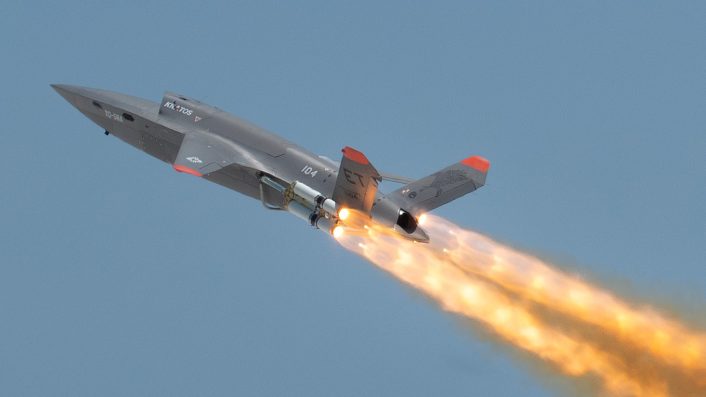
Additionally, the mission kit’s flexible technology can perform various kinetic and non-kinetic effects. We reached out to Northrop Grumman to ask for more details about the kit, and they told us the kit includes “a fully integrated sensor suite covering multiple functions and frequency bands,” which will integrate “both Northrop sensors and a variety of best of breed industry sensors into a low-cost integrated solution.”
Northrop Grumman also specified the autonomy system that will be implemented, Prism, which notably is the same that has been integrated on the Model 437 Vanguard through the Beacon autonomous testbed ecosystem. Prism also allows the integration of modules provided by partner companies to add different capabilities.
The combination of the capabilities provided by Northrop Grumman, Kratos, and commercial partners will result in a missionized CCA that includes survivability, connectivity, lethality and supportability elements, say both companies.
“The integration of the Kratos Valkyrie aircraft system configured with the world’s best multifunction mission systems from Northrop Grumman results in a high-capability CCA at a price point that enables the uncrewed systems to be deployed in mass with crewed aircraft.”
— Steve Fendley, president Kratos Unmanned Systems Division.
MUX TACAIR CCA
The Marine Air-Ground Task Force Uncrewed Expeditionary Tactical Aircraft (MUX TACAIR) Collaborative Combat Aircraft (CCA) program was launched by the U.S. Marine Corps to support manned fighter jets in operations against a peer/near-peer adversary, improving their survivability in high-threat environments. Among the main missions will be electronic warfare and surveillance.
The service is adopting a “spiral approach,” similar to the increments of the Air Force’s own CCA program, to progressively add new capabilities to the uncrewed system. According to the FY 2026 budget documents, where $58 millions were requested for MUX TACAIR, the rapid prototyping program will produce a “prototype air vehicle with fully integrated mission systems” to start demonstrating the initial capabilities.
The goal is to quickly field the CCA associated to each increment that provides a “Minimum Viable Product that is operationally relevant and balances schedule and technical complexity.” It is worth noting that, since the mention of the MAGTF in the program’s name, one of the increments might include the ability to launch and recover the aircraft from naval vessels.
Valkyrie Testing
In recent years, the U.S. Marine Corps has tested the XQ-58 Valkyrie in flight alongside crewed platforms such as the F-35 to evaluate the crewed-uncrewed integration. Among the tests were also electronic warfare, support to Suppression of Enemy Air Defenses (SEAD) and autonomous tasks, according to officials.
The tests have been ongoing since 2023 as part of the Penetrating Affordable Autonomous Collaborative Killer – Portfolio (PAACK-P) program. This is also mentioned as part of Project Eagle, the service’s aviation modernization strategy, which will inform capabilities needed in future conflicts out to 2040.
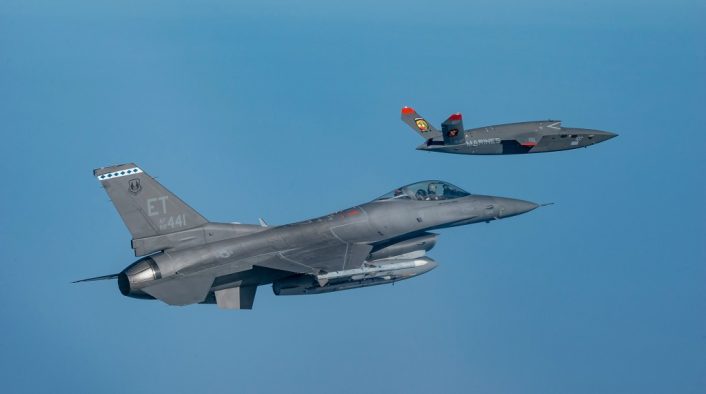
In 2024, the XQ-58A Valkyrie demonstrated newly added Link-16 capabilities, exchanging relevant tactical information in preparation for the drone’s participation to Emerald Flag 2024. On that occasion, the service said “The XQ-58A has proven itself ready for this capstone event, allowing the Marine Corps to demonstrate cooperative kill chain closure between manned and unmanned strike platforms for the first time in a large-force exercise.”
The XQ-58A Valkyrie
The XQ-58A Valkyrie is a runway-independent, high-speed, long-range unmanned combat aerial vehicle (UCAV) developed by Kratos Defense & Security Solutions in partnership with the Air Force Research Laboratory (AFRL). Part of AFRL’s Low Cost Attritable Aircraft Technology (LCAAT) effort, the Valkyrie is designed to deliver high utility at a fraction of the cost of traditional platforms.
Engineered as an attritable aircraft, the XQ-58A is low-maintenance and reusable, yet affordable enough to be considered expendable in high-threat environments. From contract award to first flight in 2019, the aircraft was developed in just two and a half years, demonstrating the benefits of accelerated acquisition and commercial manufacturing methods.
The Valkyrie’s design incorporates a stealth-optimized fuselage, V-tail, and internal payload bay. It is launched from a ground-based rail and recovers via parachute, making it runway-independent and highly flexible in deployed operations.
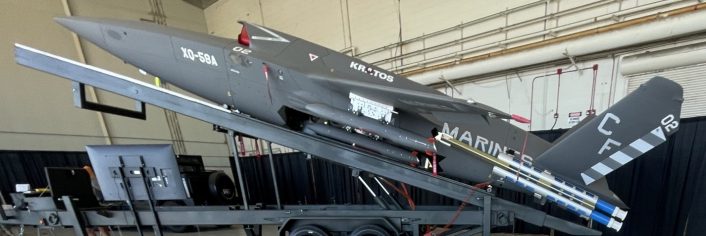
The XQ-58A can support a variety of missions, including strike, ISR, electronic warfare, decoy, and comms relay. It has also successfully demonstrated manned-unmanned teaming with fifth-gen aircraft. In a notable 2021 test, an XQ-58A released an ALTIUS-600 Small Unmanned Aerial System (SUAS) from its internal bay, showcasing its capability as an airborne launch platform for loitering munitions or other UAS.
A Block 2 variant with improved structure, payload, and operational capability first flew in 2022. The updated version is part of ongoing integration and testing at Eglin AFB, Florida, where multiple Valkyries have been delivered for evaluation under Skyborg and Autonomous Attritable Aircraft Experimentation programs.
In 2023, the Valkyrie flew a three-hour mission with AFRL-developed AI flight software, marking a major milestone in autonomous air combat. As testing continues under ABMS and CCA, the Valkyrie will help inform future development and deployment of semi-autonomous unmanned capabilities.
source
