


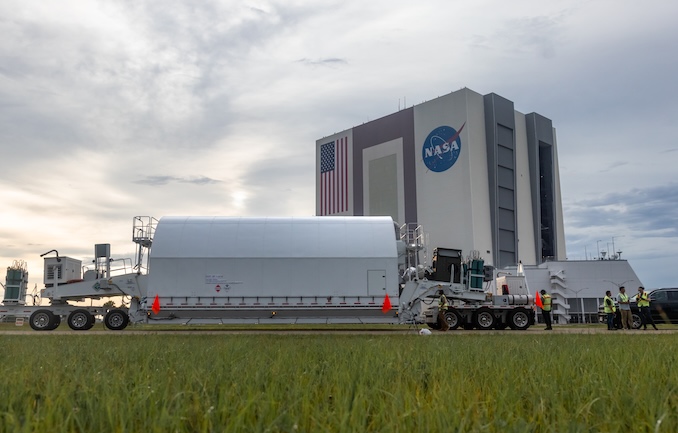
NASA’s next great observatory, the Nancy Grace Roman Space Telescope, arrived at the Kennedy Space Center aboard the agency’s massive Pegasus barge late Sunday morning.
The spacecraft was nestled inside its protective case, which NASA nicknamed the “Chariot” in keeping with the “Roman” theme. That said, telescope is named not for the ancient empire, but instead for NASA’s first Chief of Astronomy, Nancy Grace Roman.
“She was a key person in our exploration of space. She understood that in order to better understand the universe, you have to go in space,” said Lucas Paganini, the program executive for Roman. “That’s why she’s called the ‘Mother of Hubble’ because she made Hubble possible.”
The 43-foot-tall observatory disembarked from the barge shortly after 7 p.m. EDT (2300 UTC), following a stream of thunderstorms that delayed its departure by about an hour. The spacecraft will travel to the south end of the KSC campus to a building called the Payload Hazardous Servicing Facility.
There it will undergo a roughly 70-day prelaunch campaign involving checkouts, fueling, and finally the encapsulation inside the payload fairing of a Falcon Heavy rocket. The observatory is set to launch from Launch Complex 39A no earlier than August 30, moved up from the original September launch date.
“A lot of credit to this great team. They’ve been able to accommodate schedules, to accelerate to be able to launch earlier,” Paganini said. “There’s a lot of things going on at the Cape and of course the team has been amazing.”
This was the second trip to Florida for the Pegasus barge this year after it dropped off the propellant tank section of the core stage for the Artemis 3 Space Launch System rocket back in late April. While the spacecraft arrived safely, Neil Patel, the Roman mechanical engineer who traveled with the observatory, said it wasn’t entirely smooth sailing after leaving from Massachusetts.
“We do have a tight temperature tolerance on the observatory. We need to stay below 74 degrees. We have two cooling units: we had a primary and a redundant unit and they just weren’t getting the job done down here, so we had to make a stop, add additional rental units,” Patel said.
“Again, it was an amazing effort to have a team come down on an emergency basis. Basically, a MacGyver crew came in and we added additional units and those units did maintain the temperature quite well.”
Roman is designed to operate near a fixed point in space called Lagrange Point 2, about 1.5 million km away from the Earth on the side opposite the Sun. It’s designed to operate there for a minimum of five years, but Paganini said with the propellant onboard, it will likely last for 10 years or more.
The telescope is+ equipped with a 300 megapixel camera called the Wide Field Instrument, which features 18 detectors. It was developed by BAE Systems (formerly Ball Aerospace).
“It’s going to allow us to observe at least 100 times wider field of view than what we can do with Hubble. Same resolution, but a wider area, 1000 times faster,” Paganini said. “So what takes Roman a year to observe, it would take Hubble thousands of years. So it’s definitely much more efficient.”
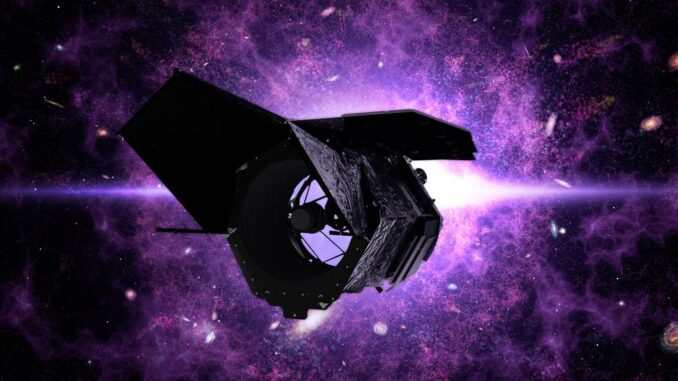
The observatory also features a chronograph instrument, developed by the Jet Propulsion Laboratory, which will allow Roman to observe the faint light of exoplanets near their stars.
Paganini said Roman will also help scientists better understand dark matter and dark energy, the combination of which he calls the “dark universe”.
“100 years ago, we discovered that the universe was expanding. 25 years ago, we discovered that it was expanding at an accelerated pace and that’s what led to a Nobel Prize,” Paganini said. “What we don’t quite know yet is if that acceleration is changing in ways. We don’t know if it’s actually dark energy, what is producing it, or is it simply that we don’t understand gravity at all.
“So eventually, we’ll see if the laws of physics that we use these days are the right ones for what we are observing. But at the end is, we’re trying to understand a very human question, which is where do we come from and where are wea heading in this universe that is our neighborhood?”
source
