

It’s been almost a century since  Lufthansa was first founded. Its history traces back to 1926, when the original Deutsche Luft Hansa was created through the merger of Deutscher Aero Lloyd and Junkers Luftverkehr. That airline operated as Germany’s flag carrier until the Second World War and was later dissolved. The modern Lufthansa emerged in the 1950s, after Luftag acquired the name, the crane logo, and the blue-and-yellow colors of the original carrier.
Next year, the airline will mark 100 years since its founding, and to commemorate the milestone it will introduce a special anniversary livery across six of its aircraft types. Lufthansa initially planned to introduce the livery on its new Boeing 787-9, but the airline recently announced that it will introduce the new livery to six aircraft types.
How Lufthansa’s 100-Year Livery Will Look

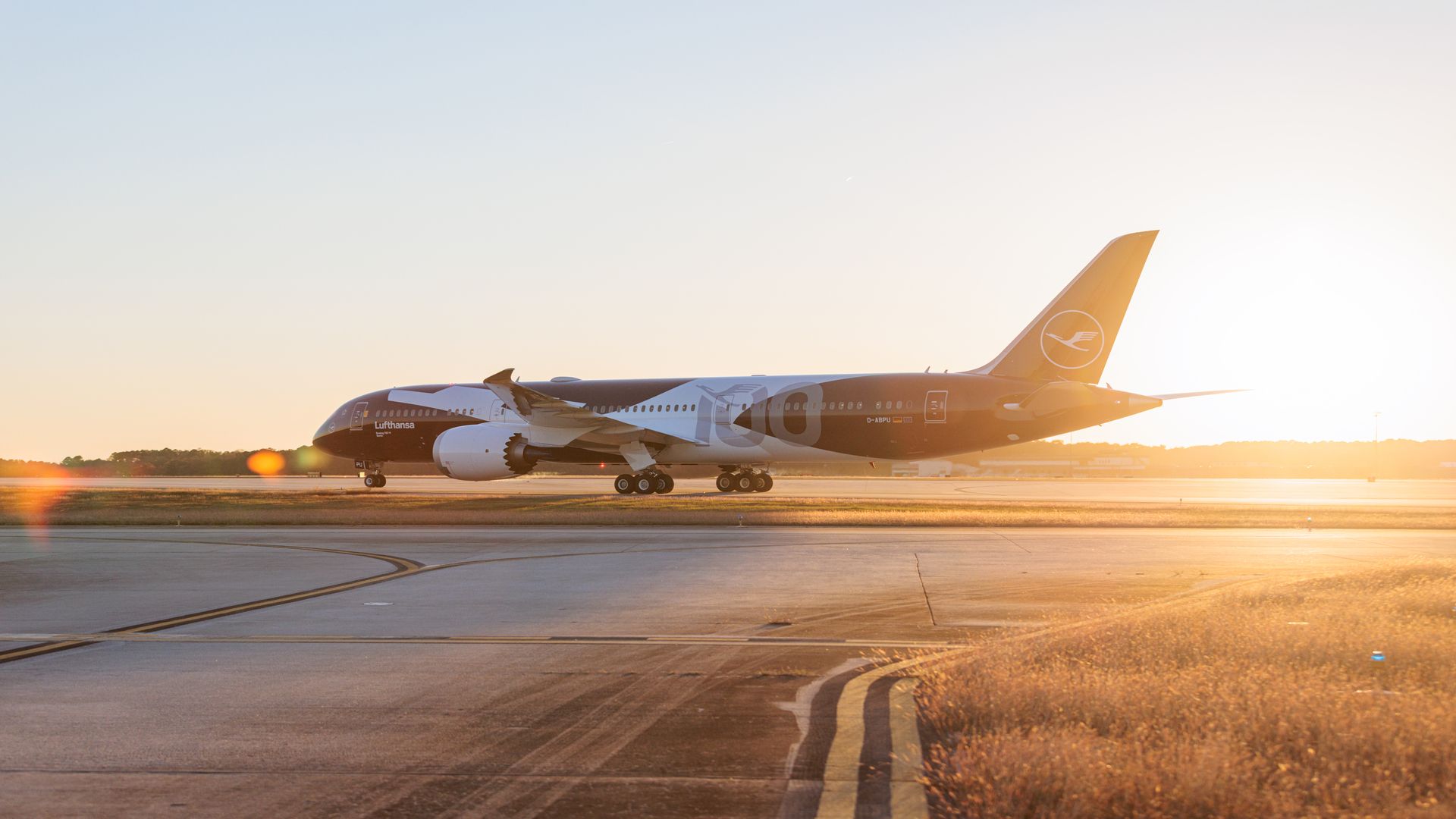
The special livery features a blue fuselage with a white crane painted above it. The bird’s wings sweep outward and blend into the aircraft’s own wings, which creates the impression that the aircraft is flying on the crane’s wings. In addition, it also features a “100” on the left side of the fuselage, as well as on the underside of each aircraft, and a “1926 / 2026” on the right. It is inspired by a graphic designer and architect, Otto Firle’s original 1918 crane design.
Lufthansa will introduce the design across six of its aircraft types: the Airbus A320, Airbus A350-900, Airbus A350-1000, Airbus A380, Boeing 747-8, and Boeing 787-9. The rollout will take place gradually, and the full anniversary fleet is expected to be completed by fall 2026. The Airbus A330 and A340 families will not receive the new livery, as the airline is currently phasing out both types.
The 787-9 Becomes The First Aircraft To Wear The 100-Year Livery

According to ch-aviation data, the airline currently operates 33 Airbus A319s, 46 A320s, 30 A320neos, 54 A321s, 18 A321neos, 31 A350-900s, eight A380s, 19 Boeing 747-8s, and nine Boeing 787-9s. It also has 15 A350-1000s on order, which will become one of the largest aircraft type in its future fleet. The first aircraft to receive the anniversary design was the Boeing 787-9 registered D-ABPU. It was painted at Boeing’s Charleston facility and then moved to Everett for final preparations.
The aircraft is expected to enter service in January, and the airline is expecting to receive the aircraft shortly before Christmas. The delivery was initially expected in November with the new Allegris cabin, but delivery delays have pushed the timeline back. Lufthansa currently deploys its 787-9s on routes from Frankfurt to Toronto, Atlanta, and Rio de Janeiro. For next year, according to scheduled data from Cirium, the airline has scheduled the type on additional services to Denver, Detroit, Newark, Los Angeles, New York JFK, Las Vegas, Chicago, and several Asian destinations, including Hong Kong and Shanghai.
Jens Ritter, CEO of Lufthansa Airlines, said, “Our Lufthansa crane stands for safety, pioneering spirit, premium quality, but also for freedom and reliability. This has been the case for the past 100 years and will continue to be so in the future. We are proud of our tradition and our values, and we look forward to continuing our great history. The special livery of the Boeing 787 honors our identity.”

Video: Lufthansa Shows Off Centenary Boeing 787 Livery
The German flag carrier has big plans for next year.
From 1926 To Today: How Lufthansa’s Branding Has Changed

Lufthansa’s crane has been a key part of its identity for decades, and the airline has only made a few major changes to its branding over time. The most recent major redesign came in 2018, and it was the first overhaul of the brand since 1989. In that update, the airline shifted to a darker blue as its primary color, while the traditional yellow was reduced to signage and select cabin details.
Overall, the crane symbol itself remained unchanged in form, apart from a slight refinement to make the lines thinner and more modern. The redesign kept the overall look minimal, avoiding bold or heavy accent colors and maintaining the understated style that has defined Lufthansa for decades.
source
