


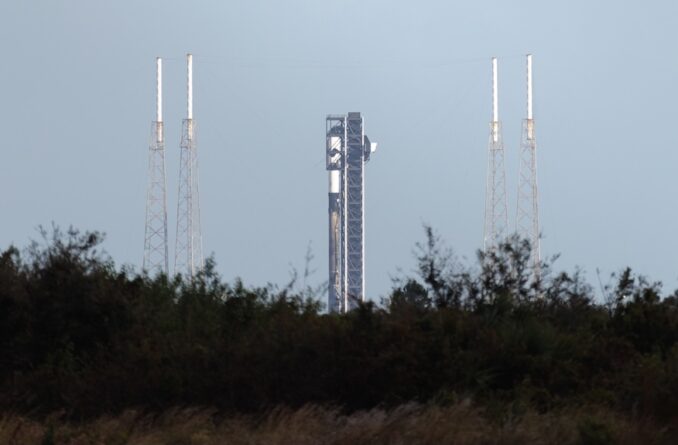
SpaceX will mark its historic launch on the stock market Friday morning with a Falcon 9 rocket launch from Cape Canaveral Space Force Station in Florida.
This will be the 650th flight of SpaceX’s workhorse launcher to date and the 68th Falcon 9 launch so far in 2026. SpaceX will fly the Starlink 10-54 mission, which will send 29 Starlink V2 Mini Optimized satellites into low Earth orbit.
Liftoff from Space Launch Complex 40 is currently scheduled for 8:37 a.m. EDT (1237 UTC), less than an hour before the trading day starts on the Nasdaq Stock Market. The rocket will fly on a north-easterly trajectory upon leaving the pad.
Spaceflight Now will have live coverage beginning about an hour prior to liftoff.
The 45th Weather Squadron forecast an 80 percent chance for favorable liftoff at the opening of the window, which drops slightly down to 70 percent as the window progresses. Meteorologists are watching for interference from cumulus clouds.
SpaceX will fly the Starlink 10-54 mission using the Falcon 9 first stage booster with the tail number B1080. This will be its 27th mission to date, including two crewed flights to the International Space Station for Axiom Space, two cargo missions to the ISS, and the European Space Agency’s Euclid observatory.
A little more than eight minutes after liftoff, B1080 will target a landing on the drone ship, ‘A Shortfall of Gravitas’, off the coast of South Carolina. If successful, this will be the 155th landing on this vessel and the 623rd booster landing to date for SpaceX.
This will be the 55th dedicated launch of Starlink satellites so far this year and the 56th overall mission featuring the spacecraft. SpaceX has more than 10,500 Starlink satellites in orbit.
Going public
The Starlink 10-54 mission marks a turning point for SpaceX as it becomes a publicly traded company more than 24 years after its founding in March 2002. It’s valuation is $1.77 trillion.
SpaceX announced that it would be selling 555.6 million shares of its Class A common stock at $135 each, raising $75 billion for the company.
The Starlink portion of SpaceX is a key driver of its business. In its financial disclosures to the U.S. Securities and Exchange Commission (SEC), SpaceX said its income from its connectivity business was about $2 billion in 2024 and $4.4 billion in 2025.
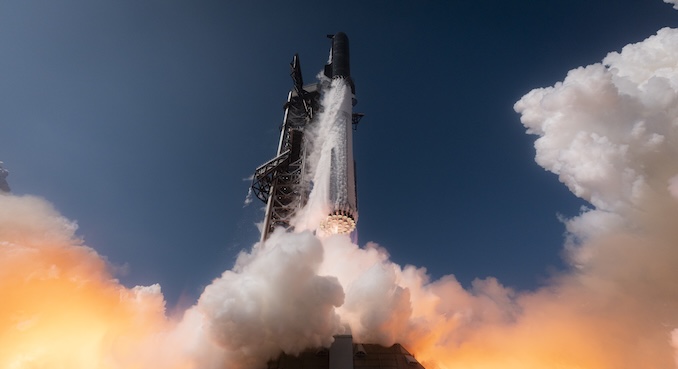
SpaceX is betting on its Starship-Super Heavy rocket to launch not only its Starship V3 satellites, but also orbiting data centers to help power the company’s artificial intelligence division, xAI.
SpaceX also hopes Starship can help unlock currently non-existent markets, like point-to-point rocket travel on Earth, asteroid mining, and large-scale infrastructure on Mars.
The company completed its 12th Starship test flight in May and is working towards a 13th flight on a yet to be disclosed date. It’s unclear exactly when the first orbital launch attempt of Starship will take place, but SpaceX has stated its intention to begin deploying Starlink V3 satellites in the back half of 2026.
“Starship is designed to enable a step-function change in our launch capability across reusability, payload capacity, and launch cadence, and is the key enabler of our long-term growth strategy by unlocking entirely new categories of missions,” SpaceX wrote in its prospectus document.
SpaceX said it spent about $3 billion in research and development on Starship in 2025 and $930 million in the first three months of 2026.
source
