

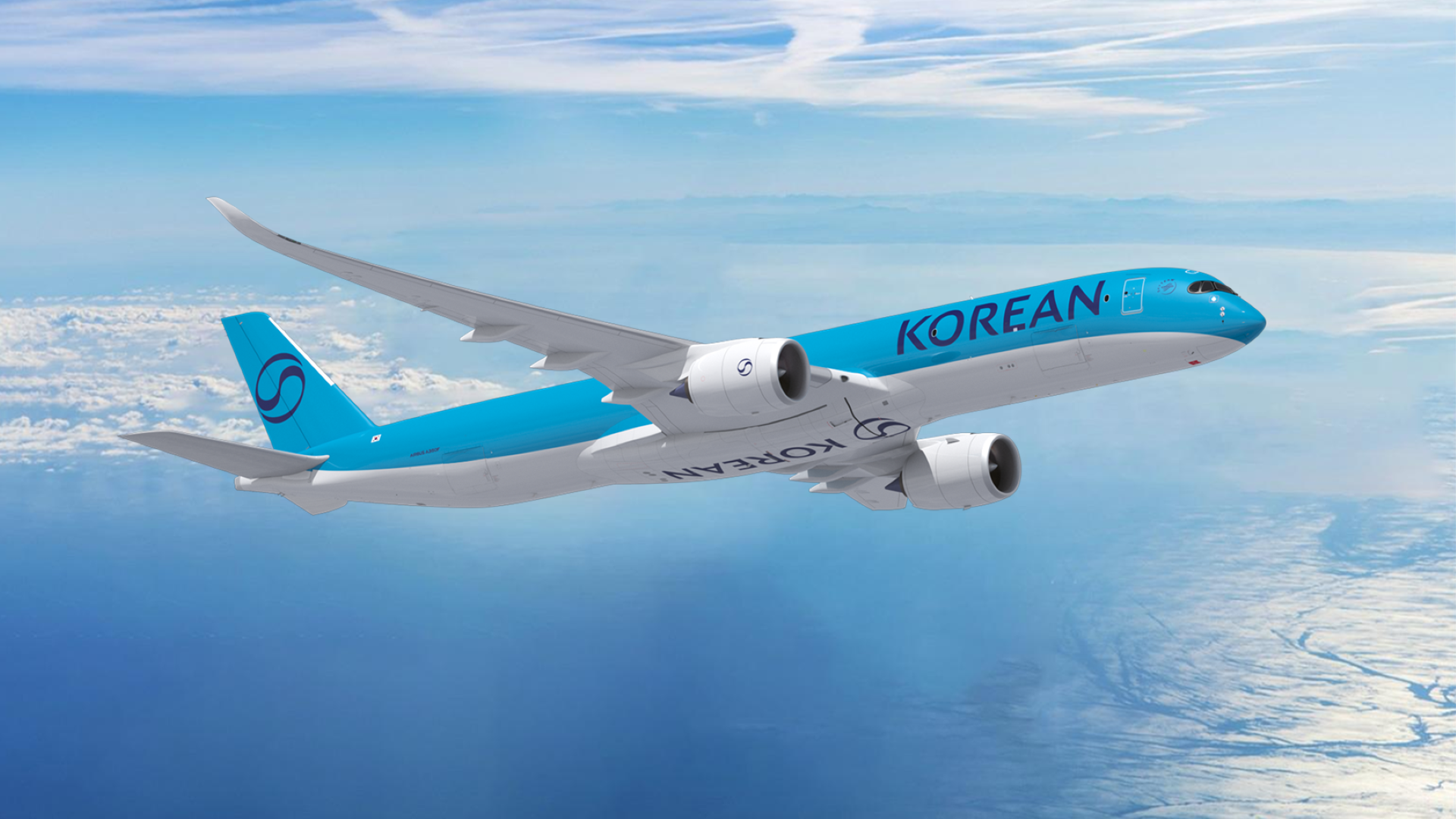
The Airbus A350F has got itself a new customer in the form of Seoul-based  SkyTeam founding member Korean Air. Earlier today, Airbus confirmed that the South Korean flag carrier had converted seven of its orders for the passenger-carrying A350-1000 to the cargo variant. This development represents another vote of confidence for the European firm’s new freighter.
While Korean Air has previously flown cargo aircraft from Airbus, its current fleet does not have any, with jets from its US rival Boeing exclusively operating the airline’s cargo flights at present. Now, it stands to diversify this side of its operations, and, with various compelling advantages such as the industry’s largest main cargo deck door, the A350F looks like it will fit the bill nicely.
Another A350F Order

Airbus confirmed the deal in a statement published earlier today. As part of the announcement, Benoît de Saint-Exupéry, who serves as Airbus’s Executive Vice President of Commercial Aircraft Sales, highlighted the fact that “Korean Air is one of the world’s largest cargo operators.” This is partly thanks to its strategic location, which it can leverage to serve both Asia and North America.
Per ch-aviation, Korean Air previously flew Airbus freighters in the form of the A300F4 and A300-600R(F). The site shows that two examples apiece of these widebody twinjet variants flew for the airline’s cargo division, before the models were respectively withdrawn in 2000 and 2009. Now, however, the carrier is using Airbus jets to modernize its cargo ops, with Saint-Exupéry saying:
“The decision to add the A350F is a very significant endorsement of the aircraft’s unique capabilities. The A350F will bring Korean Air the most efficient solution in the large freighter segment.”
Growing In Popularity

While it hasn’t all been smooth sailing for the aircraft and its development in recent times, the Airbus A350F program has enjoyed a steady growth in popularity since first being launched back in the summer of 2021. According to Airbus’s statement today, by the end of September 2025, it had received a grand total of 65 orders for the type, with these coming from 10 airlines and a lessor.
This year got off to a bad start for the jet, with supply chain issues forcing Airbus to delay the A350’s rollout. However, by the middle of the year, things were starting to look up for the aircraft, with the construction of the first example’s wings being finished in May of 2025. Two months later, Airbus was also able to confirm that it had produced the first horizontal stabilizer for the A350F.
Sandwiched in between these two milestones was a fruitful Paris Air Show, where Airbus scored a deal for 22 A350Fs from Saudi Arabian lessor AviLease and another two from Turkish cargo carrier MNG Airlines. Despite Air France-KLM downgrading its A350F order, Airbus still has plenty to look forward to with the jet, and recently reaffirmed that it is aiming for entry into service in 2027.
Korean Air’s Existing A350 & Cargo Operations In A Nutshell

As previously mentioned, Korean Air’s present cargo operations are exclusively served by widebodies from US planemaker Boeing. According to ch-aviation, the carrier currently relies on four 747-400ERFs (20.1 years old on average), seven 747-8Fs (12.1 years old on average), and 12 777-200Fs (10.2 years old on average) to serve this part of its day-to-day aviation operations.
The Airbus A350 family is, however, already represented at Korean Air on the passenger-carrying side of things. In March of 2024, the carrier placed a $13.7 billion order for six A350-900s and 27 A350-1000s, although, following today’s development, the latter model’s order book now stands at 20. The airline initially chose to deploy these aircraft on routes to destinations in Japan.
Korean Air has now received two A350-900s, and data from Cirium, an aviation analytics company, shows that they still serve Japan in a limited capacity today. Specifically, these two-class 311-seat jets fly three times a week from Seoul (ICN) to Fukuoka (FUK), a frequency shared by the type on the longer route to Rome (FCO). Meanwhile, Madrid Barajas (MAD) sees four flights a week.
source
