


Speaking at a geopolitics and aerospace conference in Rome, the Commander of the Italian Air Force’s Operational Forces said the service is evaluating the possibility of operating F-35s from highway strips if conventional airfields are threatened.
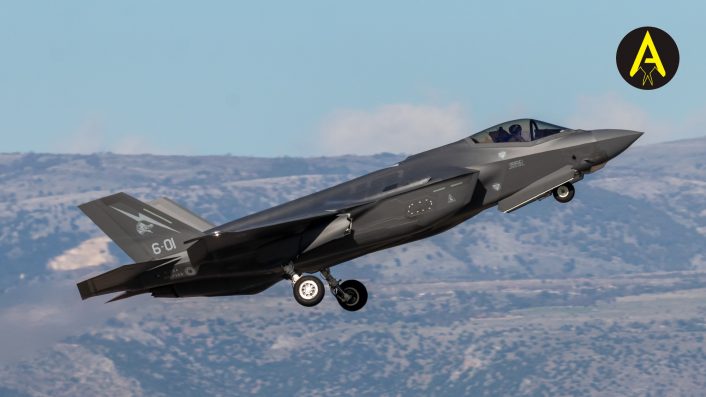
Italy is assessing the possibility of landing and operating its F-35A Lightning II 5th generation aircraft from selected highway sections should traditional air bases become vulnerable in a high-threat scenario. The concept was publicly acknowledged by Italian Air Force Lt. Gen. Silvano Frigerio, Commander of Operational Force, during remarks delivered on Feb. 4, 2026, at the “Dominio globale” aerospace and geopolitics forum in Rome.
According to a report by Il Sole 24 Ore, Frigerio stated that the Air Force is assessing “the possibility of landing F-35s on highways if the sky is threatened,” highlighting an effort to strengthen operational resilience in contested environments.
No formal program or timeline has been announced, but the general’s remarks confirmed that Rome is examining dispersal of its most valuable assets.
Highway strip operations are not new. As we often explained here at The Aviationist, during the Cold War, several air forces on both NATO and Warsaw Pact side, especially those in the Central and Nordics regions, prepared and exercised the use of straight stretches of motorway as auxiliary runways in case primary air bases were attacked. A then NATO partner and now full member, Sweden, institutionalized the concept routinely practicing road landings with its fighter fleet. Other European nations developed similar contingency plans, though few maintained the concept at high readiness in the post-Cold War era.
Frigerio’s comments suggest that the Italian Air Force is considering this approach in light of the evolving threat environment. While some tactical squadrons equipped with the G-91R /Y could operate from road and unprepared strips (and, in some cases, specific sections of the highway system were identified for such purpose), no exercises have ever been carried out.
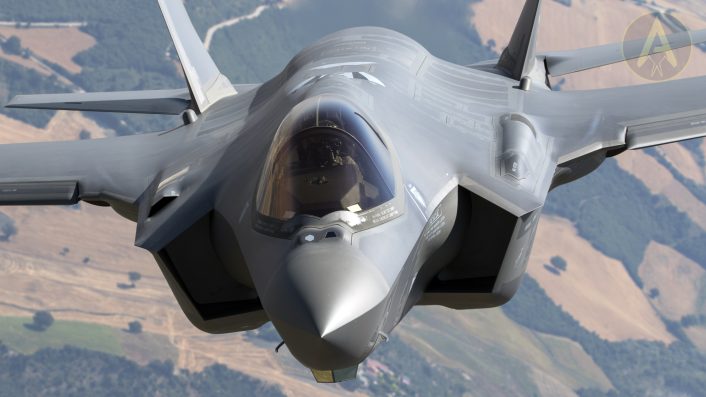
Highway operations in Italy
Italy’s geographic position in the Central Mediterranean gives it both strategic depth and exposure. As with all the other nations, its main air bases are very well known and mapped. In a high-end conflict scenario, runway denial would likely be among the first objectives of an adversary, along with the aircraft themselves, considering some airfields are not equipped with hardened shelters making them vulnerable not only to missiles but also to drones.
The underlying logic of highway operations is quite simple: dispersal complicates enemy targeting. Fixed air bases, with known coordinates and limited runway infrastructure, are vulnerable to precision-guided munitions and long-range strike systems. The ability to operate from multiple, pre-selected highway strips may increase survivability and preserve sortie generation capacity: highway operations would clearly be a way to enhance survivability, maintain operational tempo and complicate adversary targeting cycles.
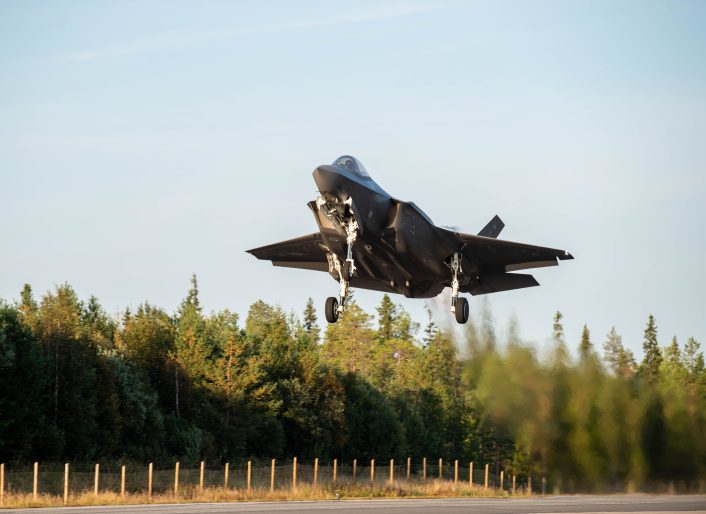
Recent exercises carried out by other NATO air forces equipped with the F-35 have shown the concept can also be applied to a 5th generation platform, even though the 5th generation aircraft, unlike earlier fighters, in some cases designed with austere operations in mind, relies on an extensive maintenance ecosystem, advanced support equipment, and a more complex logistics chain. Moreover, the weapon system is more demanding from a “data” point of view, requiring secure communications and command-and-control connectivity, that might not be easily available at dispersed locations.
Surface quality, debris management and Foreign Object Damage mitigation could also be critical factors, especially given the F-35’s low-observable coatings and overall sensitivity. Even temporary dispersal operations, for training, would require significant coordination between military authorities and civilian infrastructure operators.
That said, the F-35’s robust landing gear and short-field performance parameters make such operations technically feasible under controlled conditions. As explained, several allied air forces have already experimented with dispersed operations for their F-35 fleets, although little details have been disclosed other that the photographs showing the aircraft taking off or landing on the public roads.
At this stage, there is no indication that Italy has selected specific highway segments. Should the concept advance, many things would need to be taken into consideration before moving from evaluation to execution. The Italian national network is made by more than 7,000 kilometers of motorways. Some of these are quite busy and proper procedures for rapid closures should be established in order to allow training cycles for pilots and ground crews. At the same time, such activities would require significant civil-military coordination, as well as investments.
Therefore evolution of this initiative will be worth monitoring: while technically feasible and certainly needed, it is not yet clear how long it will take for the Italian Ministry of Defense to secure all the necessary approvals, including at the political level, to carry out the activities required to support the capability.
For now, Frigerio’s remarks in Rome offer an interesting glimpse into how the Italian Air Force envisions resilience and survivability in an era in which fixed infrastructure can no longer be assumed safe.
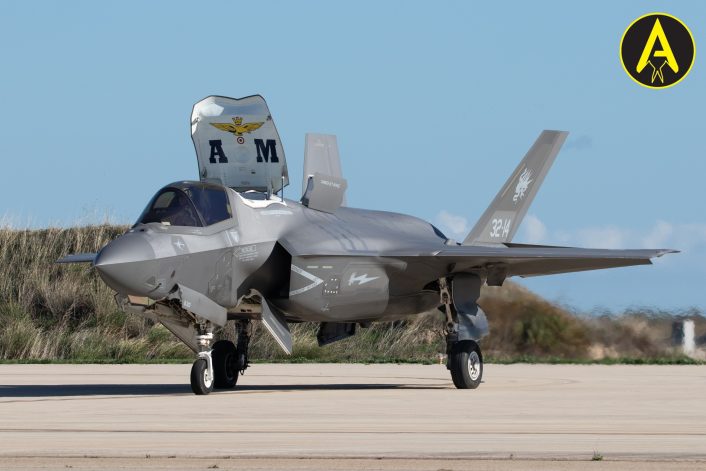
As a side note, it is worth noting that the Italian Air Force also operates the F-35B. The service considers the STOVL (Short Take Off Vertical Landing) variant a crucial component of a broader expeditionary system that enables the Italian Air Force to project air power far from home, in semi-permissive environments, from austere or bare runways normally unusable by conventional aircraft and with limited force protection provided by the host nation.
“In Africa there are about 100 runways that have a length between 2,800 and 3,000 meters, but there are 20 times as many runways between 1,000 and 1,500 meters in length,” Gen. Alberto Rosso, then Chief of Staff of the Italian Air Force, said in 2020 while addressing the media at Pantelleria during the F-35B’s Expeditionary Proof of Concept. “Being able to use short runways allows you to multiply your ability to deploy where needed, in a more convenient and faster way, especially closer to the area of operations. Having an aircraft capable of taking off from shorter runways provides incredible flexibility, even in scenarios that are currently only barely conceivable. In case of conflict, aircraft able to operate from shorter runways can also be dispersed to increase their survivability.”
The F-35B is an asset capable of operating from short runways. The F-35B can take off vertically but not operationally in most real-world scenarios.
source
