

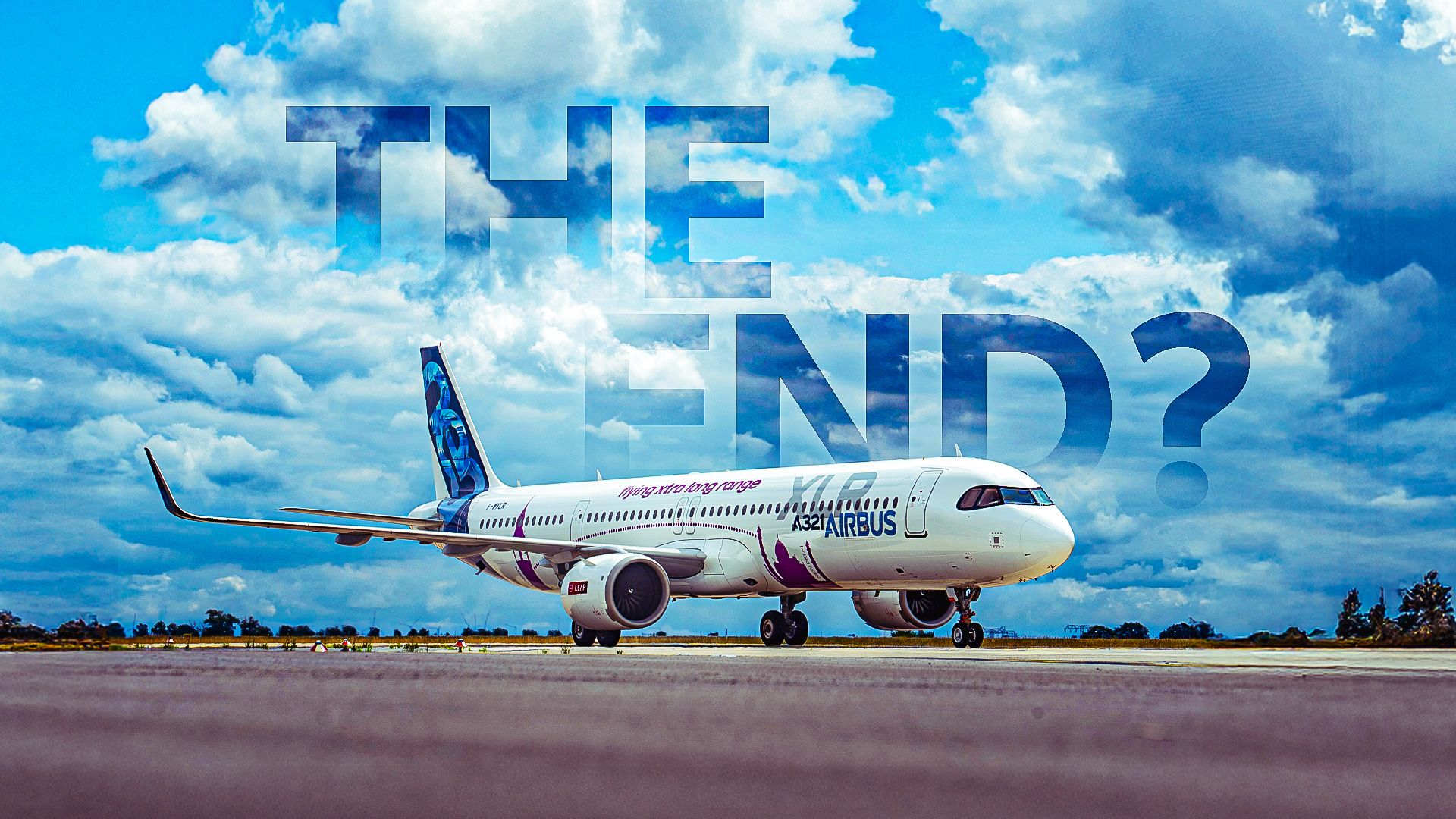
How much could the Airbus A321XLR shake up  Boeing’s future in the long-range narrowbody market? As Airbus pushes the limits of what a narrowbody can achieve, Boeing increasingly appears constrained. In our article, we will examine how the A321XLR may alter the competitive landscape and whether Boeing can respond effectively.
To better understand this battle, we’ll trace the lineage of the A321 from its roots in the Airbus A320 family, show how Airbus engineered the XLR variant, and then compare it with Boeing’s attempt (and failure) to retain relevance in the mid-size narrowbody space. We’ll revisit the Boeing 757 story and why it was discontinued, whether Boeing regrets that choice, and how Boeing’s strategy of stretching the 737 runs into structural limits. The conclusion: Airbus may have won a crucial race; Boeing never really entered because it exited too early.
What Is The Short Answer?

In short, the A321XLR gives Airbus a credible and competitive long-range narrowbody aircraft that dominates in what once was Boeing’s territory (the 757 domain). Boeing lacks a direct equivalent, and its workarounds (extending the 737, or proposing an “NMA”) have struggled.
Because Airbus retains strong commonality across the A320 family, the incremental cost of producing and introducing the A321XLR is relatively low, and at the same time, it unlocks new long, thin routes. Airlines see it as an efficient way to open transatlantic or transcontinental routes between smaller cities without committing to a full widebody.
Historically, Boeing once had the 757 to fill that gap, but by ending production and not following up with a modern successor, Boeing ceded the “long-range single-aisle” niche. Airbus now fills that gap, thereby weakening Boeing’s one-aisle dominance in many route profiles. And the Airbus backlog says it all – many historical and current operators of the Boeing 757 are now turning to Airbus for replacement, such as Icelandair or  United Airlines.
Factors Leading To The A321’s popularity

Several key factors have propelled the Airbus A321, and especially the A321XLR variant, into a position of remarkable popularity among airlines. These include smart design choices, engineering limitations faced by competitors, evolving market needs for long-range narrow-body aircraft, and strategic decisions that shape the competitive landscape. Let’s take a closer look at the leading contributing factors:
- Commonality and cost efficiency: Airbus can transfer much of the A320neo architecture to the XLR, reducing development risks.
- Range and fuel capacity: The XLR uses a novel fuel tank design (rear center tank) and a higher MTOW to push its range envelope.
- Shifting market appetite for “long and thin” routes: Airlines seek aircraft that can serve new long-haul destinations with fewer seats, thereby reducing the risk of low load factors.
- Boeing’s strategic focus on the 737 line: Boeing prioritized updating the older 737 line over reviving or developing a new 757-style platform.
- Boeing’s structural limitations: Boeing tried to push the 737 farther (as with MAX 10) but has to contend with fuselage, landing gear, and structural loads coming into structural limits, making it impossible for the biggest 737 to match simultaneously the size, range, and load of a 757 or A321.
Key specs comparison A321XLR vs Boeing 757 vs 737 stretch variants:
|
Aircraft |
Approx Range / Role |
MTOW / Structural adaptation |
Strengths/limits |
|---|---|---|---|
|
A321XLR |
4,700 nmi |
Higher MTOW (~101 t), rear center tank |
Gains new transatlantic capability with modest change to A321 core |
|
Boeing 757 |
3,900–4,100 nmi (depending on variant) |
Original structural design; ceased production in 2004 |
Highly capable for its era, but legacy systems, fuel burn disadvantages vs new designs |
|
737 stretch (MAX 10 etc.) |
More limited relative to A321XLR |
Pushing design limits: gear, wing loading, structural load concerns |
Boeing must compromise or accept reduced margins to maintain both safety and performance. |
Sources: Airbus, Boeing
As a case study, note that Airbus introduced the A321XLR on a “pilot line” to minimize disruptions to existing A320 production. This shows Airbus’ confidence in integrating the XLR variant without massive disruption. In contrast, Boeing’s attempts to stretch the 737 further have faced criticism for having limited margin headroom and trade-offs in performance versus structural stresses. The aircraft is still based on the original Boeing 737 design of the 1960s, when many airports lacked the necessary infrastructure to load and unload passengers. As a result, it was designed with a lower profile to accommodate retractable built-in stairs.

Thus, the fuselage cannot be stretched indefinitely, as the tail will strike the ground even though Boeing engineers managed to improve the landing gear by making it taller. But there was a catch. For instance, the specific variant, the Boeing 737 MAX 10, required a special “levered-landing gear” design to accommodate the longer fuselage while retaining the same wheel-well size; however, despite all modifications, it still can’t match the 757 in capturing its niche.
Expert Opinion

Airlines and industry analysts increasingly acknowledge that the A321XLR fills a crucial gap. United, for example, has committed A321XLRs to replace 757s on some long domestic and international transatlantic routes. Boeing itself has delayed or rethought its “middle of the market” (abbreviated as MOM; a niche between the short-haul narrowbodies and long-haul widebodies) plans in part due to shifts caused by Airbus’ lead.
One telling quote: when Airbus won European certification for the A321XLR, Reuters noted that it was explicitly targeting the “gap left by the discontinued Boeing 757.” Boeing company, in response, indicated that they would wait for new engine technology before launching a new competitor, implicitly conceding Airbus a head start.
The implications are that airlines may feel less pressure to wait for Boeing’s plans as they already have a working XLR on the market. That shifts competitive dynamics: Boeing must respond with more radical proposals, not incremental ones.
What Boeing Can Do To Keep Up with Airbus

One alternative might be for Boeing to revive the 757 or create a clean-sheet, new mid-size narrowbody (the NMA). Another alternative is to lean harder into widebodies or end-of-life models for the 737 family.
But there are some issues. Unfortunately, reviving the 757 is nearly impossible: tooling is gone, certification would be costly, and the design is outdated. Meanwhile, the new MOM/NMA proposals have been delayed or scaled back by Boeing, citing a need for new engines rather than refinements to existing airframes.
The current option of stretching the 737 further has diminishing returns due to structural and aerodynamic limits; you risk making compromises to meet safety or performance margins.
Thus, Airbus’ path with the XLR is arguably lower risk and higher reward. Boeing’s options are heavier, costlier, and riskier, meaning Airbus likely holds a strategic advantage, especially if Boeing delays or missteps.
The Main Drawbacks

No aircraft is perfect. The A321XLR, of course, has some limitations: its seat count is modest compared to widebodies, payload on ultra-long legs may be limited, and regulatory or certification issues related to safety (e.g., evacuation, fuel tank safety) require careful handling. Furthermore, with the full payload, the maximum advertised range is not achievable.
In some densely populated markets or on very high-capacity routes, airlines will still prefer larger aircraft. Additionally, if fuel prices drop significantly or the demand structure changes, widebodies may regain their relative advantage. Moreover, any unanticipated operational issues, maintenance issues, or residual certification constraints could slow adoption.
Pros & cons of A321XLR vs widebody and vs Boeing fallback:
|
Option |
Pros |
Cons / Risks |
|---|---|---|
|
A321XLR |
Lower risk introduction, route flexibility, lower fuel burn per seat, and opens new routes |
Payload constraints on long sectors, limited seat count, certification, and safety margins |
|
Widebody alternative |
High capacity, flexibility, economies of scale for high-demand routes |
Risk of low load factors, higher cost to operate, and more seats to fill |
|
Boeing’s new design/revival |
Potentially matching or better performance, Boeing brand leverage |
High development cost, long lead time, technical risk, and delayed entry |
We should pay attention to how Boeing responds (if it reignites NMA plans or develops a true rival), whether airlines adopt the XLR at scale, and how it performs in revenue service, as well as how fuel prices and operational costs evolve. Time will show us.
Overall Takeaway

Despite many visual similarities, the Airbus A321XLR is more than just a stretched version of the A321. This aircraft represents a strategic lever. It allows Airbus to slide into Boeing’s traditional stronghold in long-range narrowbody operations, without Boeing responding with a completely new aircraft (yet). Boeing, by contrast, is on the defensive: its attempts to stretch the 737 are reaching structural limits, and it has no mature successor to the 757 niche.
Boeing’s decision to stop producing the 757 in 2004 (the last one delivered in 2005) was understandable in its era: demand had dropped back then, and the 737 NG and 787 were on the horizon, along with cost pressures. But that decision left a vacuum Airbus is now filling, and Boeing still seems to regret not courting that niche more aggressively.
Looking forward, Boeing’s challenge is steep: either develop a credible new mid-market challenger with modern propulsion or continue conceding market share. Airbus, meanwhile, needs to prove the XLR can perform reliably, support a growing route map, and maintain profitability for operators. The competitive balance in single-aisle aviation may well tilt more in Airbus’ favor in the years ahead.
source
