

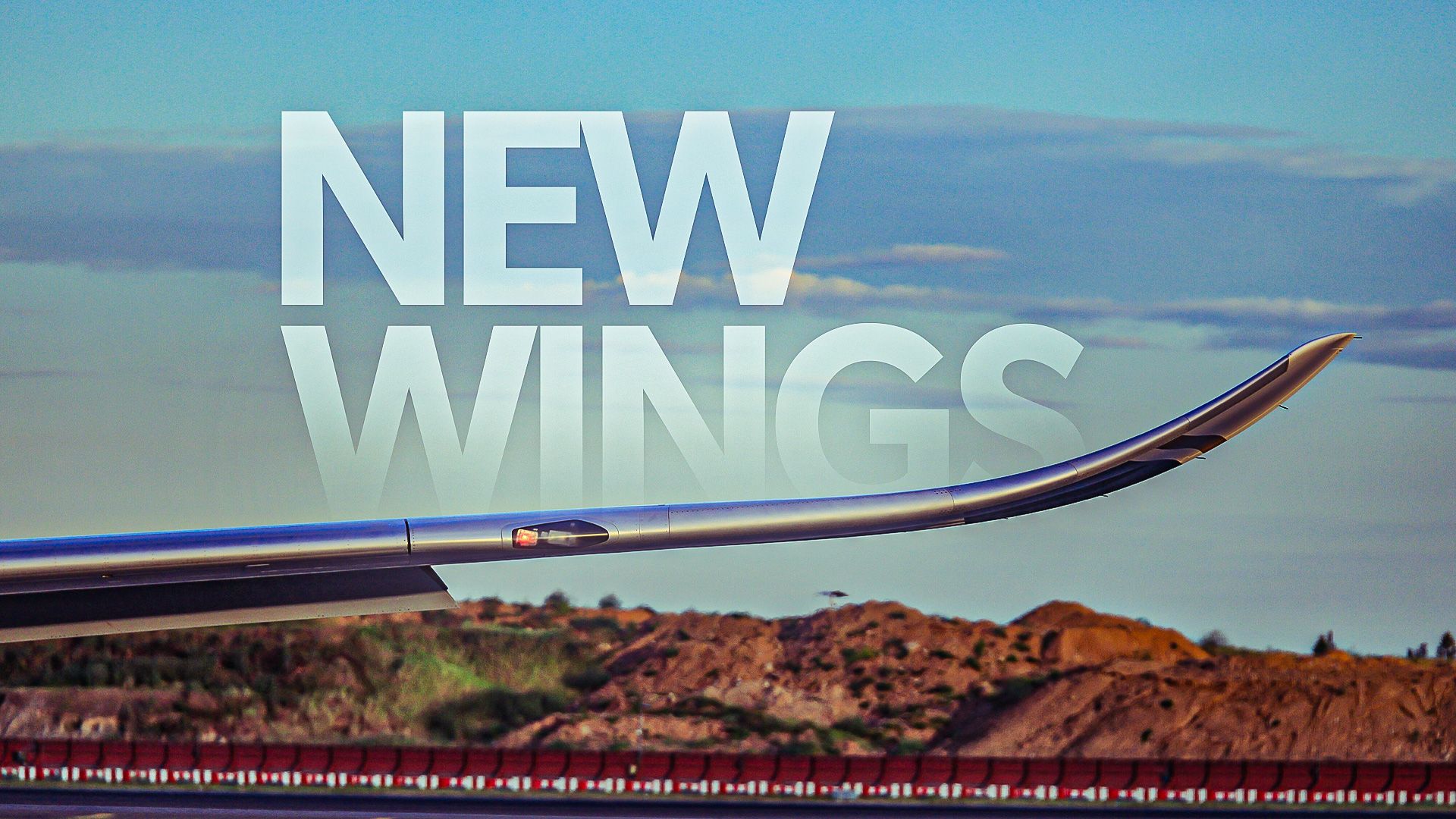
Wings are a vital part of the aerodynamic performance of aircraft. Their design has changed over the years and could change significantly in the future if truce-braced wings or blended wing bodies prove successful. This article will discuss the wings of subsonic commercial aircraft, but not those of supersonic aircraft like the Boom Overture with its delta-shaped wing. The most significant way wings save money for airlines is by reducing drag and thereby fuel consumption.
However, there are also other factors, like the cost of the materials, the weight of the wings, the maintenance requirements of the wings, and the durability of the wings. The early issues with cracks in Lockheed’s C-5 Galaxy strategic transport aircraft are an example of how poorly designed wings can drive up the cost of an aircraft. Let’s examine some of the ways in which designing modern wings can help save airlines money by increasing the fuel efficiency of the aircraft.
Increasing Use Of Advanced Materials To Reduce Weight

One of the key ways to improve an aircraft’s performance and efficiency is to decrease the weight of the aircraft by increasing the amount of lightweight advanced materials used. While the Airbus A380 was a large aircraft, it wasn’t a particularly new aircraft, with most of the aircraft still being made out of aluminum. The wings of older commercial aircraft were typically made out of aluminum.
Whereas the A380 is around 25% advanced materials, this increased to around 70% in the clean-sheet Airbus A350 and a comparable amount for the Boeing 787 Dreamliner. Honeywell notes manufacturers are now using carbon-fiber composites more extensively in the wings as they are lighter than aluminum alloys. These can cut fuel consumption by 5% compared with metal wings.
The upcoming Boeing 777X is an evolutionary upgrade of the older Boeing 777-300ER, and as such, it comes with design compromises compared with a clean-sheet aircraft like the 787. Only around 30% of the aircraft are made of advanced materials, although this is particularly concentrated in the wings, which are now made of lighter and more aerodynamic composite wings.
Increased Wingspan

As time has gone on, aircraft wings have got longer. Airbus redesigned the Airbus A330/A340 wing for the A330neo. The wing was lengthened from 197.5 feet to 210 feet, making it almost as long as the A350’s 212.4-foot wingspan. The Boeing 777-300ER has a wingspan of 212.7 feet, and this is being lengthened to 235.4 feet on the new Boeing 777X. Increased wingspans help improve the aircraft’s aerodynamic performance.
It’s estimated that the new, longer, lighter, and better optimized A330neo wings offer a 4% improvement on fuel consumption, but a major issue is ICAO Code E and Code F regulations limiting aircraft wingspans to 213 feet and 262 feet, respectively. Modern twinjet widebodies have their wings built to comply with Code E, while the Airbus A380 maxes out Code F regulations. The Boeing 777X is getting around Code E regulations by introducing folding wingtips, allowing them to be 11 feet longer.
|
Select aircraft |
Wingspan (per Boeing and Airbus) |
|---|---|
|
Boeing 787 |
197 feet |
|
Airbus A330 |
197.5 feet |
|
Airbus A330neo |
210 feet |
|
Airbus A350 |
212.4 feet |
|
Boeing 777X |
235.4 feet |
|
Airbus A380 |
262.5 feet |
The 777X has a wingspan of 235 feet, but this comes with some drawbacks. The folding mechanism adds weight, and the wing needs to be strengthened, which adds more weight. Perhaps most importantly, folding wingtips is a novel design, and the FAA may require more testing to be confident in the technology. The Boeing 777X has been delayed to 2027, and it is unclear if this is due to the wingtips or other considerations the FAA has. Airbus is also considering folding wings for its future aircraft.
Wingtip Devices

One of the notable advances in wing design has been the incorporation of wingtip devices. Wings experience what is called the ‘tip effect’ or ‘end effect’, where there is a continual spilling of air upwards around the wing tip. This creates drag but can be countered by increasing the height of the lifting system by adding a vertical fin or winglet. Besides reducing fuel consumption, wingtip devices can increase range, reduce takeoff field length, reduce in-flight noise, and increase cruising speed.
Aircraft are estimated to see a 4-6% increase in fuel efficiency from wingtip devices, and the first commercial airliner to incorporate wingtip devices was the Airbus A310-300 in 1985. There are multiple types of wingtip devices, including wingtip fences, blended wingtlets, raked wingtips, and split winglets. The massive A380 has wingtip fences typically found on smaller wings for several reasons, one of which was to stay within Code F regulations.
|
Types of wingtip devices |
Select aircraft types |
|---|---|
|
Wingtip fences |
A320ceo, A300-600, A380 |
|
Blended winglets |
A320neo, A330neo, A350 |
|
Raked wingtips |
Boeing 777/777X, 787, 747-8 |
|
Split winglets |
Boeing 737 MAX |
Wingtip fences and blended winglets are favored by Airbus, while raked wingtips and split winglets are favored by Boeing. The Embraer E-Jet E2 also has raked wingtips, and each design comes with its own set of advantages and disadvantages. Some are better at providing optimal benefits at cruise, while others are better optimized for takeoff and climb performance.
General Engineering Improvements

Besides the factors discussed above, wings have made various other improvements as technology has progressed. For example, when designing the new wing for the Airbus A330neo, Airbus was able to visualize, model, and optimize the new wings using 3D Computational Fluid Dynamics. The new wings found on the A330neo are also more flexible than the old wings, allowing them to twist and flex while in flight.
Airbus was able to design the A330neo’s wing with an aspect ratio of 11, which is the highest of any commercial aircraft in production today. Airbus also designed these wings for better engine/nacelle/pylon integration. It’s worth noting that the older twin-engined A330 and its quad-engined A340 shared a common wing apart from engineering adjustments for the wings to carry one or two engines.
This meant that the wing on both the A330 and A340 was suboptimal for both. By contrast, the A330neo has a wing optimized for a twinjet. Wings are also optimized for what is expected to be the most common variant in the family. For example, the Boeing 787’s wing is more optimal for the 787-9 variant. This is a problem for the Airbus A380-800, whose wing was optimized for a future, planned, stretched A380-900 that never came.
Blended Wing Body & Truss-Braced Wings

One radical way to improve wing performance is to blend it with the body of the aircraft in a blended-wing-body design. Today’s commercial aircraft are all conventional tube-and-wing designs, but this could change. The startup company, JetZero, is building a blended-wing-body jet for the United States Air Force in partnership with Northrop Grumman, and is planning to produce a version of the aircraft as a commercial passenger plane.
Boasting low-drag and being lightweight, JetZero claims its upcoming all-wing Z4 aircraft will use up to 50% less fuel than existing commercial jets. The aircraft is being designed as a mid-sized airplane and is expected to have a range of 5,000 nautical miles. Time will tell if the design proves successful or even disruptive or not. For now, the aircraft remains in the design phase, although United Airlines, Alaska Airlines, and Delta Air Lines have all invested in the jet.
Meanwhile, NASA is working on developing transonic truss-braced wings. These wings generate less drag compared with modern wings and therefore allow the aircraft to burn less fuel. However, one of the drawbacks is that the design could make the wing more prone to ice buildup. NASA is currently working to address ice up and develop an ice protection system.
Modern Wings Benefit From Many Evolutionary Improvements

Wings have changed significantly over the years. Aerodynamic performance has benefited from better optimizing the shape of the wing, the length of the wing, the weight of the wing, the wing’s wingtips, and more. It remains unclear if the future will bring continued evolutionary improvements or if there will be a major improvement to the current design, such as truss-braced wings. As engines designed for an aircraft change, so too does the wing need to be updated to carry those engines.
Alternatively, the industry may veer in a new direction with blended wing body aircraft. It is also unclear if apparent improvements like the Boeing 777X’s folding wingtips will pay off. While the design offers improved aerodynamic improvements, it also increases the complexity of the wing, potentially driving up maintenance costs, and it comes with a weight penalty. This is not the first time Boeing has considered folding wings, but it has previously dismissed the idea as being too complex and risky.
The design could be contributing to the type’s delayed certification, and if Boeing doesn’t get it right, it could contribute to increased downtime for the aircraft after entering service. If Boeing does get its new wing right, it can help save airlines on aviation fuel and provide a significant advantage over its Airbus A350 competition. An aircraft’s wing can have a significant impact on which variants of an aircraft family are more popular than others.
source
