

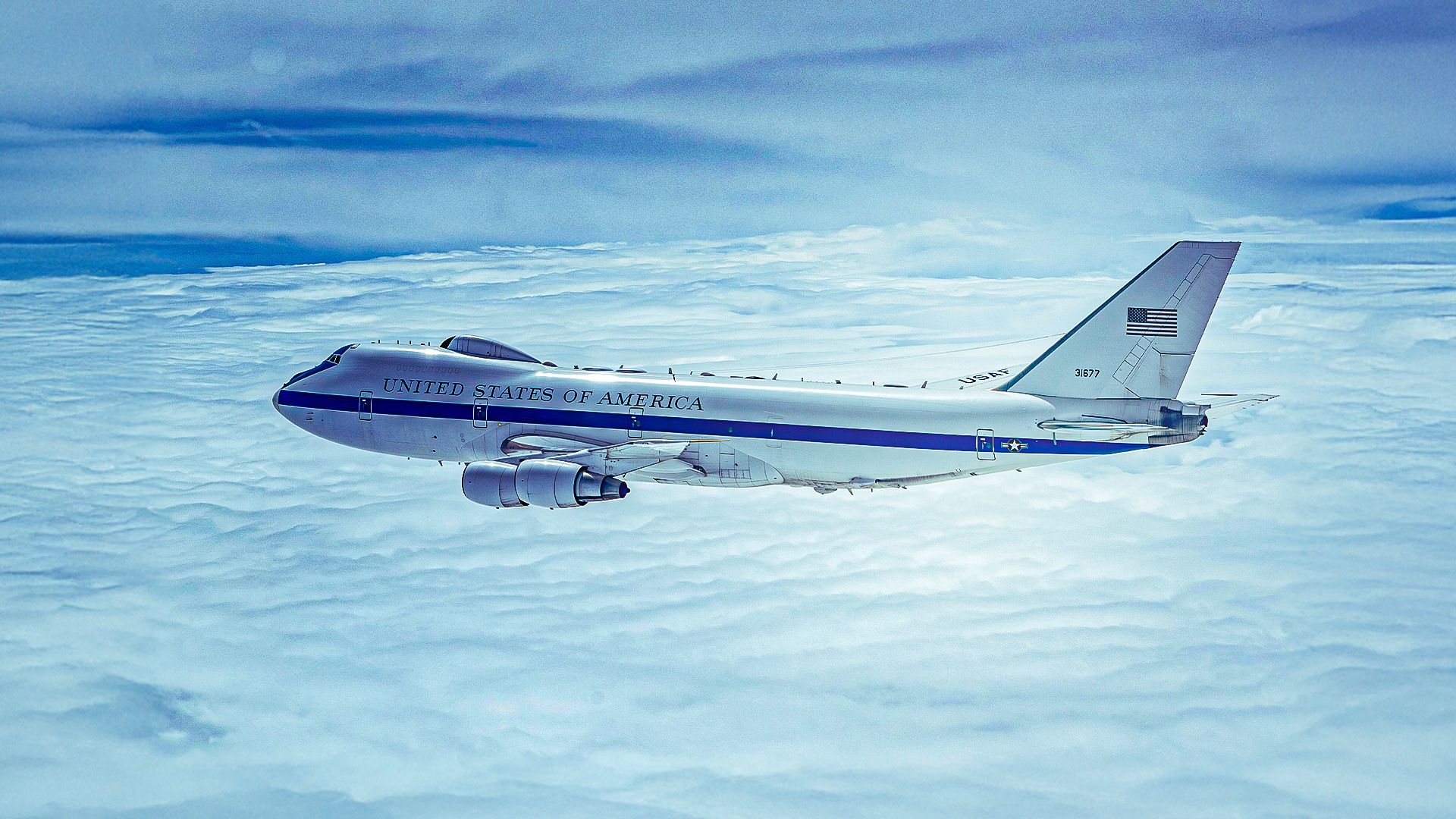
The once prolific Boeing 747 is slowly fading into the annals of history as more fuel-efficient twinjets dominate the world of aviation. Presently, there are only two 747-derived aircraft in use by the United States military. The United States Air Force operates six jets for two different missions, with two more on order.
A single example of a third platform has already been retired, the YAL-1 airborne laser. The most famous 747 variant flown by the USAF is “Air Force One,” officially designated VC-25A. There are also four examples of the E-4B still in service.
Nicknamed the Doomsday playing, the E-4B is officially a National Airborne Operations Center (NAOC). The Next Generation Air Force One has yet to be delivered. Boeing is currently outfitting the last two 747-8Is it will ever build to become the Next Generation Air Force One.
|
Mil-Spec 747s |
USAF Inventory |
|
E-4B NAOC |
4 |
|
E-4C SAOC |
5 (ordered) |
|
VC-25A |
2 |
|
VC-25B |
2 (ordered) |
The one and only YAL-1 laser testbed was retired in 2014. As part of the canceled “Star Wars” weapons development program that was a legacy of the Cold War arms race, the technology it tested has become outdated. The aircraft was broken up at the Davis-Monthan Air Force Base, “Boneyard,” in Arizona.
Doomsday Plane: E-4B

The Boeing E-4 Advanced Airborne Command Post (AACP), officially named “Nightwatch,” serves as a strategic command and control military aircraft. It was developed from the Boeing 747-200B under the National Emergency Airborne Command Post (NEACP) program. Only four were produced, and all of those aircraft remain in service to this day.
The Nightwatch fulfills a critical role in the “Nuclear Triad” of the US Armed Forces’ strategic doctrine. In the event of a “doomsday” scenario, the 1st Airborne Command Control Squadron (1ACCS) of the 595th Command and Control Group deploys the E-4B as a flying command post for the President of the United States (POTUS) as well as other high-ranking government and military members.
The jets are based at Offutt Air Force Base, Nebraska, alongside the United States Navy’s E-6 Mercury, which performs a similar role. The E-6 is based on the Boeing 707, and 16 were built. All of these jets serve a similar role to Air Force One should a nuclear war break out. These aircraft simply do not fulfill the diplomatic role and are tailored purely for military operations.
Next-Gen Nightwatch: E-4C

The Sierra Nevada Corporation (SNC) was selected in 2024 to deliver replacements for the aging fleet of E-4B jets. The company was awarded a $13 billion contract to deliver five Survivable Airborne Operations Center (SAOC) aircraft by 2036. SNC purchased five 747-8 jets from Korean Air in 2024 after receiving the contract. The first deliveries are expected sometime in 2032. Rolls-Royce is slated to provide the power plants of the SAOC fleet.
The E-4B was originally slated to be phased out in 2009. However, the absence of a clear successor led to the decision to extend the service life. The gradually declining efficiency and 1970s vintage technology have contributed to the decommissioning of the aircraft, but ultimately, the airframes are very near their maximum service lives.
The Aviationist reported that on August 7, 2025, SNC completed the first test flight of an E-4C SAOC prototype. The process to certify the type will take several years. In the meantime, the E-4B will fulfill the mission, and the full series of five airframes will continue to be outfitted. The fourth 747-8I from Korean Air arrived at the SNC Aviation Innovation and Technology Center (AITC) in Dayton, Ohio, on April 20, 2025.
Jon Piatt, executive vice president of SNC’s IAS business area, remarked in a company press release following the new jet’s induction:
“For the past year, SNC has been committed to excellence and innovation in our execution of SAOC, and the arrival of the fourth SAOC aircraft to SNC’s AITC marks a significant milestone in our journey… We are proud of the progress we’ve made and are excited for the future as we continue to support the critical SAOC mission.”
The first aircraft conversion began just six weeks after the contract award in 2024. In November of that same year, it completed a ferry flight to Wichita State University’s National Institute of Aviation Research (NIAR) for advanced engineering and development activities. The SAOC program is one of the largest USAF aircraft modernization contracts awarded to a company that is not the original equipment manufacturer (OEM).
Failure To Launch: YAL-1

The Airborne Laser (ABL) program of the US Missile Defense Agency (MDA) was designated the YAL-1. The aircraft was developed from a Boeing 747-400F in 2002. Its intended purpose was to use a chemical fuel-powered laser beam to destroy tactical ballistic missiles (TBM) in the boost phase. The intended targets were rogue nation-states with unstable actors in the highest levels of leadership, like Iran or North Korea.
The system itself was capable of destroying test missiles, as demonstrated on at least two occasions. However, funding was cut in 2010 due to its low operational feasibility. The laser’s range was not sufficiently long to keep the plane outside the air defenses of potential adversaries. Therefore, the only realistic application would be to have several of the jets flying over the airspace of potential launch sites.
It is obviously completely unviable for an unarmed civilian airliner with a short-range laser carrying thousands of pounds of toxic chemicals to fly over hostile airspace in large numbers for extended periods of time. The entire program was an abject failure, accomplishing little more than novel technological experimentation.

The program was not the first of its kind, but rather succeeded the Airborne laser laboratory of the 1980s, when a Boeing 707-based NKLC-135A tested a less powerful laser and destroyed several missiles. The program cost billions of dollars that were directed away from other developments, like the fifth-generation common airframe stealth fighter now known as the Lockheed Martin F-35 Lightning II.
The plane was broken up shortly after the program was scrapped in 2014, and the only obvious contribution it made to other defense projects is the development of anti-drone lasers and laser-armed unmanned aircraft. The MDA is now pursuing unmanned aircraft with more efficient, more powerful laser systems under a different program.
Air Force One: VC-25A

Referred to by Boeing as the “Flying Oval Office,” the VC-25A is capable of accomplishing a similar mission to that of the E-4B but with the addition of a comprehensive diplomatic role. Air Force One has 4,000 square feet of interior spaces, including conference rooms, offices, catering and dining facilities, media accommodations, a medical suite, and more.
The aircraft is designed for self-sufficiency, no matter what airport it flies to. It has a longer range than a normal 747-200B on which it is based, and is capable of aerial refueling. The communications Suite on board is capable of air-to-air, air-to-ground, and satellite communications for matters of the state and wartime needs. The plane even has its own baggage loading system.
First flying in 1987, the operational costs and efficiency of the first-generation Air Force One 747s are becoming uneconomical for the Air Force. On top of that, the airframes are nearing the end of their service life, and the systems are becoming antiquated compared to modern contemporaries. The Next Generation Air Force One, VC-25B, is behind schedule and not expected to arrive until sometime in 2028 or 2029, at the earliest.
A Flailing Replacement: VC-25B

The Next Generation Air Force One is based on two 747-8I jets that were originally ordered by Transaero, a Russian airline. Before the aircraft could be delivered, the airline was shut down after filing for bankruptcy. The United States Air Force took advantage of the two planes that were in storage in the Mojave Desert to begin a replacement program designed to save money over starting with a brand-new airframe.
The 2018 contract was valued at just under $4 billion, but Boeing expects to be in the red by over 25% when the planes are finally finished. The deal was negotiated between Boeing CEO Dave Calhoun and President Donald Trump during his first term. Trump has been vocally impatient about receiving the new aircraft and has gone so far as to push for the conversion of a former Qatari 747 BBJ.
It remains unclear if VC-25B or the retrofitted BBJ will be ready before the end of Donald Trump’s current term as president. Before their political falling out, Trump even had Elon Musk visit the production facility in an attempt to get the program on track for a more timely and cost-effective delivery window.
The current projection by the Department of Defense, aka the Pentagon, is that the program will be two to three years behind at a minimum. That puts the first delivery on track for 2027 and the second for 2028 if no other delays or issues prolong the program. Boeing and the Air Force are continuously working on new ways to streamline the process, but so far, no major breakthrough has been announced.
source
