


Japanese group Honda has completed the first flight of its full-scale electric vertical takeoff and landing (eVTOL) prototype.
The maiden flight took place on April 1, 2026, but was announced by the company via its X account on May 28, 2026.
The uncrewed, 7,000lb (3,175 kg) prototype, called F1, was airborne for around 90 seconds within the grounds of Honda’s research and development center in San Luis Obispo, California.
Although it has kept a relatively low public profile compared to other eVTOL developers, Honda has been working on an eVTOL program since at least 2020. In the same post that announced the F1’s maiden flight, the Japanese company revealed it has already conducted more than 400 flight tests with sub-scale prototypes.
As reported by AeroTime back in November 2025, the aircraft Honda is developing features eight boom-mounted lifting propellers and two rear pusher propulsors and uses hybrid-electric propulsion for extended range. In this regard, Honda is targeting a range of 400 km (249 miles) for this aircraft.
The advanced air mobility (AAM) industry has captured the attention of several prominent automakers. Japan’s Toyota is the largest investor in Joby Aviation, while Archer Aviation has partnered with Stellantis. Hyundai, in turn, has invested in its own eVTOL subsidiary, Supernal, which was reactivated in May 2026 after several months of impasse following the signature of a deal with Korea Aerospace Industries (KAI).
While it is primarily known for its automotive business, Honda has long had its own aerospace division based in North Carolina, the Honda Aircraft Company, which produces a small executive jet called HondaJet HA-420.
The HondaJet belongs to the very light jet (VLJ) category, where it competes with aircraft such as the Embraer Phenom 100, Textron’s Cessna Citation M2 and the Cirrus Vision SF50.
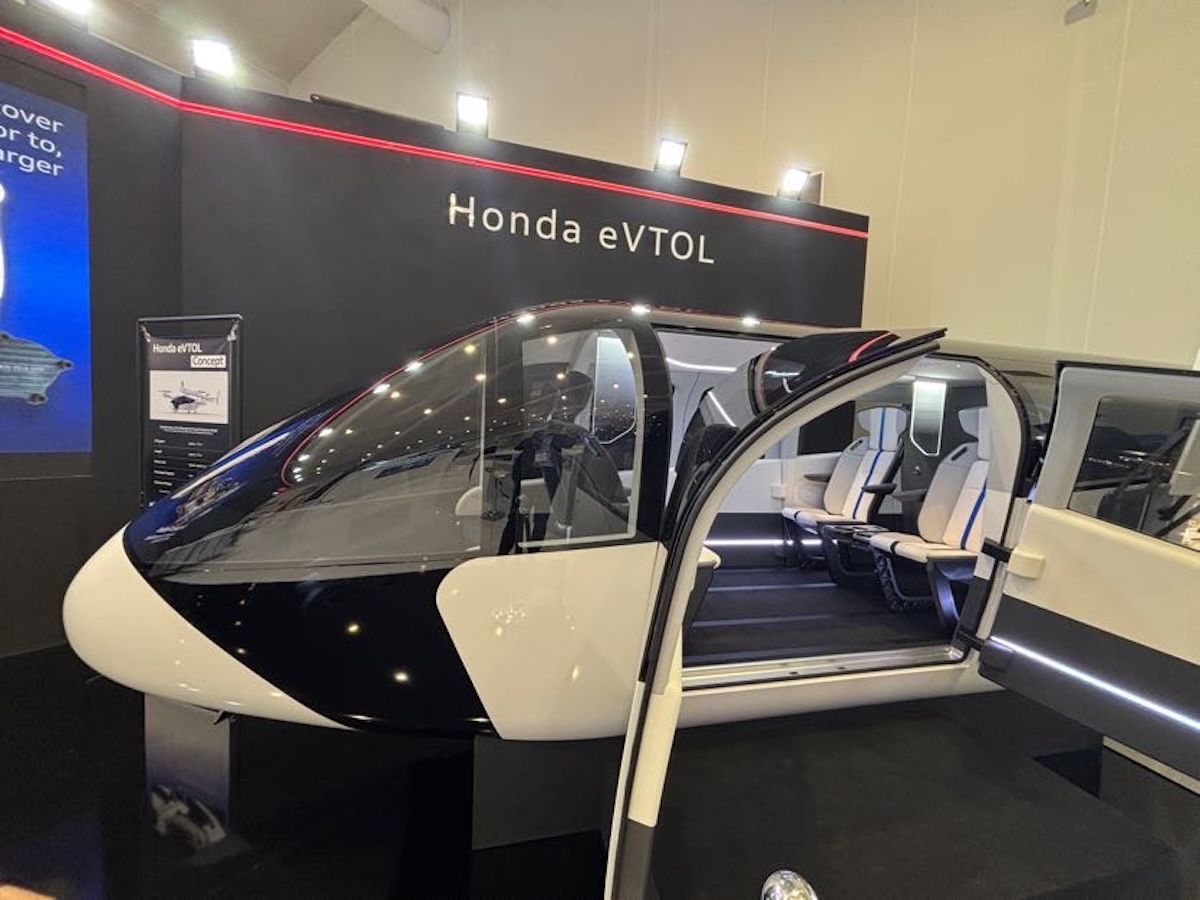
As part of its eVTOL program, Honda was present at the Dubai Airshow 2025, where it exhibited a mockup of the aircraft.