


Log-in here if you’re already a subscriber
Air safety reporting is made accessible without a subscription as a public service. Subscribe to The Air Current for full access to our scoops, in-depth reporting and industry analysis.
U.S. Coast Guard aviation leadership sharply criticized the Federal Aviation Administration’s changes to Washington, D.C.’s congested airspace following a January 2025 midair collision, saying the revisions may increase the risk of a serious accident between helicopters.
In a June 17 public Transportation Research Board (TRB) meeting, U.S. Coast Guard (USCG) personnel suggested the FAA did not adequately weigh the risks of a helicopter-on-helicopter collision when moving to eliminate helicopter routes and change airspace procedures to protect against close calls between rotorcraft and fixed-wing aircraft. Instead, charting revisions are pushing helicopters closer together, making it harder for crews to train for proficiency and increasing the risk of helicopter controlled flight into terrain (CFIT), the USCG pilots said.
Related: Special Report: The night everything at DCA finally went wrong
“It seems like a lot of what was being pushed was mitigating the risk between commercial airliners and helicopters, but it wasn’t mitigating the overall risk, it was just transferring that risk elsewhere,” said Commander Nate Rhodes, a pilot who leads the Coast Guard helicopter unit based at Washington’s Reagan National Airport (DCA).
The FAA after the meeting pushed back on the USCG pilots’ assertions, contending that helicopters operating in the region actually faced more conflicts with each other when they had greater access to DCA airspace. Now that they have been excluded from the area immediately surrounding the airport, an FAA official said, “they have the whole rest of the U.S. to fly [in]. If they can’t separate themselves from the whole rest of the national airspace system — they just need this two miles around the airport to make themselves safe — then there’s something wrong with the way the system is operating.”
New rules of the road
In the wake of the midair collision between a U.S. Army Black Hawk helicopter and an American Eagle CRJ700, the FAA moved to restrict fixed-wing and rotorcraft traffic from simultaneously operating in the area around DCA. The regulator also removed several helicopter routes close to the airport, eliminating choke points where airplanes were in close proximity with helicopters.
“Claims that these changes increased the risk of helicopter-to-helicopter collisions are not supported by the data,” FAA assistant administrator for communications Hannah Walden said in a written statement, adding that the FAA’s actions were guided by emergency National Transportation Safety Board recommendations stemming from the 2025 crash.
The FAA earlier this year published an interim final rule to permanently codify the changes and “will carefully review all public comments before issuing a final rule,” Walden said. “Notably, no military agencies submitted comments on the rule,” she added. (The public docket shows only two comments were received for the rule, a brief anonymous submission in support of the changes and a more detailed one from Vertical Aviation International.)
The FAA and NTSB have lauded the revisions as effective in decreasing the number of close calls between helicopters and airline traffic, but USCG aviators said they also made it harder for rotorcraft to operate with the same flexibility that they had before.
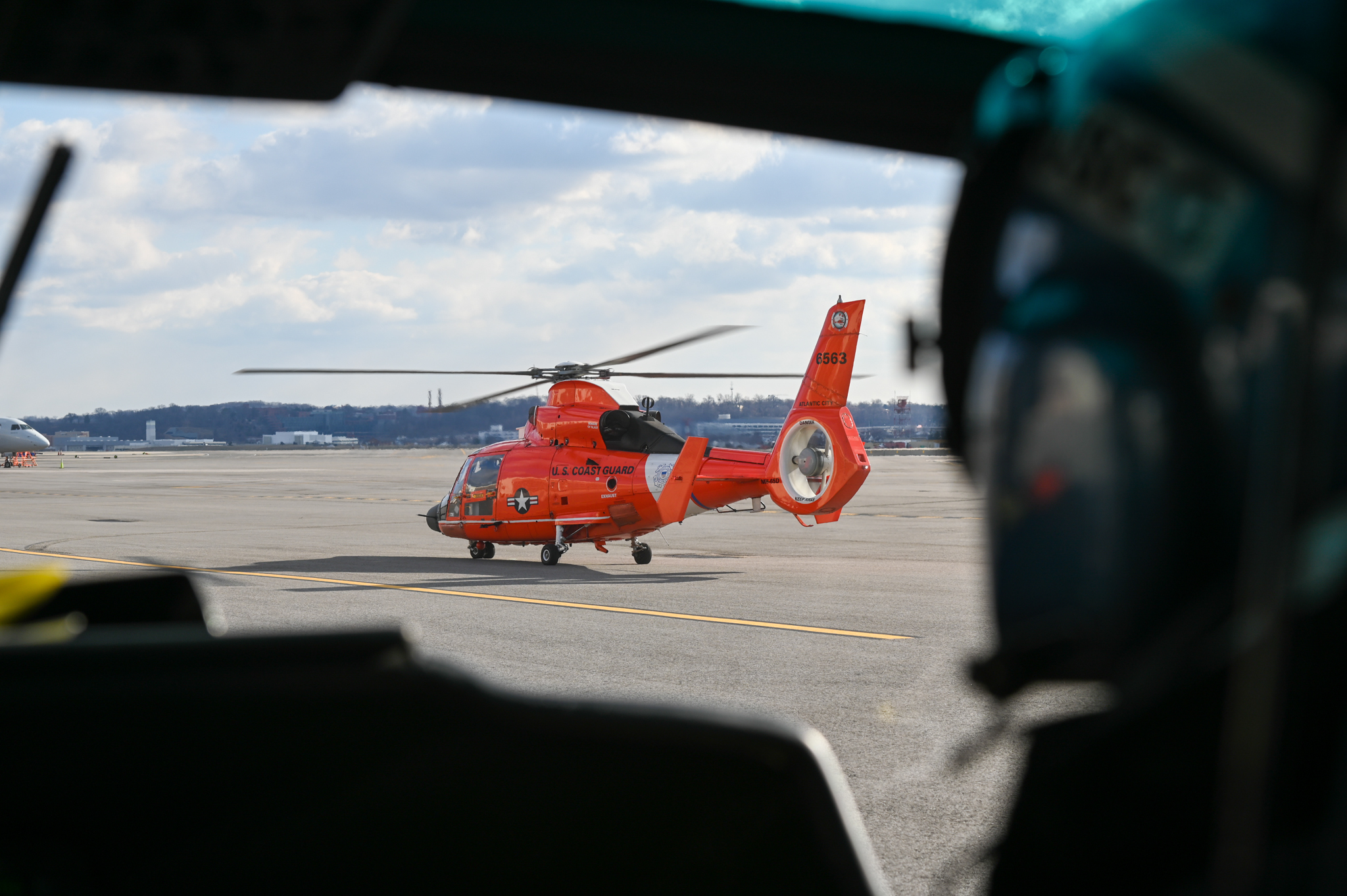
“I think some of the bigger risks are, one, just making sure that we’re proficient in the area and flying in the area, low level, which we can’t necessarily do and operate anymore, because they’ve worked to push all the helicopters away from DCA,” said Rhodes, whose DCA-based unit is tasked with intercepting aircraft that penetrate secure airspace zones within and around the capitol.
“What that’s done is that I believe [it has] increased the risk [of] a helicopter versus helicopter collision, because it’s actually far harder to spot another helicopter flying in the area — because they’re also low-level, mixed in with all the cultural lighting — than it is an airliner; they’re big and very bright, and they’re actually on set paths,” he added.
The FAA in October shrank and relocated several charted helicopter operating “zones,” labeled geographic regions for helicopter operations which make for easier reference by pilots and air traffic controllers over the radio. Rhodes said that in pushing helicopter traffic away from DCA, the changes created a smaller area for those helicopters to operate in, further congesting the airspace.
“They’ve cut out a number of routes, and some of them are good, but some of them have made things more challenging, and they’ve also decreased the zone sizes,” he told the TRB, a subset of the National Academy of Sciences which stood up its own expert committee to issue recommendations stemming from the D.C. crash.
“So, what you’ve done is now you’ve pushed everything farther away from the commercial aircraft, but you’ve put all the helicopters now operating in a smaller, more congested airspace,” Rhodes said.
In a separate statement, Capt. Scott Austin, the commanding officer of Coast Guard Air Station Atlantic City, which oversees the USCG’s DCA unit, confirmed his colleagues’ remarks were “accurate.”
“However the Coast Guard has been working collaboratively with the FAA on iteratively improving airspace changes based on our concerns for months,” he added.
Walden said the FAA has not received any reports of near-midair collisions involving military helicopters in the DCA airspace since 2023, compared to 10 reports involving any helicopter operators from 2017 through 2022.
The NTSB in its March 2025 preliminary report on the DCA crash found 85 recorded events between helicopters and fixed-wing aircraft that involved lateral separation of less than 1,500 feet and vertical separation of less than 200 feet in the local area between October 2021 and December 2024. However, those close calls were identified through data associated with cockpit alerting systems, such as TCAS, equipped as standard on many fixed-wing aircraft but typically not used on helicopters. Data on close calls between helicopters would generally require pilots to manually report each instance.
The USCG’s chief of aviation safety Commander Mike Freeman said his data shows that Coast Guard helicopters in the region were involved in six recorded, serious near-midair collisions between 2015 and 2025, four of which were with other helicopters. (The consequences of such an accident were tragically illustrated on June 14 when two helicopters collided over Rio de Janeiro, killing six people including the musician Oliver Tree.)
Changing the map
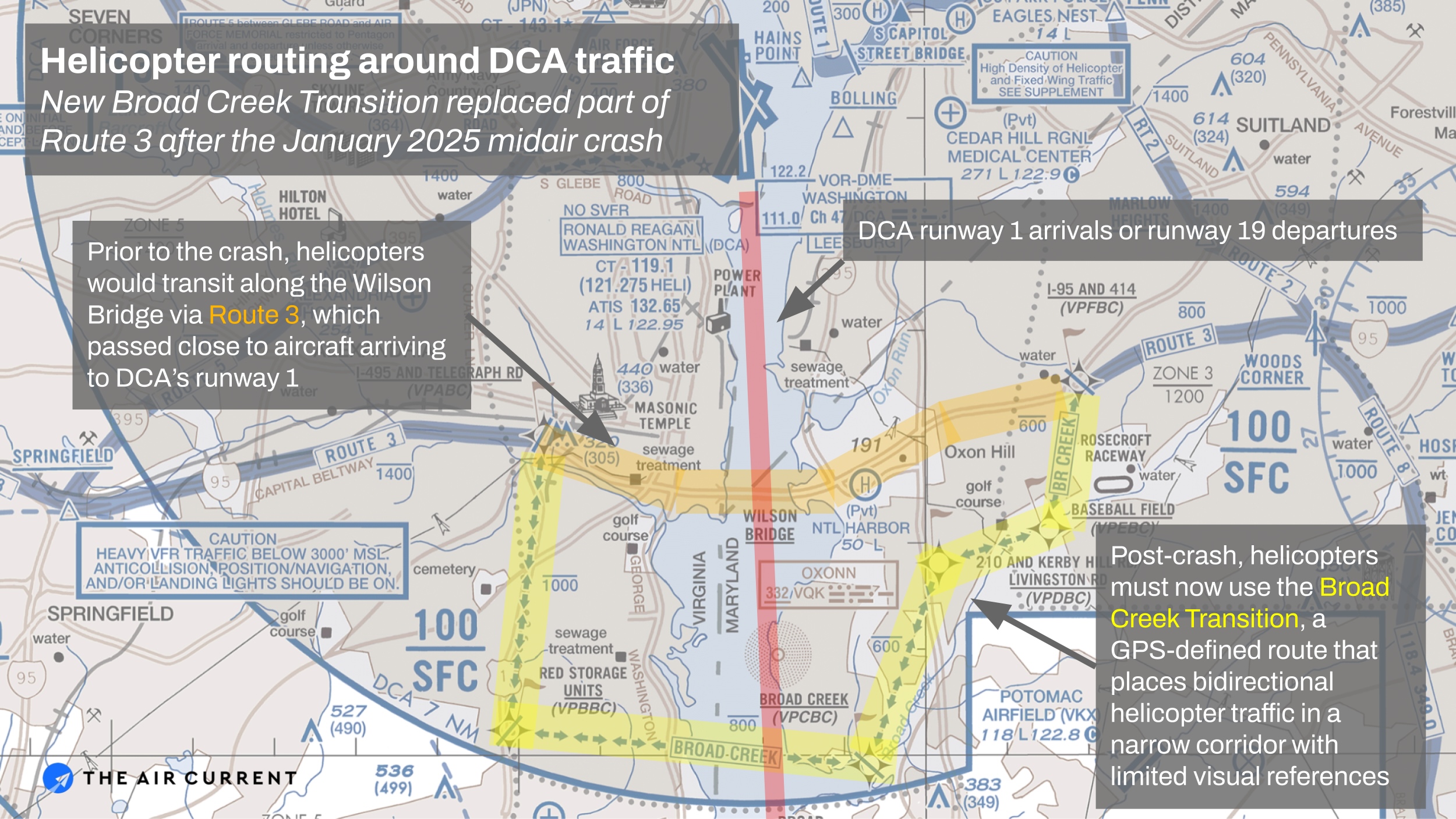
Rhodes also raised concerns about the Broad Creek Transition, which replaced the section of helicopter route 3 that previously ran along the Wilson Bridge just south of DCA. In an earlier part of the hearing, FAA personnel said this GPS-defined route “provides a way for helicopters to move safely under VFR conditions” with greater separation from arrival and departure paths at DCA.
But Rhodes claimed the transition creates more ambiguity over positioning when helicopters are approaching each other head-on compared to flying along a roadway, in which case each pilot would know to bias to the right side of the road to avoid conflict. The transition also requires an almost 90-degree turn that is impractical in flight, and it forces helicopters transiting from west to east to descend to low altitudes over rising terrain, he said.
“I don’t think any of the CFIT hazards were looked at,” Rhodes said. He mentioned that he participated in several safety risk management (SRM) panels the agency convened last year to review the D.C. airspace changes, but said FAA personnel did not prioritize having comprehensive data including CFIT data when they were designing the airspace changes. “It seemed like they were really more focusing on just getting those new processes through the FAA procedures as quickly as they could,” he said, expressing frustration that local helicopter operators did not have more influence over the design of the changes.
“Industry and USCG were involved in the initial design and revision at the working group meetings,” the FAA official said. “SRMs are designed to discuss implementation, not airspace designs.”
In the wake of the mid-air collision, the FAA also banned non-essential training missions, given that the accident Black Hawk helicopter was conducting a routine evaluation flight on the night of the 2025 accident. This topic has become a flashpoint since the crash as military operators argue they still need access to the region’s capitol to train in a representative manner for their missions, while others argue that regularly flying so close to commercial air traffic endangers the flying public.
USCG deputy commander Blake Morris said that decision has complicated things for his unit. He recalled a recent flight where the DCA tower did not allow him to depart from DCA under instrument flight rules (IFR), a type of operation that requires ATC to separate aircraft adhering to strict procedures while in bad weather.
Since the airport’s weather was not technically below IFR weather minimums — even though surrounding airports were — Morris said the tower considered the mission a “training flight” rather than a “required operation.” The tower instead required him to conduct a riskier visual flight rules departure that necessitated low-level flying under the cloud ceiling until he was able to obtain an IFR clearance away from the airport. Morris did not provide a specific date for this incident, which the FAA said it could not verify.
The D.C.-area airspace is some of the most congested in the country and is home to a number of helicopter operators with national security, medical or law enforcement missions. The Coast Guard shares airspace with, among others, local police in Virginia, Maryland and D.C. as well as the U.S. Marine Corps’ presidential helicopter squadron, U.S. Park Police, helicopter air ambulance operators like Metro Aviation and the U.S. Army’s 12th Aviation Battalion, which the 2025 accident helicopter belonged to.
Related: The collision avoidance tool that could help prevent the next midair disaster
“Especially with our mission and the constraints that we have with weight, fuel, and then adding in the special D.C. airspace [security zones] makes this probably the most complex that I’ve operated in,” said Morris, who has also flown in Los Angeles and San Francisco.
Since the January 2025 crash, stakeholders from industry, the Pentagon and the FAA have all been at odds regarding how to properly share the airspace while ensuring that required operations can safely continue.
In December 2025, lawmakers clashed over a now-passed provision in an annual defense bill that made it easier for military aircraft to operate without location-transmitting ADS-B technology enabled. A separate legislative battle to determine how to respond to the slew of recommendations issued by the NTSB in January is still ongoing, as both chambers of Congress disagree over how to move forward with competing bills containing different technology mandates, airspace changes and safety audits.
The NTSB found that a lack of data-sharing and collaboration ultimately contributed to the 2025 midair crash, since publicly-accessible databases contained warnings from flight crews and air traffic controllers about the D.C. airspace which were never addressed by the FAA. As previously detailed by The Air Current, a broader misunderstanding between stakeholders about how each type of operation works also contributed to a lack of awareness about risks in the D.C. airspace.
Rhodes said the USCG is invested in trying to improve safety and balance operations through more interactions between stakeholders, “but that’s going to require just looking at the entirety of the risk and not just trying to shift it from one side to the other.”
Elan Head contributed to this article.
Write to Will Guisbond at will@theaircurrent.com
Subscribe to The Air Current
Our award-winning aerospace reporting combines the highest standards of journalism with the level of technical detail and rigor expected by a sophisticated industry audience.
- Exclusive reporting and analysis on the strategy and technology of flying
- Full access to our archive of industry intelligence
- We respect your time; everything we publish earns your attention
Subscribe
source
