

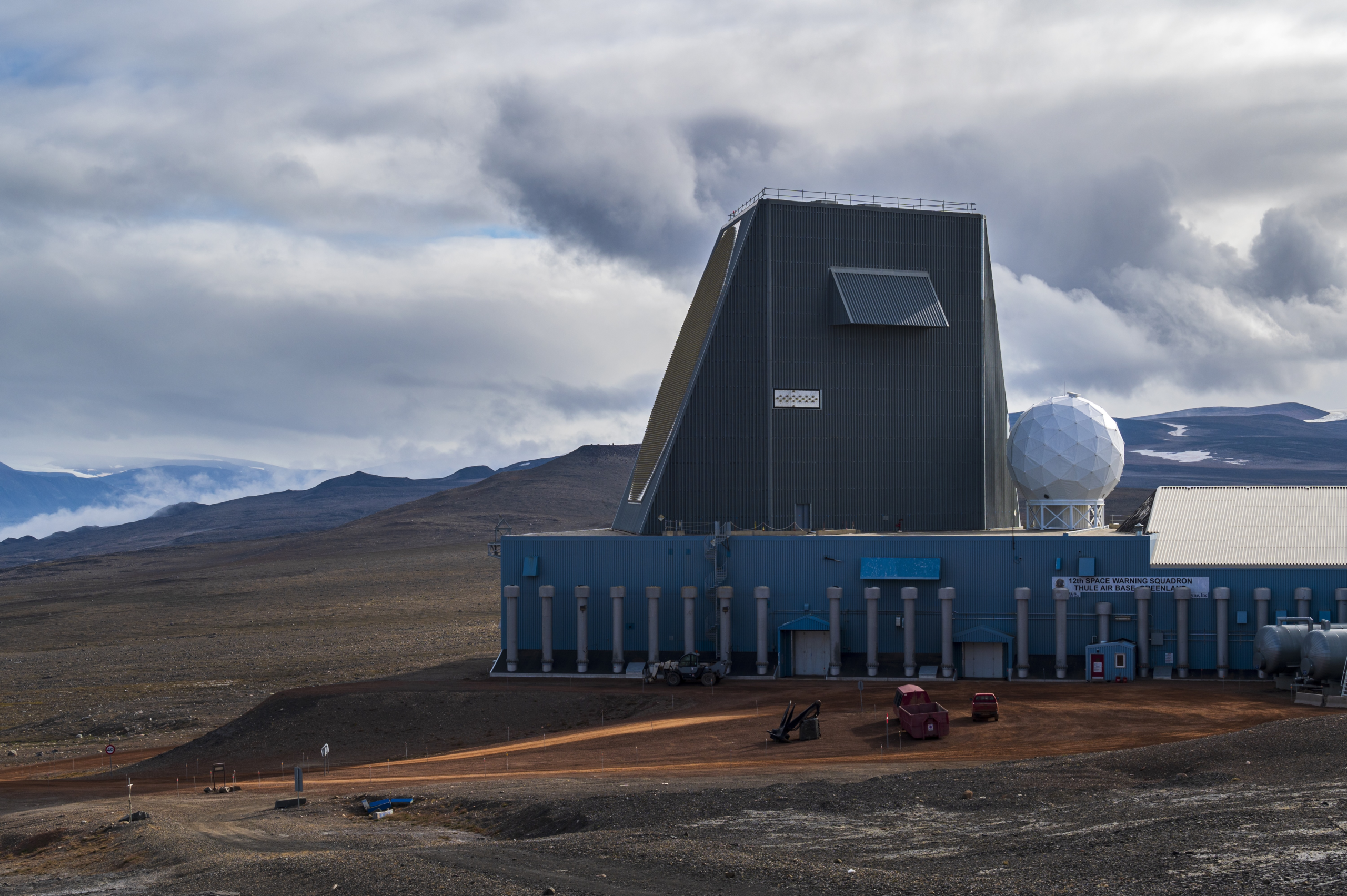
Since the early days of the Cold War, the early warning radars on Greenland have been a linchpin for defending North America against nuclear attack by intercontinental ballistic missiles.
But the radars themselves are vulnerable to attack by hypersonic missiles, critics warn. U.S. bases in Greenland can neither detect those missiles, nor shoot them down.
“The U.S. does not have a standing integrated air and missile defense shooter layer in Greenland today,” Troy Bouffard, director of the Center for Arctic Security and Resilience at the University of Alaska, told Defense News.
“The new and future threat of hypersonic cruise missiles has changed everything, because the existing defense system cannot defend against them,” Bouffard said.
RELATED
In a recent essay for Small Wars Journal, Bouffard and his co-authors advocated a comprehensive air and missile defense system for Greenland, particularly for Pituffik Space Base and its missile and space defense sensors. Though Pituffik is guarded by an Air Force Security Force squadron, those units are oriented more for ground defense against commando or terrorist raids, rather than stopping hypersonic streaking in at Mach 5-plus.
The authors advocate a “layered air defense using short- and medium-range systems adapted to Arctic operations,” which would be part of a distributed defense system across the North American Arctic. Such a system could include Patriot batteries, National Advanced Surface-to-Air Missile Systems, or NASAMS, and short-range air defense, or SHORAD, systems, the authors propose.
This would require a mix of sensors: ballistic missile radars, air defense radars for low-altitude threats and airborne early warning aircraft or over-the-horizon radars, according to the essay.
“Even future Army-owned systems such as Layered Laser Defense (LLD) systems could also factor in as tactical solutions to a strategic defense system,” the essay noted.
As always with Arctic operations, the question is how to accomplish this in an environment where the temperature can drop to almost a hundred degrees below zero Fahrenheit. Ice, snow and temperature, among other factors, can significantly impact radar performance and visual sensors, the essay noted.
Technology, such as adaptive optics and polarimetric radar, may be able to mitigate some of these effects. However, “success in this theater requires specialized Arctic tactical warfare capabilities and proficiency,” said the essay.
Since 1960, when the first Ballistic Missile Early Warning System, or BMEWS, radar became operational, Greenland has been the distant frontier of American early warning. Today known as the Upgraded Early Warning Radar system, these sensors are part of the 12th Space Warning Squadron, which is tasked with scanning the skies for missiles as well as tracking objects in space.
The politics of defending Greenland can be as challenging as the terrain and climate. Though geographically part of North America, the world’s largest non-continent-sized island is an autonomous territory of Denmark, which makes Greenland both an American and European/NATO issue. The Trump administration has indicated an interest in purchasing Greenland, an idea that has neither delighted Greenlanders nor Danes.
Until recently, the Department of Defense assigned Greenland to U.S. European Command. But in June, U.S. Northern Command took over responsibility for Greenland in yet another sign that the island is seen as part of U.S. homeland defense.
The Pentagon’s current Unified Command Plan assigns the North American Arctic to U.S. Northern Command and the European Arctic to U.S. European Command. Defending Greenland will require close cooperation between multiple combatant commands, the Small Wars Journal essay urged.
“[North American Aerospace Defense Command] and [U.S. Northern Command] might handle immediate air threat response as part of homeland defense, [U.S. European Command] could include Greenland in NATO’s regional defense plans, and [U.S. Strategic Command] could ensure the defense of the strategic assets, supporting overall deterrence and missile defense architecture,” the authors proposed.
The defense of Greenland should also fit with NATO’s integrated air and missile defense plan, the essay argued.
“Multi-command oversight guarantees that defending the missile defense hub in Greenland is not an isolated effort, but part of a comprehensive Arctic campaign plan aligned with U.S. homeland defense and allied collective defense,” said the essay.
The defense of Greenland will require not only resources, but patience and dedication, the essay noted.
“The effective way to achieve the necessary readiness and proficiency in such conditions is to refocus resources, attention, and planning towards the Arctic as a forethought, and not as the afterthought it’s been since the end of the Cold War,” the authors concluded.
source
